


PETRONAS’ Activity Outlook (PAO) 2026–2028 adopts a more conservative stance, underpinned by tighter upstream investment discipline and a strategic shift towards optimising brownfield assets to sustain production at lower unit costs.
This approach is framed against a softer oil price environment, alongside domestic uncertainties following PETRONAS’ move to seek clarification from the apex court on the regulatory framework governing its operations in Sarawak.
“Based on our review of the PAO, despite Brent crude averaging USD68.2/bbl in 2025, the sector experienced a broadly lacklustre year, with actual activity levels falling short of earlier expectations amid project deferrals, cost pressures and a more cautious investment environment,” said Public Investment Bank (PIB).
Looking ahead, the expectation of lower oil prices in 2026 has led to the deferral of certain activities initially planned for 2026 and 2027, as PETRONAS prioritises cash flow preservation and capital efficiency, while continuing to support the domestic oil and gas services and equipment (OGSE) ecosystem amid a more challenging operating landscape.
“This reinforces our Neutral call on the sector, premised on our expectation for Brent crude oil to average around USD60/bbl in 2026,” said PIB.
Direct impacts were most evident across Hook-Up and Commissioning (HUC), Modification, Construction and Maintenance (MCM), and Offshore Support Vessel (OSV) segments.
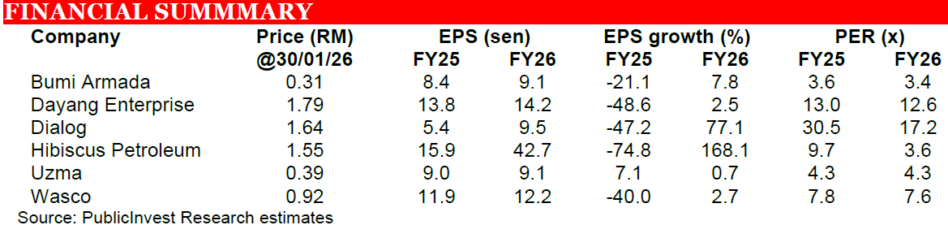
HUC and MCM activities were the hardest hit amid sector challenges, underperforming expectations by 4.55m man-hours and 2.17m man-hours, respectively in 2025.
Reflecting the softer activity outlook, HUC and MCM activity assumptions for 2026–2027 have also been revised down by 2.71m man-hours and 0.47m man-hours respectively.
Similarly, weaker offshore activity reduced OSV demand, with actual vessel requirements in 2025 falling short by around 30 vessels.
Looking ahead, OSV requirements for 2026–2027 have been further revised lower by 118 vessels, in line with the more subdued upstream activity outlook.
However, on positive note, the outlook for well services has improved meaningfully, with the addition of 18 development wells, 14 appraisal wells and 43 plug and abandonment (P&A) wells scheduled for 2026–2027.
“In our view, the PAO adopts a conservative stance amid near-term headwinds from softer oil prices and domestic regulatory uncertainties,” said PIB.
The internal reorganisation undertaken by PETRONAS in 2025 further underscores deeper structural challenges relative to previous downturns in 2016 and 2020.
“We expect any scaling back of PETRONAS’ capital expenditure to be structural and gradual on a year-to-year basis, rather than abrupt, to mitigate immediate shocks while sustaining the broader industry ecosystem,” said PIB.
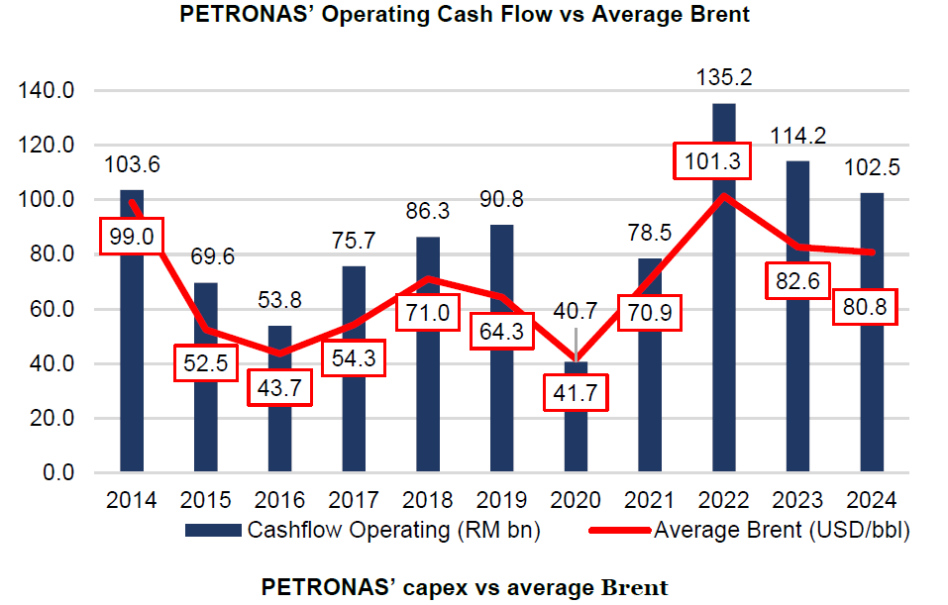
PIB’s earlier sensitivity analysis indicates that at an average Brent crude price of USD70/bbl, PETRONAS’ operating cash flow could compress from RM102.5 bil in 2024 to around RM81 bil in 2025.
This would place pressure on its annual capital expenditure commitments, estimated at RM40–50 bil, as well as its dividend obligation of RM20 bil in 2026. —Feb 3, 2025
Main image: MMC