
COMPETITION is the very lifeblood of a free market economy. But at what cost? Surely big businesses and established brands cannot be allowed to trample all and sundry in their quest for complete market dominance.
This was the concern expressed by X user Swifties for Palestine & Sudan (@folkloreswift) who contended that “it should be illegal for big companies to compete with Ramadan bazaar small traders for market share given this will kill the small business owners”.
I don’t know how to say this perfectly, but it should be illegal for big companies to compete with the small traders in their market share. It will kill the small business owners. https://t.co/E2hnYJukyW
— Swifties For Palestine & Sudan ❤️🔥 (@folkloreswifty) February 21, 2026
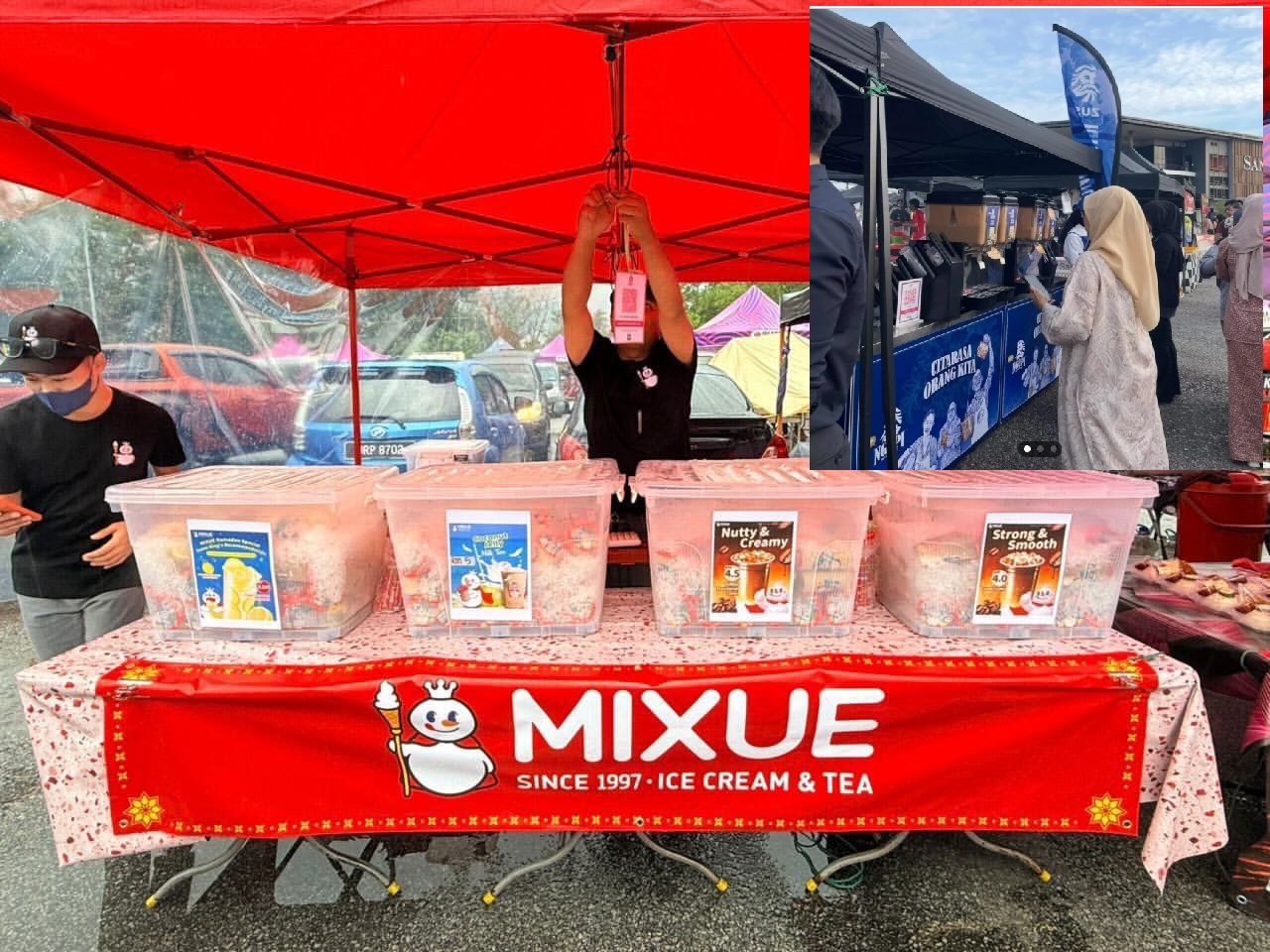
Reacting to another post that expressed similar sentiments at the sight of (unverified) coffee/tea chains Zus and Mixue booths at these annual pop-up food paradises, the poster argued that such spaces should be the preserve of the smallholder lest such businesses be wiped out by the heat of unfair competition.
The post by the Taylor Swift afficionado has generated 471.6K views and 7.5K likes at time of writing with the Ramadan bazaar visitor citing a number of reasons to justify her protectionist stance.
In arguing that franchises with numerous outlets benefit from economies of scale which allows for competitive pricing, she cited that if “big corporation like Baker’s Cottage opens in a Bazaar Ramadan, small ayam (chicken) traders won’t be able to survive”.
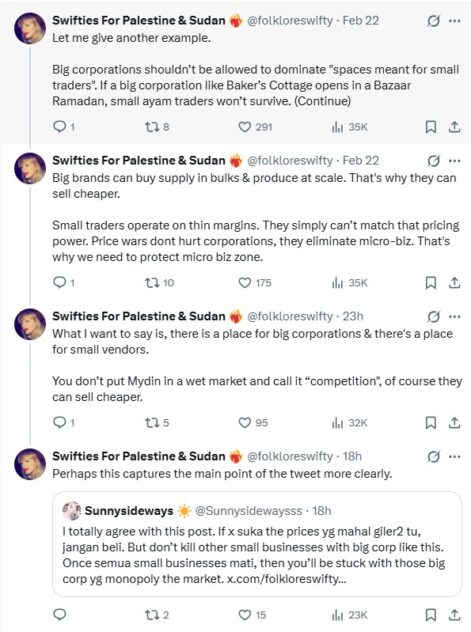
This is given that big brands are able to acquire supply in bulk and produce at scale, thus able to sell at cheaper prices.
“However, small traders operate on thin margins. They simply can’t match that pricing power,” justified the poster.
“Price wars don’t hurt corporations (but) they eliminate micro-biz. That’s why we need to protect micro biz zone. You don’t put (retail chain) Mydin in a wet market and call it ‘competition’ as they can surely sell cheaper.”
Weeding out profiteers
However, some commenters disagreed with this perspective, citing competition as healthy and vital to any industry.
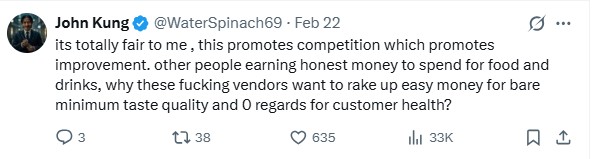
One observer simply countered that competition promotes improvements, insinuating that “vendors who want to rake easy money for bare minimum” will be eliminated. Will anyone actually miss vendors who serve tasteless food and have zero regard for customer welfare?
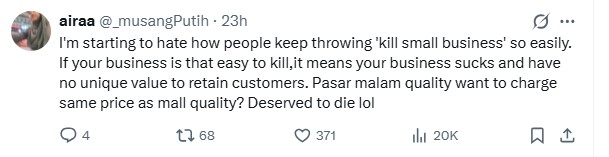
Only the strong will survive. This was the clear message from one commenter who argued that businesses that are easy to kill off were not meant to survive in the first place.
After all, businesses that charge mall prices for sub-standard pasar malam fare deserve to die anyway, it was opined.
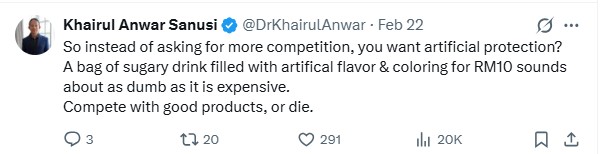
The protectionist stance was also ridiculed by a fed-up foodie who did not see the sense in paying RM10 for a sugary drink with artificial flavours and colouring. Competition will eliminate sub-standard goods and services was the main contention here.
It was obvious from a number of comments that many visitors to the Ramhan bazaars are plainly fed-up with what they perceive as unethical, dishonest and unscrupulous pricing and practices.

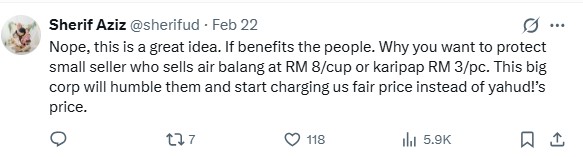

One commenter simply surmised that if the big brands offer better products at lower prices, why not? There is no reason to protect businesses that overcharge especially if the authorities have reduced rental space for Ramadan Bazaar as in the case of the Kuala Lumpur City Hall (DBKL).
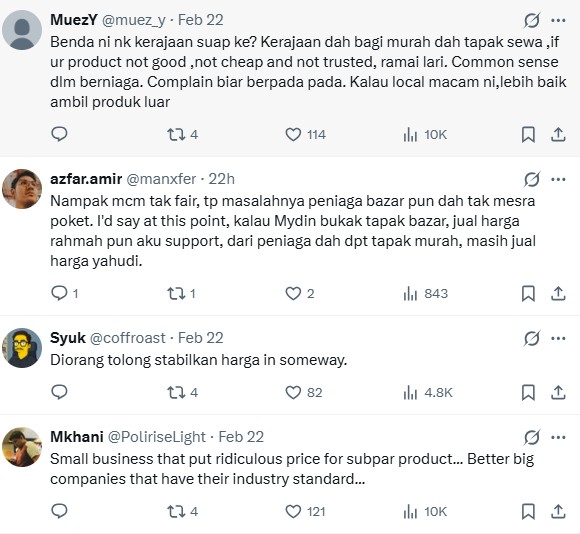

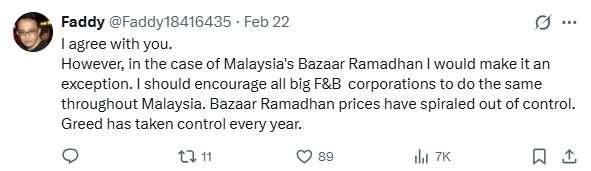
Judging from the many negative comments, it is clear that many Malaysians are simply fed-up with spiralling prices at Ramadhan bazaars for what is perceived to be sub-standard fare.
When greed becomes the driving factor among smallholders, perhaps having big brands like Mixue and Zus shaking up the market may not be a bad thing. – Feb 23, 2026