SUCH is the disruptive, market shake-up tactic which bears semblance to what Grab did when it first entered the Malaysian e-hailing market till many red and white cabbies were unable to compete and ultimately become e-hailing drivers themselves.
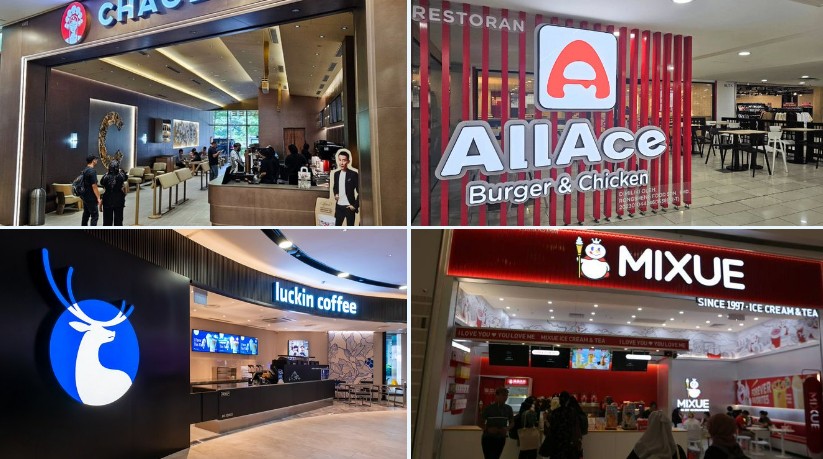
In a similar fashion, entrefluencer Umar (@umarmaggi) pointed to Chinese brands – notably Mixue, Luckin, Wallace/AllAce, Chagee – entering Malaysia with the same playbook in recent times.
“All of them come (into Malaysia), open tonnes of outlets, slash prices left and right,” observed Umar Abdul Aziz who is co-founder of Mokky’s Pizza, a local pizza chain, on X.
Kalau kau perasan, jenama-jenama China masuk Malaysia dengan playbook yang sama: mixue, Luckin, Wallace/AllAce, Chagee.
Semua masuk, buka banyak outlet, buang harga kaw-kaw. Ni lah ‘war yang diorang tengah lancarkan ada teori dan bukti industri yang jelaskan kenapa diorang boleh… pic.twitter.com/Fi0pb9VYGT
— Umar (@umarmaggi) January 29, 2026
“This is the ‘war’ they’re launching – there’s industry theory and evidence explaining why they can sustain this seemingly irrational price-cutting.”
Umar who aspires to set up 108 pizza outlets nationwide went on state that such “market share first, profit later” concept has been around for a long time.
“The idea is that by controlling market share, one will suffer temporary losses but profit forever,” he justified.
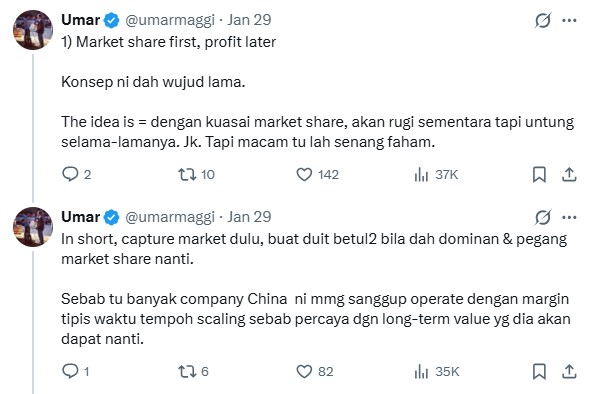
“In short, capture the market first, make real money when you are dominant and hold market share later. That’s why many Chinese companies are willing to operate with thin margins during the scaling period because they believe in the long-term value they will get later.”
Eventually, the “entry warfare” strategy by opening many outlets and setting low prices is one form of predatory market entry that will both disrupt the market and “kill off competitors”.
“This isn’t complicated till the issue has even been discussed at the Organization for Economic Co-operation and Development (OECD) level,” shared Umar.
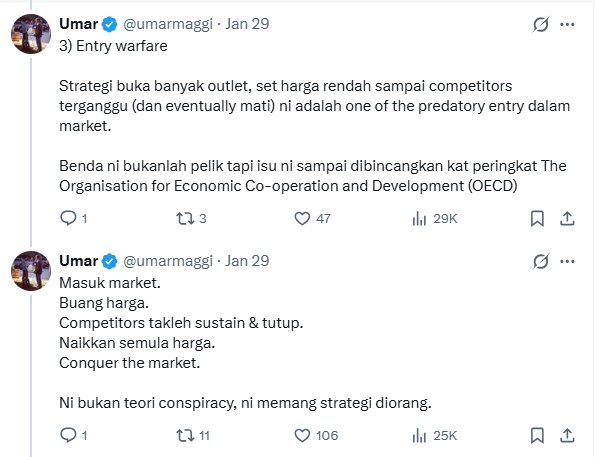
“Competitors who can’t sustain their price drop will close down. Then they’ll raise the prices again. Conquer the market. This is not a conspiracy theory but their (marketing) strategy.”
Counter-action
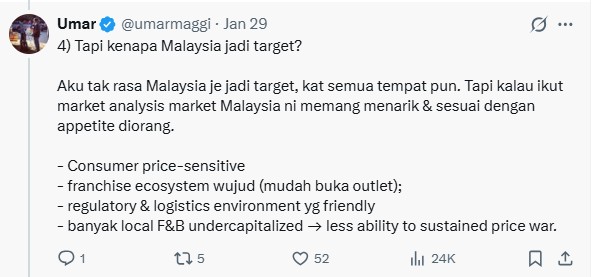
While Malaysia is not the only target for a similar trend happens everywhere, Umar reckoned that from a market analysis perspective, the Malaysian market is nevertheless an “attractive target for it suits their tastes” in terms of:
- Price-sensitive consumers;
- A well-established franchise ecosystem (easy to open outlets);
- A friendly regulatory and logistics environment;
- Many local F&Bs are under-capitalised (henceforth, less able to sustain price wars).
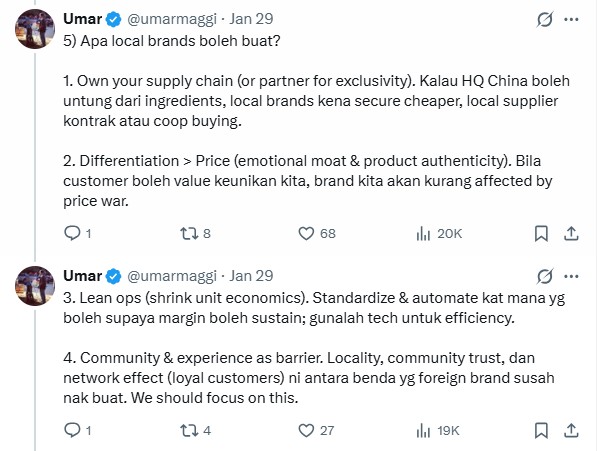
While he supported the measures by the authorities to control price war emanating from the proliferation of big Mainland Chinese businesses given “competition is good but competition with unhealthy strategies will harm the country in the long run”, Umar revealed four strategies that local brands can adopt:
- Own your supply chain (or have exclusive partnership). While China brands can profit from low ingredient pricing secured by the headquarters, local brands, too, can find ways to secure better pricing, local supplier contracts or cooperative purchasing.
- Boast differentiation with emotional moat and product authenticity: If customers are allowed to value uniqueness, the local brand will be less affected by price wars.
- Lean ops (shrink unit economics). Standardise andd automate where possible so that margins can be sustained; leverage technology for efficiency.
- Community & experience as barrier. Locality, community trust and network effect (loyal customers) are among the things foreign brands struggle to create. Local businesses should focus on this.
Whether one agrees with Umar that all China brands – or only some – are indeed throwing prices or otherwise, the underlying truth is that pricing can be so sensitive that it is often a crucial determinant if one thrives or fails in his business.
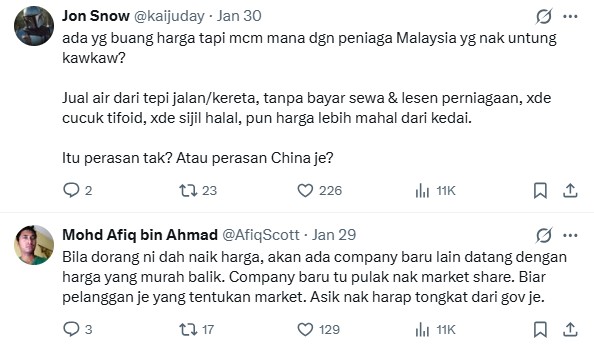
“Some people are throwing prices away but what about Malaysian traders who want to make a kawkaw (hefty) profit?” wondered one commenter while insinuating that such greedy traders deserved to be weeded out.
“Selling water from the side of the road/car without paying rental or owning a business license, no typhoid test, no halal certificate yet their prices are far more expensive than shops.” – March 11, 2026