

ON THE consumer front, RHB continues to favour companies with defensive characteristics and earnings driven largely by domestic demand, which offer resilience amid ongoing geopolitical uncertainty.
Nestlé stands out as a solid defensive play, supported by its strong brand presence, while Eco-Shop and MR DIY are well-placed to capture demand from value-conscious consumers.
Farm Fresh is expected to post stronger growth, driven by output from its new ice cream facility, and AEON’s earnings are projected to improve as it moves past the start-up losses that weighed on its 2025 performance.
Consumer spending, as is typical, picked up towards the end of the year, particularly among discretionary segments.
This uplift was supported by seasonal factors such as school holidays and festive periods, and may also reflect a more stable consumption pattern in line with improving sentiment.
Overall, management outlooks have been cautiously optimistic, with several discretionary players reporting stronger sales momentum entering 2026.
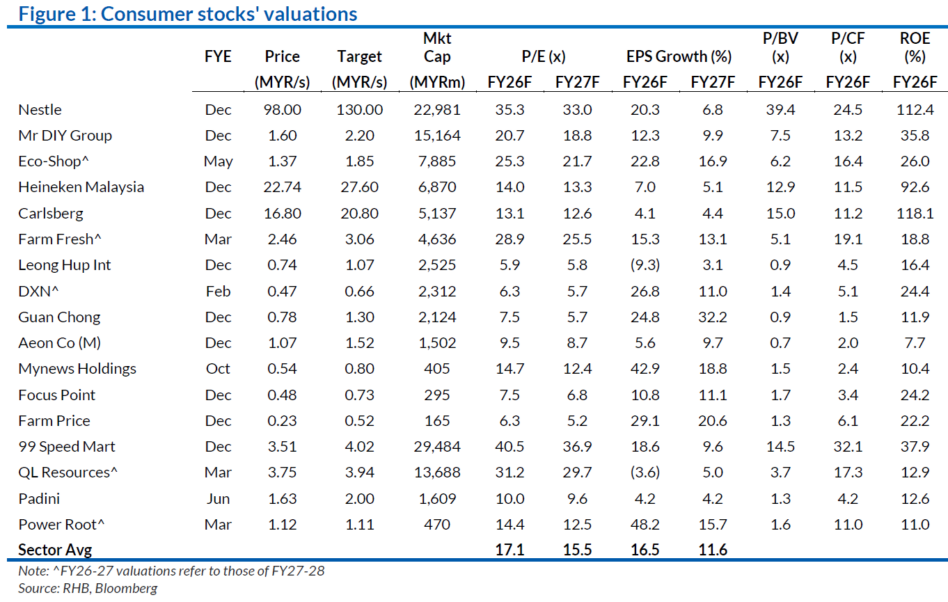
This trend is likely supported by firmer consumer confidence, underpinned by stable macroeconomic conditions, rising disposable incomes, a stronger ringgit, and spillover benefits from Visit Malaysia Year 2026.
Overall, 2025 sector revenue and profit grew by 6% year-on-year (YoY) and 11% YoY.
The sector should continue to provide earnings resilience and visibility, underpinned by stable domestic consumption and ongoing fiscal support.
Measures such as Sumbangan Asas Rahmah (SARA) and targeted fuel subsidies (RON95) should help support consumer spending amidst soaring global energy prices.
Under BUDI95, while the monthly quota is reduced to 200 litres, 90% of users consumer below this level, implying a limited immediate impact on the mass market.
“Overall, we do not expect any near-term policy shifts that could materially disrupt consumption trends. However, we remain watchful that a prolonged Middle East conflict could pose second-order risks via inflation,” said RHB.
Downside risks to RHB’s outlook include prolonged elevated energy prices, a sharp surge in commodity prices, and inflationary pressures. —Mar 30, 2026
Main image: Dreamtimes.com