

MALAYSIA must urgently reform its fiscal foundation as soaring fuel prices expose deep structural weaknesses in government revenue, the Institute of Strategic Analysis and Policy Research (INSAP) said.
Diesel prices in Peninsular Malaysia climbed to a record RM6.02 per litre this week, nearly doubling from RM3.04 just five weeks ago. Over the same period, the monthly fuel subsidy bill ballooned from RM700 mil to RM3.2 bil.
INSAP chairman Datuk Dr Pamela Yong warned that the country remains trapped in a recurring cycle of fiscal strain whenever global energy prices spike.
“This is not the first time Malaysia has been caught off guard by an energy shock, and it will not be the last. Prices surge, subsidies swell beyond sustainable levels, and households are left to absorb the adjustment,” she said.
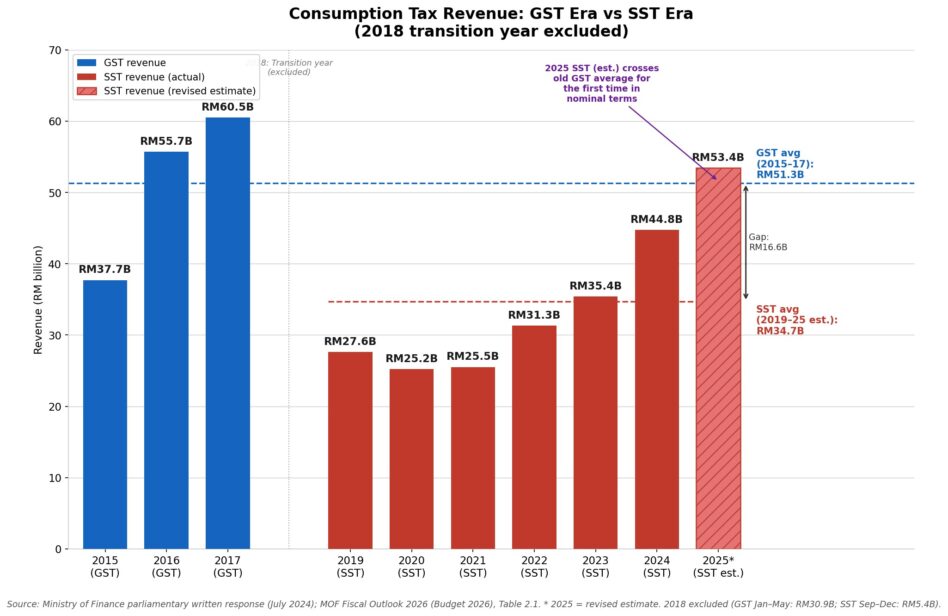
She attributed the vulnerability to a revenue structure that has been running a structural deficit since 2018, following the replacement of the Goods and Services Tax (GST) with the Sales and Services Tax (SST).
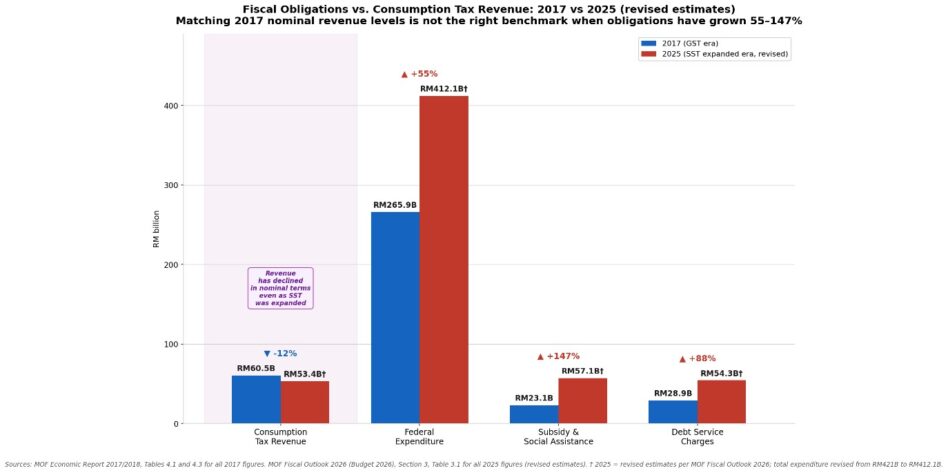
While SST collection is projected to reach RM53.4 bil in 2025, it still lags behind GST’s contribution relative to the size of the economy.
GST generated about 4.4% of GDP in its final year, compared with an estimated 2.6% under SST—a shortfall equivalent to roughly RM35 bil to RM38 bil annually.
INSAP said it is not calling for the immediate reintroduction of GST, cautioning that doing so amid current cost pressures would worsen the burden on households and businesses.
Instead, it urged the government to begin work now on a clear roadmap for GST reinstatement, including consultations with industry and civil society, so the country is better prepared for future shocks.
“A well-designed GST provides a broader and more resilient revenue base, while avoiding hidden cost cascades in supply chains,” Yong said.
INSAP also called for the establishment of a formal revenue reform working group with a defined timeline, warning that delaying reforms would only leave Malaysia exposed to the same cycle in the next crisis.
“(This is) so that Malaysia enters the next global disruption with the fiscal foundation to protect its people rather than ration its way through,” she added. ‒ April 3, 2026