
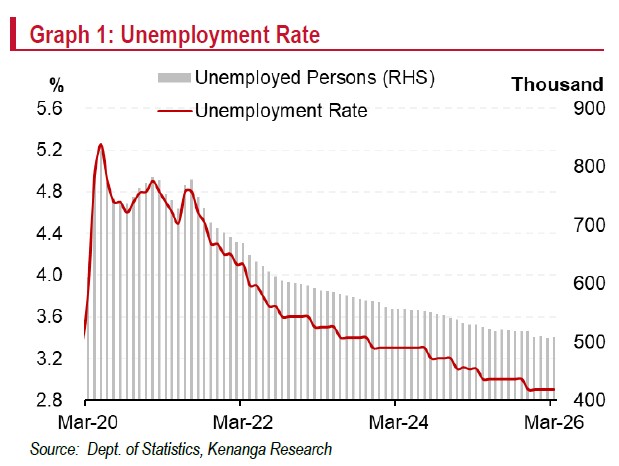
THE UNEMPLOYMENT rate was held at 2.9% in March, marking the fifth straight month at this level, the lowest since November 2014.
Actively unemployed, defined as those available for work and actively seeking jobs, rose to 405.8k, though their share of unemployed edged down to 79.7%. Note that February was 79.9%.
According to the DOSM report, the services sector remained the main contributor, led by accommodation and food & beverage services, information and communications activities and transportation & storage activities.
Employment also rose in manufacturing, construction and agriculture sectors.
In contrast, a separate manufacturing report showed employment fell for a second straight month by 0.1% month-on-month (MoM) to 2.41mil (Feb: 2.42m), with payroll falling for a third straight month.
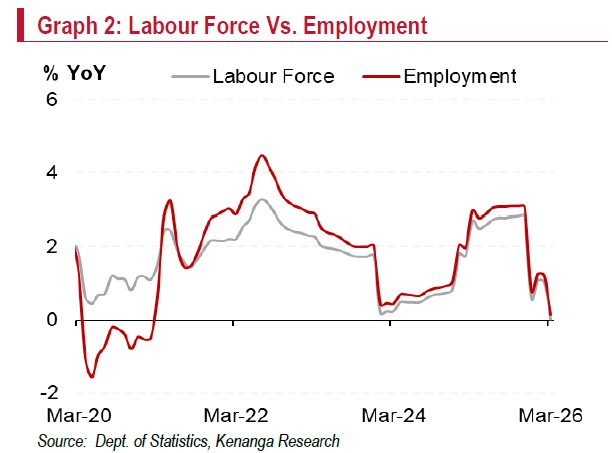
Most categories recorded MoM gains except unpaid family workers. Gains were led by own-account workers, followed by employers, and employees, albeit at a slower pace.
Meanwhile, unpaid family workers fell by 0.2%. Labour force participation rate held steady at 70.9% for the third straight month.
Labour force grew steadily at 0.1% MoM (Feb: 0.1%) to 17.31m (Feb: 17.30m). Meanwhile, those outside the labour force fell marginally to 7.101 mil.
On another note, Asia labour markets showing mild softening in March.
Japan (2.7%; Feb: 2.6%) edged up, reflecting a rise in jobseekers seeking for new positions.
Taiwan (3.4%; Feb: 3.3%) inched up too, due to post-Chinese New Year job transitions.
“We maintain our unemployment rate forecast at 2.9% in 2026 despite rising external risks,” said Kenanga.
Malaysia’s labour market is expected to remain resilient near term, supported by still-firm domestic demand, policy support, and services-sector hiring linked to Visit Malaysia 2026.
Fiscal measures and targeted subsidies continue to support household spending.
The E&E sector and continued public sector hiring will also underpin labour demand amid global semiconductor demand and Ministry of Education reform plan.
Latest data from Perkeso’s MYFutureJobs showed condition remained stable, with active vacancies stood at 112,429 as of 30 April while the loss of employment (LOE) rose to 6,297 (Mar: 5,855), slightly above the 2025 monthly average LOE of 6,237.
However, risks could rise into the second half of 2026 (2H26), if global growth slows or trade-related frictions re-escalate.
“We reaffirm our 2026 GDP growth forecast at 4.5%, reflecting a cautiously optimistic outlook into 2H26,” said Kenanga.
Growth is projected to remain above 5.0% in 1H26, but potential supply disruptions and demand erosion from higher energy prices could weigh on growth in 2H26.—May 13, 2026
Main image: marketwatch.com