

MALAYSIA’S TELECOM sector delivered a resilient start to 2026, with steady service revenue growth, expanding fibre subscriptions and rising demand for digital solutions helping offset industry challenges.
As operators focus on 5G monetisation, cloud services and cost optimisation, analysts remain constructive on the sector’s medium-term prospects.
In the recently concluded quarter one 2026 (1QCY26) quarterly earnings season, telcos have displayed commendable resilience in the service revenue performance.
Maxis and CDB reported service revenue growth of +3.3% year-on-year (yoy) and +1.6%yoy respectively while Telekom Malaysia (TM) revenue grew by +2.9%yoy.
Only Axiata posted a slightly weaker revenue growth of -3.2%yoy as a result of unfavourable forex. Referring to CDB’s revised mobile offering early this year, competition appears to be more rational.
This shows that more emphasis is place on giving more value rather than focusing on unsustainable price wars.
“We view that the risk of price wars, if any, would primarily come from Umobile as it seeks to grow its customer base,” said MBSB Research.
On the home and fibre business segment, Unifi remains the market leader with 3229k home subs as at 1QCY26.
Celcomdigi’s home customer based grew at a faster pace with year-on-year net adds of 92k to 297k home subs while Maxis has the lowest net adds among its peers with additional 20k subs.
These showed that the fibre business remains a growth area for the telcos. Similarly, MBSB observed that TM and CDB posted sustainable average revenue per user (ARPU) of RM132 (+3.9%yoy) and RM102 (+1.0%yoy) while there was some pressure seen for Maxis as ARPU declined slightly to RM108.5 (-1.5%yoy).
Expanding the convergence strategy remains a key priority for growing this business segment.
For Maxis, growth was supported by increased subscriptions to IoT and other fixed-network solutions.
The stronger momentum in CDB was driven by demand for IoT, cloud and cybersecurity services, along with the benefit of a low base effect.
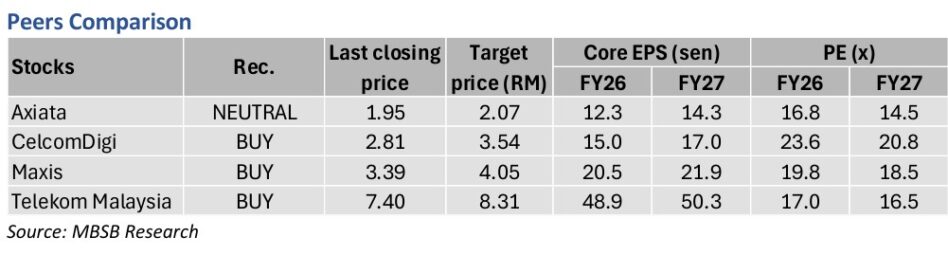
Looking ahead, telecom operators are expected to continue gaining from efforts to monetise 5G, rising demand for data centres and cloud services, and broader adoption of converged solutions.
To deliver meaningful profitability improvements, telcos are focusing on building a leaner cost structure. This includes disciplined capital expenditure and tighter control of operating costs.
On the operational front, CelcomDigi is undertaking a structural cost transformation following its integration, targeting RM450 mil in savings across cost of goods sold and operating expenses.
Most of the savings — about RM390 mil — are expected to come from operating expenditure reductions, particularly through site operating cost optimisation and procurement efficiencies.
Maxis has also continued improving operational efficiency since 2023 as part of its management and operational reset.
Note that Digital National Bhd (DNB) is undergoing structural shift when the Ministry of Finance Inc fully exited DNB. Originally, the transaction was expected to be completed by mid-2026.
This has now been pushed back to early 4QCY26. To recap, DNB reported a net loss of RM1.2 bil for 2024.
“Following the shift in DNB’s shareholding, we view that Maxis, CDB and YTL would be in a better position to drive the operation and performance of DNB,” said MBSB.—June 5, 2026
Main image: guinea.pe