

“MALAY UNITY” is a phrase that has been bandied about a lot lately. It’s become an inescapable theme as certain political parties up the ante with impending polls looming.
However, not everyone is so enamoured with this constant brow beating by nationalists claiming that Malay rights and identity are under threat.
One such individual is Amanah’s former Shariah affairs director Zolkharnain Abidin Al-Abyadhi who postulated what can be termed an unpopular opinion in a recent Facebook post.
It was contended that one almost never hear such rhetoric about “Chinese unity” whether it is in the sphere of politics, business or religion.
“The Chinese join different political parties. The difference is that they don’t just talk but produce results,” claimed the former one-term state assemblyman of Santan in Perlis (1999 to 2004) in a recent Facebook post.
“Malays’ problems are not because there are so many Malay parties. Chinese parties are plentiful too. Even if you want to claim division because of groups, the Chinese have more groups than the Malays.
“But the Chinese doesn’t talk much about Chinese unity. Why? Because for Chinese, unification is not just about talking but about agreeing to build success together,” he passionately argued.
Chinese are practical-minded
Doubling down on this unpopular opinion, the Amanah politician criticised the Malays for lacking the necessary gumption to emulate the Chinese.
Instead of working towards a common goal, the nationalist Malays add a religious element to the equation by claiming that Islam is under threat if the Malays do not unite.
Moreover, the former PAS man pointed out that the Chinese do not resort to petty threats or ostracisation when people disagree or do not align with one set of values or views. The important thing was the end result.
He thus observed:
“You don’t hear of Chinese saying ‘who doesn’t support our party, then the Chinese will be out of their religion or prohibited to study in Chinese schools or forbidden to enter Chinese temples’.
“Malays don’t have the mentality to compete in a healthy way. Malays don’t have the mentality of taking advantage of differences to learn new things and move forward.
“Take a look at the Chinese. They are persistent, don’t blame other races, be quick to seize advantage of opportunities and be good at agreeing with differences.
“However, Malays are a bit different. Those with differing opinions are viewed as “less Malay” or “anti-Islam.
“Malays don’t have the mentality to compete in a healthy way. Malays don’t have the mentality of taking advantage of differences to learn new things and move forward,” was the 59-year-old Islamic scholar’s observation.
“Take a look at the Chinese. They are persistent, don’t blame other races, quick to take advantage of differences and are good at co-operating despite differences”.
This led Zolkharnain to make the following damning conclusion: “If you ask me, why Malays behave like that, my answer is that Malays are addicted to religion!”
His FB’s post has generated 1.6K likes, 511 comments and 215 shares at time of publication. Unsurprisingly, it has sparked a lively debate.
‘Apple-orange comparison’
One commenter urged the poster to avoid using the Chinese as a yardstick as it only heightens the tensions by making them “the enemy” and thereby “a target by extremist groups”.

This unease was shared by a few other commenters who also felt that it was unhelpful to be comparing the two races. Some felt it was an attempt to further drive a wedge between the races.

Some felt it was comparing “apples and oranges” and perhaps it would be better to focus on one’s own strengths.

“This is all the DAP’s fault.” One commenter brought up the usual bogeyman used to scare off Malay voters.
This obviously fed-up netizen argued that no matter the issue, it seems that DAP was always at fault. It was said the Chinese were too busy trying to earn a living than to engage in such political warring that sought to fan the flames of hate.
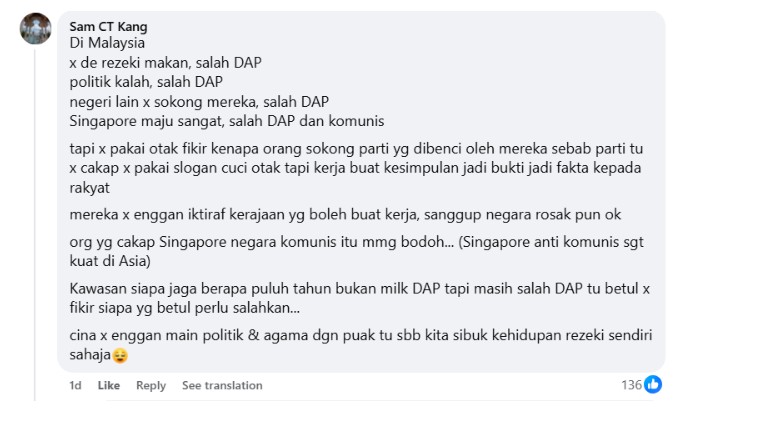
“The Chinese only help their own kind.” It was claimed that this was another oft-heard excuse for the need for “Malay unity”. This commenter succinctly asked if Malay politicians were really helping the Malay community?

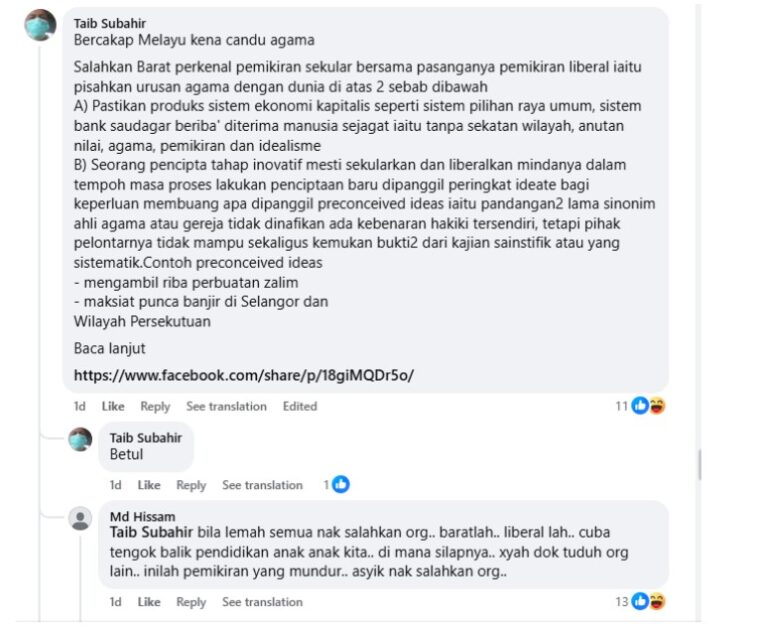
One pious observer tried to argue that progress cannot be isolated from religious values. His contention is that liberal and secular ideas and practices cannot be normalised as this will lead to the decay of society, henceforth the floods in Selangor and Kuala Lumpur were the result of vice activities.
This brought a stinging rebuke labelling “backward thinking” that faulted one’s own weaknesses on Westernisation and liberal values.
It would seem there are enough commenters who agree with the poster and feel that it is old hat to be using ‘Malay unity’ as a political tool.
One commenter is puzzled why the Chinese who seldom raise racial issues at religious, social or even political events are still labelled as “racist.”


Perhaps best summing up the mood was one comment that highlighted the main difference – “The Chinese would unite for progress. The Malays unite to create disharmony”. – July 7, 2026