
AFTER YEARS of grappling with volatile commodity prices and weather uncertainties, palm oil investors may once again find themselves looking skyward.
The return of El Nino conditions, coupled with growing expectations of a very strong weather event, is reviving hopes of tighter global palm oil supplies and firmer crude palm oil (CPO) prices in the years ahead.
With the likelihood of a severe El Nino rising sharply, analysts are turning more bullish on the plantation sector.
While the full impact on crop production may only emerge next year, history suggests that prolonged dry spells can curb yields, tighten inventories and provide a significant boost to CPO prices.
Against this backdrop, Kenanga Research has raised its CPO price forecasts and is urging investors to remain invested in the sector.
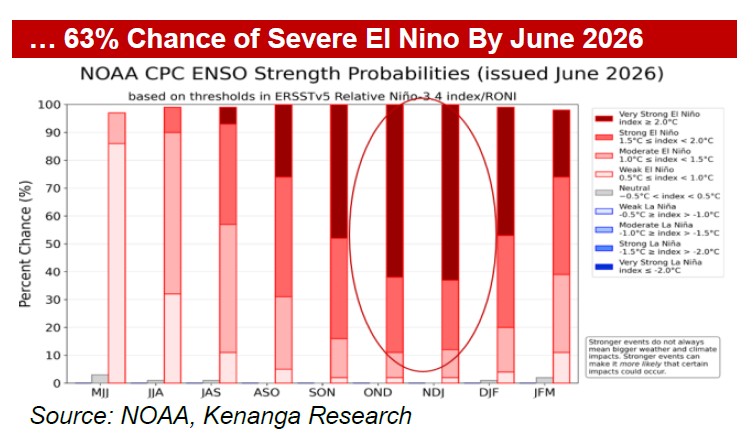
US-based National Oceanic and Atmospheric Administration (NOAA) reported that El Nino conditions are already present. It has raised the likelihood of a severe or “very strong” El Nino occurring from 33% chance in May to 63% in June.
Kenanga Research raised their CPO prices from RM4,250 per MT in 2026 to RM4,400 and from RM4,200 per MT in 2027 to RM4,450.
While further CPO price upgrades cannot be ruled out, key at this early juncture is to have exposure in the sector and stay invested, hence keeping Overweight.
Historically, palm oil production is not affected unless there is a very strong El Nino, whereby pro-longed dryness, six months or longer, can disrupt the fruiting and flowering cycles.
As El Nino usually starts in the second half of the year, crop yields in the following year would be more affected under a very strong El Nino.
Globally, palm oil supply can thus swing from year-on-year (YoY) growth to YoY contraction of between 2% to 9%, based on historical observation.
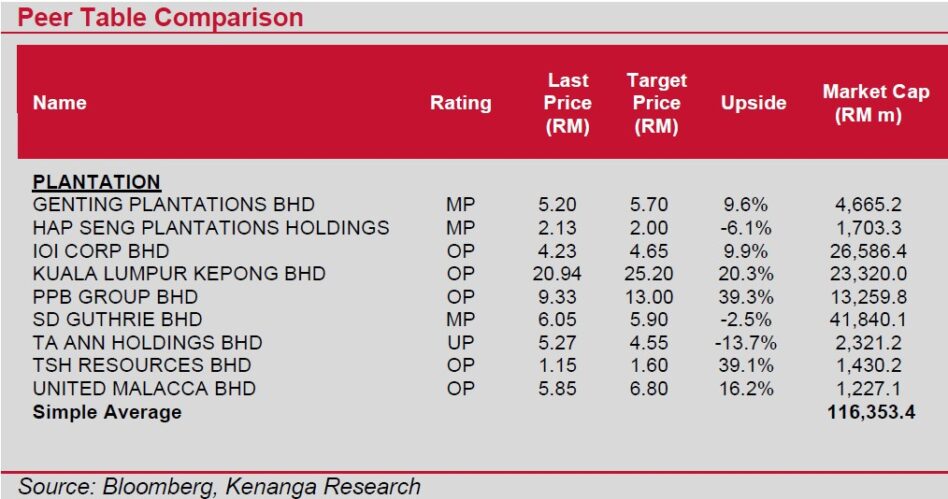
Historically, El Nino tends to lift CPO prices, with the prices starting to increase either in the second half of the year when El Nino starts or, more often, in the first half of the following year.
The price changes vary considerably, from initially dipping quarter-on-quarter (QoQ) to spiking 10-40% QoQ in subsequent quarters.
“On the whole, we believe a 5-10% uptick is reasonable for now considering CPO prices have already been elevated since the Middle East conflict,” said Kenanga.—June 12, 2026
Main image: gbindustries.net