

WITH THE 2026 FIFA World Cup now underway, millions of fans worldwide will be focused on the action unfolding on the pitch.
For investors, however, another question emerges: does the world’s biggest football tournament have any meaningful relationship with stock market performance?
A review of historical data suggests that the answer is largely no. Looking back at the 12 World Cup tournaments since 1978, the FBM KLCI ended the year in positive territory only four times, said MBSB Research.
While the benchmark index still managed to deliver a marginally positive average return across all World Cup years, this was largely due to a handful of exceptionally strong performances in years such as 1978, 2006 and 2010 that outweighed several weaker periods.
More importantly, market direction appeared to be shaped by broader economic and financial developments rather than football fever.
Events such as the global downturn in the early 1980s, the 1994 market correction, the aftermath of the Asian Financial Crisis and various global economic cycles had a far greater influence on investor sentiment and market returns.
That said, a more interesting pattern emerges when examining the tournament period itself.
During the actual World Cup weeks, the FBM KLCI posted gains in seven out of the 12 tournaments studied, suggesting that markets have historically fared somewhat better while the competition is taking place.
Even so, the positive trend is likely more reflective of prevailing economic conditions at the time than any direct impact from the football spectacle itself.
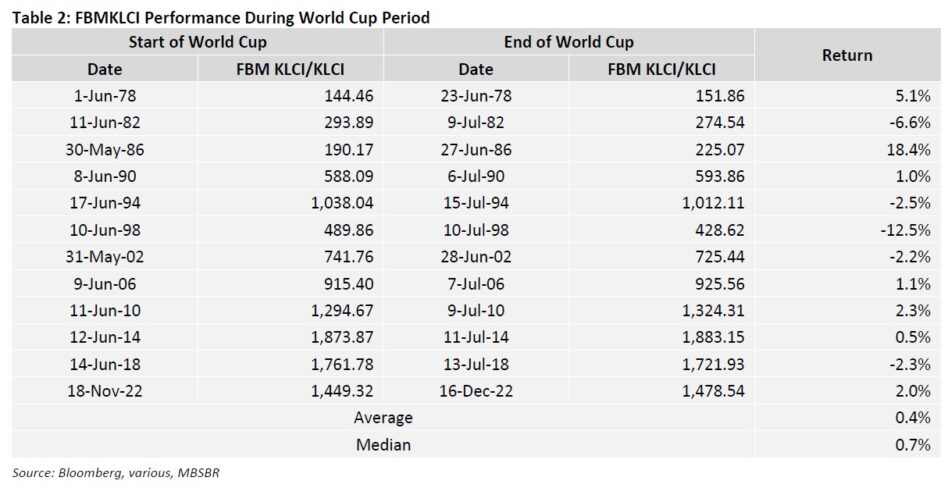
“While our observation yielded interesting results, we cannot infer that the market was mainly driven by the World Cup,” said MBSB.
MBSB opines that the climate and themes of the year were probably the factors that drove the market during those periods.
For example, the strong performance between 30 May 1986 to 27 June 1986 (+18.4%) was likely due to the theme of late-cycle recovery expectations (see above).
Similarly, the -12.5% drawdown during 10 June 1998 to 10 July 1998 was likely due to the Asian Financial Crisis of 97/98.
This year’s World Cup will be played with the backdrop of external or uncertain external environment.
Geopolitical situation has not cleared with the Iran-US conflict remains unresolved with the possibility of reigniting given the exchange of strikes this week.
It is expected that the possible supply chain disruption will cause inflationary pressures going forward.
In fact, the US inflation intensified further in May-26, as the annual headline CPI inflation accelerated for the third consecutive month to reach a three-year high of +4.2%yoy (Apr-26: +3.8%yoy), matching market consensus.
“As for Malaysia, we expect that inflation to remain manageable given our subsidy policy and we expect overnight policy rate to be maintained at 2.75% at current juncture,” said MBSB. —June 12, 2026
Main image: Getty Images