
ASIAN markets closed largely higher on the final session of June, extending Wall Street’s upbeat momentum after the Dow Jones Industrial Average notched another record close.
Optimism was underpinned by sustained enthusiasm for artificial intelligence-related technology stocks, improving geopolitical sentiment, and Brent crude stabilising around US$72 per barrel—its pre-conflict level—as indirect talks between the United States and Iran continued in Doha.
Investor confidence was further strengthened by China’s better-than-expected composite PMI, which highlighted the resilience of its manufacturing sector and continued strength in high-tech exports, even as domestic demand remained subdued.
Meanwhile, the pullback in crude oil prices eased concerns over inflationary pressures.
However, stronger-than-forecast US JOLTS job openings suggested the labour market remains resilient, reinforcing expectations that the Federal Reserve is unlikely to rush into interest rate cuts and may keep monetary policy restrictive for an extended period.
Investors now turn to ADP employment, ISM Manufacturing PMI, factory orders and Friday’s NFP report for fresh clues on the Fed’s policy path.
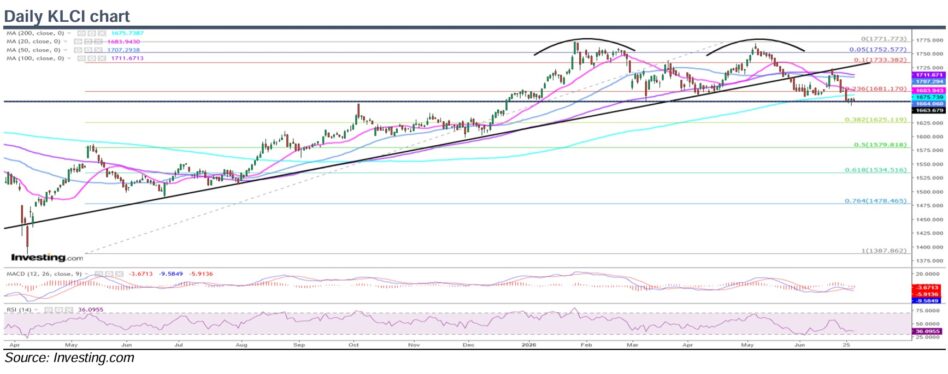
Towards Malaysia, the KLCI traded sideways within the 1,661.8–1,669.8 range before slipping 1.85 pts to 1,664.1, in line with broader weakness in ASEAN markets.
Market breadth improved to 1.35 (vs. 1.15 previously), while trading activity remained subdued at 2.91bn shares worth RM2.78bn, reflecting a lack of fresh catalysts.
Foreign investors turned net sellers at RM183m, alongside local retailers. In contrast, local institutions remained the anchor net buyers for the 6th straight session.
In the near term, the KLCI is expected to remain volatile and headline-driven, with sentiment hinging on developments surrounding US-Iran diplomacy, although no highlevel talks are currently scheduled.
Domestically, the absence of fresh catalysts, persistent foreign selling and rising political uncertainty ahead of the Johor and Negeri Sembilan state elections, amid lingering GE16 speculation, are likely to keep risk appetite subdued.—July 1, 2026
Main image: Sinar Harian