


MALAYSIA is facing a silent epidemic. It’s not a virus, inflation or unemployment. It’s online fraud bleeding the nation dry.
Every day, ordinary Malaysians watch their life savings disappear. Teachers, retirees, small business owners and young professionals are being out-manoeuvred by increasingly sophisticated criminal syndicates operating through fake investment schemes, spoofed phone calls, phishing links and fraudulent banking transactions.
The numbers are staggering. Between 2024 and May 2026, Malaysians lost RM5.37 billion to online scams. That’s enough money to build thousands of schools, equip hospitals or fund critical infrastructure projects across the country.
Almost half of these losses, RM2.68 bil, came from fake investment schemes. Telecommunications scams accounted for RM1.54 bil, while e-financial crimes totalled RM660.6 mil. Together, these three categories made up more than 90% of all scam losses.
The trend is equally alarming. Scam losses nearly doubled from RM1.57 bil in 2024 to RM2.97 bil in 2025. In just the first five months of 2026, victims have already lost RM830 mil, and the figure continues to rise.
The uncomfortable truth is that we’re still treating these as isolated criminal cases when they have evolved into a national security and economic crisis.
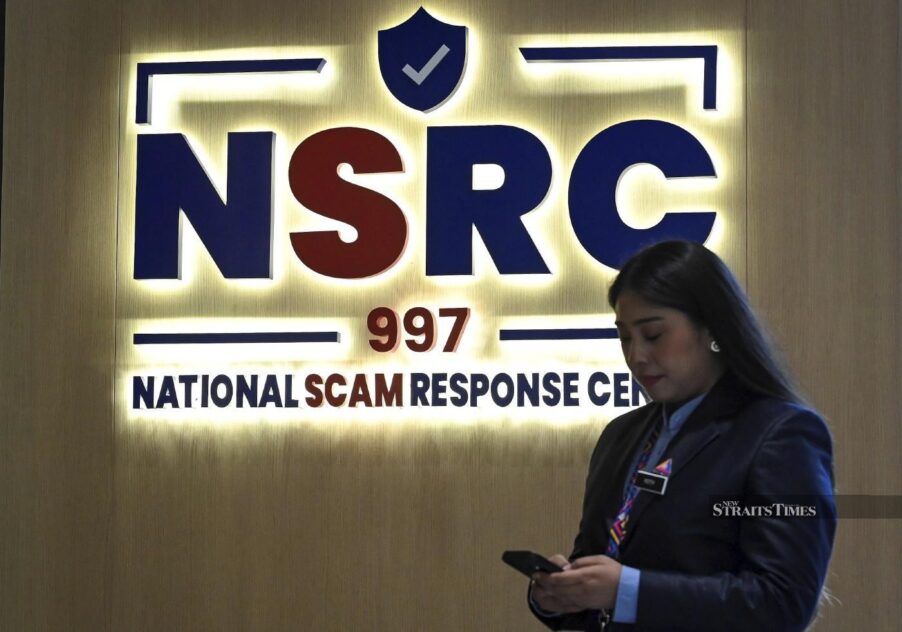
The government has taken encouraging steps. The National Scam Response Centre (NSRC) now operates around the clock, bringing together the Royal Malaysia Police, Bank Negara Malaysia, the Malaysian Communications and Multimedia Commission (MCMC), and financial institutions.
The 997 hotline has enabled faster action to freeze suspicious accounts, while amendments to the Penal Code have introduced tougher penalties for online scammers.
Those efforts have delivered some encouraging results. Since its establishment, the NSRC has frozen RM32.49 mil, with RM10.9 mil successfully returned to victims. The recovery rate has also improved from 29% between 2022 and 2025 to 49% in the first five months of 2026.
That’s progress worth acknowledging. But we’re still fighting fires instead of preventing them.
Today, we chase scammers after they’ve struck, freeze accounts after money has been transferred, and investigate only after lives have been upended.
We need to stop these crimes before money ever leaves victims’ bank accounts. That requires a shift in mindset and a greater sense of urgency.
What needs to change
First, every investment advertisement on social media should require prior verification by the Securities Commission Malaysia.
Digital platforms must face legal consequences if they continue hosting fraudulent investment advertisements after receiving official notice. The excuse of “we’re just a platform” is no longer acceptable.
Second, banks should deploy advanced artificial intelligence capable of detecting unusual transactions in real time.
High-risk transfers should automatically trigger a brief cooling-off period, giving customers an opportunity to verify the legitimacy of a transaction before funds are released. A few minutes of inconvenience could save a lifetime of savings.
Third, telecommunications companies must strengthen caller authentication to eliminate spoofed phone numbers.
Many telecom scams begin with criminals impersonating police officers, bank representatives or government officials. The technology exists. Wider adoption should become mandatory.
Fourth, Malaysia must launch a nationwide education campaign that matches the scale of the threat.
Scam awareness should become part of school curricula, workplace induction programmes and community outreach initiatives. Prevention remains our cheapest and most effective defence.
Finally, Parliament should consider establishing a National Anti-Scam Commission with dedicated powers to coordinate intelligence, monitor emerging fraud trends, regulate digital platforms and publish quarterly performance reports.
Cybercriminals are organised, well-funded and technologically advanced. Our response must be equally coordinated.
We should never lose sight of the human cost behind these statistics.

Online scams do more than steal money. They wipe out retirement savings built over decades, force families into debt, erode confidence in digital banking and undermine trust in Malaysia’s growing digital economy.
Every ringgit stolen represents years of hard work, sacrifice and hope.
Behind every scam report is a real person. Someone who believed they were making a sound investment or helping a family member in need. The financial losses are devastating, but the emotional scars often last even longer.
The government must build a digital future Malaysians can trust.
Malaysia aspires to become a high-income digital nation. That ambition cannot succeed if citizens fear every phone call, every online advertisement and every banking transaction. A thriving digital economy cannot be built on a foundation of distrust.
The fight against scams is no longer just about catching criminals. It’s about protecting public confidence, safeguarding national wealth and ensuring technology remains a force for progress rather than exploitation.
This is a moment that demands leadership, urgency and collective action, not only from the government, but also from banks, telecommunications companies, digital platforms and every Malaysian.
If we fail to act now, the next RM5.37 bil won’t just be another statistic. It will be our parents’ retirement savings, our children’s education funds and our neighbours’ hard-earned livelihoods. ‒ July 21, 2026
KT Maran is a Focus Malaysia viewer.
The views expressed are solely of the author and do not necessarily reflect those of Focus Malaysia.
Main image: theSun