
IT was registered. It was legal. It was not a scam. It was something far more complex.
It operated in plain sight within the letter of the law yet for many investors, it ended in the loss of a lifetime of savings.
The critical question we must ask is not just who is to blame but how a legitimate corporate structure can be leveraged so irresponsibly that it creates catastrophic investor risk without any mandatory disclosure.
When news broke that 1,800 investors, mostly retirees, lost over RM100 mil in cash trust schemes, the public’s immediate instinct was to call it a “scam”.
While that reaction is entirely understandable, it is structurally inaccurate. More importantly, using the wrong label obscures the deeper systemic lesson.
A classic “scam” relies on deliberate, baseline deception, a scheme designed from day one to extract money under completely false pretences.
The legal remedy for this is straightforward criminal prosecution; Malaysia’s penal code is well-equipped to handle outright fraud.

Marketing loophole
What occurred across several high-profile cash trust failures was structurally and conceptually different:
- The trust companies were legally registered with the Companies Commission of Malaysia (SSM).
- The trust deeds were valid legal documents executed by genuine corporate entities.
- The underlying investment activities actually existed.
What was not real was the marketing narrative. Investors were led to believe that basic corporate registration equated to regulatory oversight, implying their principal was protected in the same manner as a licensed investment product.
Libelling it merely a “scam” over-simplifies the problem. This was the irresponsible exploitation of a legitimate legal framework orchestrated to enrich operators at the expense of retail investors.
It created massive risk exposures in a regulatory blind spot where authorities could not easily reach.
The law sets the floor for what is permitted; ethics defines the ceiling of what is acceptable. Too many of these cash trust schemes weaponised the ambiguity of the space in between.
Worth asking is if a financial entity is legally registered yet its product is completely unregulated for commercial investment activity, who is actually watching your money?
Three regulators, three mandates
To understand how this investor harm manifested, one must look at the fractured nature of Malaysia’s historical regulatory architecture.
Trust companies sat at an administrative crossroads where SSM handled basic registration, the Securities Commission Malaysia (SC) oversaw capital markets under the Capital Markets and Services Act (CMSA) 2007 while the underlying Trustee Act 1949 sat under the purview of the Prime Minister’s Department without strict registration mandates.
Each regulatory body held an isolated piece of the puzzle but none held the complete picture. In the cracks between these mandates, an aggressive shadow market flourished.
Operators used the prestige of SSM registration to project an aura of institutional legitimacy while safely operating in a legal gap that none of the three authorities had the explicit statutory power to police.
This was not a failure of individual oversight; it was a failure of regulatory architecture. It is the predictable consequence of trying to govern sophisticated, modern investment mechanisms using a legislative framework written in 1949.
‘Conflict of interest never disclosed’
At the core of these investment-style trust schemes lies a profound conflict of interest that would be flatly illegal in any licensed fund environment and was systematically hidden from retail buyers.
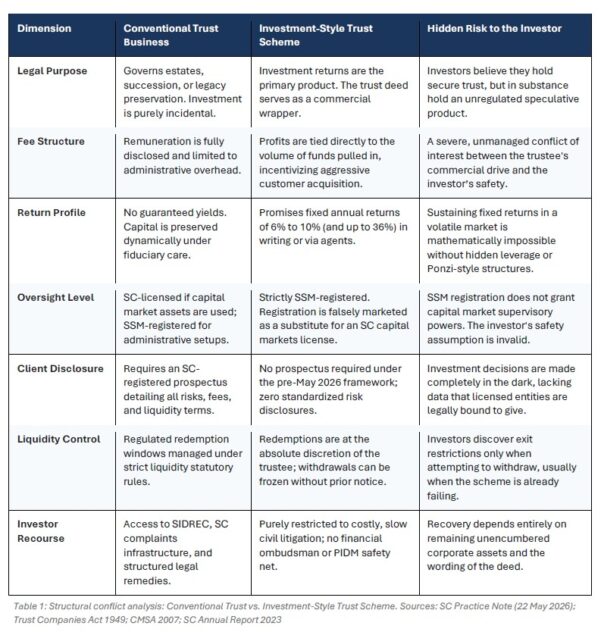
The defining red flag of these failed schemes was the guarantee of high, fixed annual returns, frequently yielding 6% to 10% and sometimes wildly higher, completely insulated from market performance.
Let us look at the economic reality of the 2022 to 2024 period when these funds were actively soliciting capital:
- Malaysian 10-year Government Securities (MGS): Yielded roughly 3.8% to 4.2%.
- Fixed deposits (FD): Offered 2.5% to 3.5% p.a.
- SC-regulated unit trusts: Operated under stringent licensing and full fee transparency, averaging returns in the 5% to 7% range with zero guarantees.
The distribution trap: Sold by the trusted
These products did not proliferate through random internet spam. They were distributed via trusted networks: personal insurance agents, wealth planners and close referrals.
Investors were frequently told the trust company carried the “implicit endorsement” of financial authorities.
That narrative was a material misrepresentation. SSM registration is an administrative incorporation process, not a Bank Negara Malaysia (BNM) endorsement or an SC capital markets license.
An SSM certificate simply notes that a corporate entity exists on paper. It says absolutely nothing about whether the investment operations, risk profiles or financial activities of that company have been vetted or supervised by a competent market regulator.
Regulation restores order but cannot erase risk
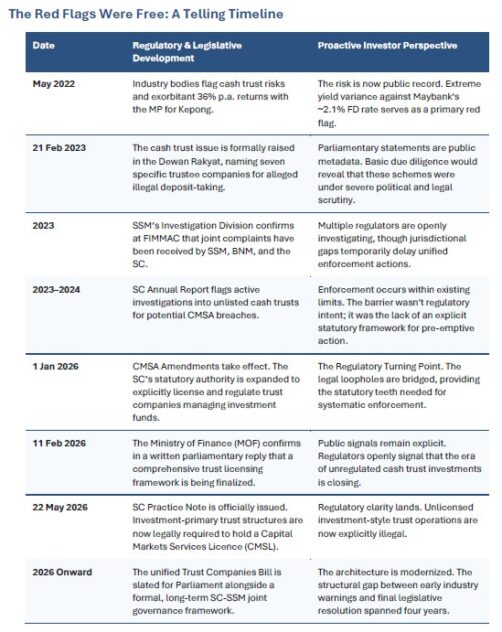
The SC’s May 2026 Practice Note and the upcoming Trust Companies Bill represent major milestones in Malaysian financial regulation. They bring clear classification, robust conduct standards, and mandatory prospectus disclosures to a once-shadowy asset class.
However, investors must not fall into a new psychological trap: assuming an SC-licensed product is entirely “safe”.
Licensing ensures that a product is structured legally, audited independently and transparent about its fees. It does not alter the immutable laws of risk and reward.
Therefore, the six questions to ask before one sign up are as follows:
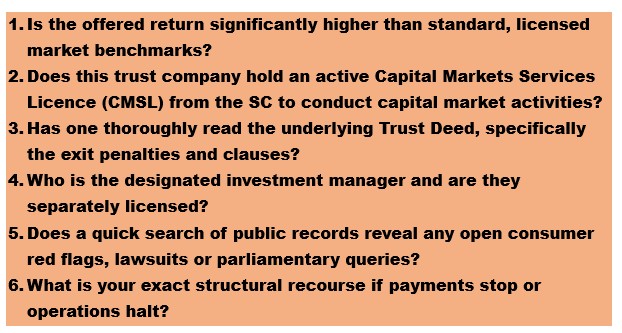
The everyday citizens and retirees who lost their livelihoods to unsustainable cash trust structures did not deserve that fate.
They were let down by an antiquated regulatory architecture that simply had not caught up with the aggressive financial engineering happening right under its feet.
The single most powerful tool in investor protection is the question you ask before you sign. – July 25, 2026
Aida Lim Abdullah has more than 30 years of experience in a variety of organisations and institutions ranging from audit firms, conglomerates, digital & fintech financial institutions, GLCs to regulators such as Bursa Malaysia Bhd and the Securities Commission Malaysia (SC).
The views expressed are solely of the author and do not necessarily reflect those of Focus Malaysia.
Main image credit: Sim & Rahman