
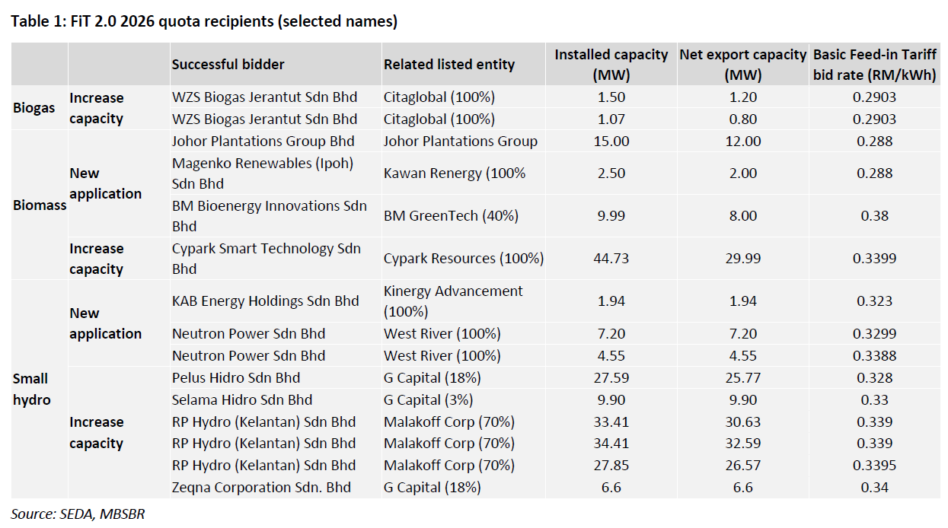
SUSTAINABLE Energy Development Authority (SEDA) has approved 42 out of 48 applications under the 2026 FiT 2.0 round, representing 331.4MW of net export capacity and 387.4MW of installed capacity.
This is made up of 169.23MW of small hydro (51%), 135.9MW of biomass (41%) and 26.19MW of biogas (8%).
The successful projects are expected to commence commercial operations between 2029 and 2030, with total investments estimated at RM4.3 bil.
This represents the largest FiT quota awarded to date, surpassing the 181.3MW in net export capacity approved under the 2025 FiT 2.0 allocation.
Malakoff emerged as one of the key beneficiaries of the latest allocation. Its 70%-indirect subsidiary, RP Hydro Kelantan Sdn Bhd, received additional capacity for three small hydro projects, lifting its combined net export capacity to 89.79MW.
Meanwhile, Cypark Resources, through its subsidiary Cypark Smart Technology Sdn Bhd, was awarded an increased capacity of 29.99MW for its waste-to-energy facility in Port Dickson.
The additional allocation represents an important step towards the development of the plant’s second phase.
West River was another notable recipient, with its wholly owned subsidiary Neutron Power Sdn Bhd securing two new small hydro quotas with a combined capacity of 11.75MW.
“We view the latest FiT 2.0 2026 awards positively,” said MBSB Research (MBSB).
While solar continues to dominate Malaysia’s renewable energy landscape, the expansion of biomass, biogas and small hydro capacity will provide greater diversification of the country’s energy mix while helping to reduce reliance on gas and coal.
“As such, we retain our Positive view on the Renewable Energy subsector, supported by favourable structural policy developments and Malaysia’s longer-term decarbonisation agenda under the National Energy Transition Roadmap,” said MBSB.
An overarching goal is raising the RE capacity mix to 70% by 2050 from 23% in 2020 which necessitates a more than quadrupling in annual RE installations to 2.2GW/annum by 2050.
“We view that this will continue to be dominated by solar, which is now shifting towards hybrid solar-plus-storage projects,” said MBSB.
BESS is now becoming an integral component of new utility-scale renewable generation. This should help mitigate intermittency, improve dispatchability and support grid stability as renewable penetration rises.
“We have BUY recommendations on Pekat and Samaiden,” said MBSB—Aug 12, 2026
Main image: smhb.com
.