
RHB’S latest checks across the technology supply chain further strengthen its view that the sector remains firmly positioned within an upcycle, with momentum potentially carrying into 2027.
This positive outlook is supported by strong factory utilisation, growing order books and optimistic customer projections, driven largely by rising AI demand alongside a recovery in other technology segments.
Most technology companies are expected to post improved earnings, backed by healthy order backlogs, high production utilisation, consistent project execution and faster billings.
The earnings momentum is also expected to continue through the second half of 2026, aided by the seasonal increase in activity and favourable quarter-on-quarter foreign exchange movements.
Meanwhile, the Semiconductor Industry Association (SIA) has lifted its forecast for the global semiconductor market to USD1.5 tril in 2026, representing 89.9% growth, led by memory, logic, microcontroller and analogue integrated circuits.
The industry is expected to expand by another 27% in 2027 as AI adoption continues to accelerate.
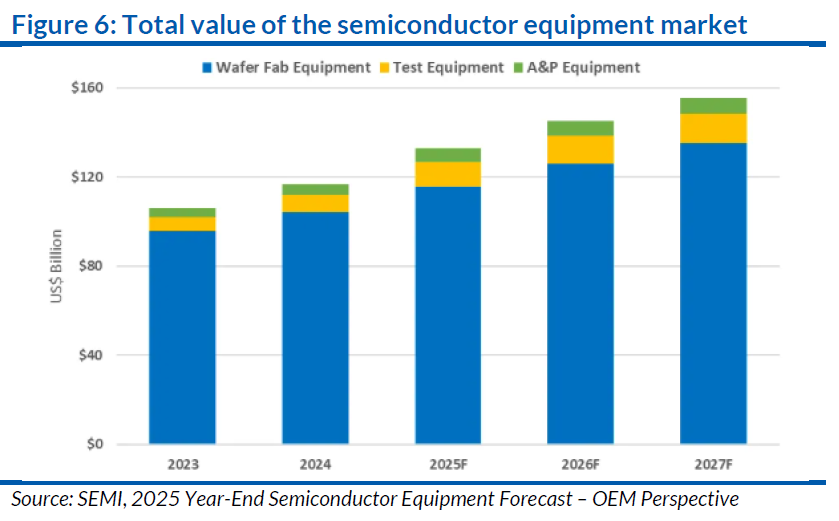
Meanwhile, SEMI expects semiconductor equipment spending to rise 10% year-on-year (YoY) to USD138 bil in 2026, driven by aggressive capacity expansion in leading-edge logic, dynamic random-access memory and advanced packaging.
Regionally, Malaysia’s E&E exports jumped 43% YoY to MYR468 bil in the first half of 2026 (1H26), contributing over half of total export growth.
Rising 2026 and 2027 capex estimates for the Magnificent 7 further reinforce expectations of a sustained AI infrastructure buildout and industry upcycle.
The rapid adoption of generative AI and hyperscale data centres is driving structural demand for advanced packaging, power semiconductors and high-speed networking, as the ramp-up in compute intensity and rack power densities create critical power, thermal and bandwidth bottlenecks.
This is accelerating the adoption of wide-bandgap materials such as silicon carbide and gallium nitride for more efficient power conversion, alongside 2.5D/3D advanced packaging to integrate chiplets, and high bandwidth memory for higher compute density.
It is also quickening the shift towards high-speed optical transceivers such silicon photonics and co-packaged optics to reduce latency and improve energy efficiency.
Elevated memory prices could pressure consumer electronics demand by raising costs for smartphones, personal computers and automotive electronics, potentially triggering downward revisions to global device shipments.
Other downside risks include geopolitical tensions, FX volatility, cost-driven margin pressure, and intermittent order delays from component shortages.
Potential US Federal Reserve rate hikes could also compress valuations.—Aug 17, 2026
Main image: tstar.com