
LOCAL consumer companies could face renewed cost pressures as several key food and beverage commodities moved higher in August, although a stronger Ringgit and resilient domestic demand may offer some relief.
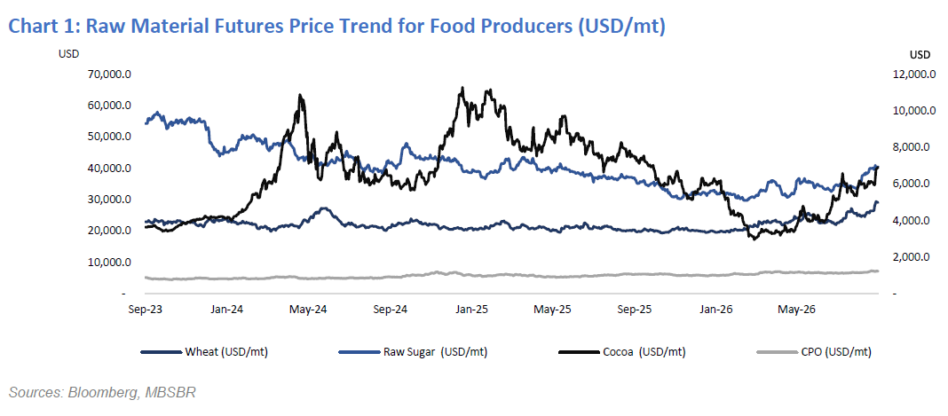
According to MBSB Research, wheat increased +5.4% month-on-month (mom) to USD26,098/mt, suggesting renewed cost pressure for flour-based producers.
Cocoa rose +7.1%mom to USD6,092/mt, indicating volatility after the earlier correction. Sugar prices also moved higher, with raw sugar up +12.3%mom, while white sugar was broadly stable at +1.0%mom.
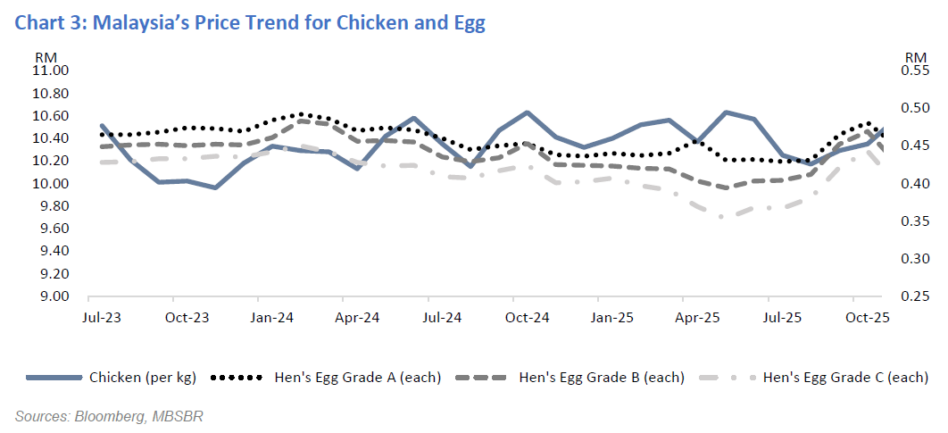
Poultry prices strengthened in Jul-26, with both egg and chicken prices rising on a month-on-month and year-on-year basis.
Retail egg prices were higher across all grades, with Grade A up +4.2%mom to RM0.476/egg, Grade B up +4.5%mom to RM0.440/egg, and Grade C up +0.8%mom to RM0.394/egg.
Meanwhile, average retail chicken prices increased +1.0%mom to RM10.88/kg, suggesting firmer poultry pricing momentum after the earlier normalisation.
“Overall, the rebound in both egg and chicken prices should support poultry average selling prices, although higher feed costs remain a key margin watchpoint for integrated producers,” said MBSB.
The Malaysian Ringgit remained stronger year-on-year against the US dollar in Aug-26, with USD/MYR averaging 4.07 versus 4.23 in Aug-25, implying a +3.8% year-on-year (yoy) appreciation.
Sequentially, the Ringgit was broadly stable, strengthening marginally by +0.4%mom from 4.08/USD in Jul 26. Against the Chinese yuan, however, MYR remained weaker, with CNY/MYR at 0.60, implying depreciation of -0.1% mom.
Overall, the still-stronger year-on-year Ringgit against the USD should continue to partly cushion landed costs for USD-denominated commodities and imported raw materials, but the weaker Ringgit against CNY may reduce import-cost tailwinds for China-sourced products.
MBSB maintains Positive on the Consumer Sector although they advocate a more selective and defensive positioning.
Underlying macro conditions remain supportive, underpinned by resilient domestic consumption, stable employment conditions, manageable core inflation, continued fiscal assistance via STR/SARA, wage support and ongoing value-seeking behaviour.
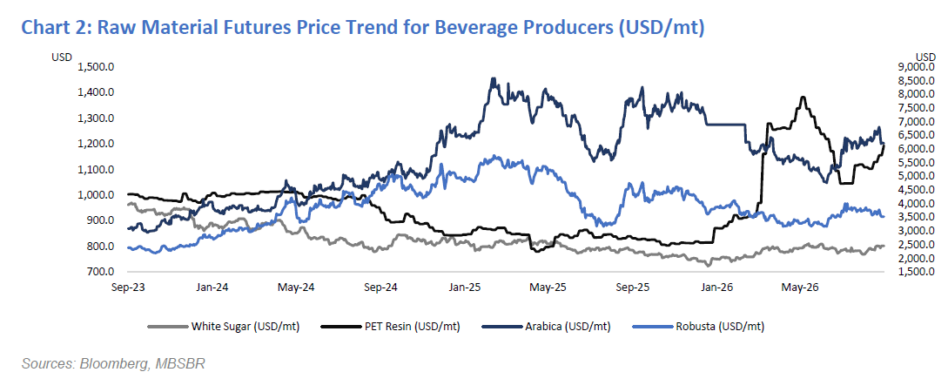
“That said, we remain watchful of margin pressure, as several key inputs remain elevated on a year-on-year basis despite sequential easing in Jun-26, particularly PET resin, CPO, wheat and feed-related inputs,” said MBSB.
The research house believes staples should remain relatively more resilient, especially bottled water, poultry/protein and essential retail, where demand is defensive and selected players retain some pricing flexibility.—Sept 9, 2026
Main image: Unsplash