

LOCAL REITs may have endured a challenging year so far, but resilient earnings and healthy leasing fundamentals are keeping the sector firmly on investors’ radar.
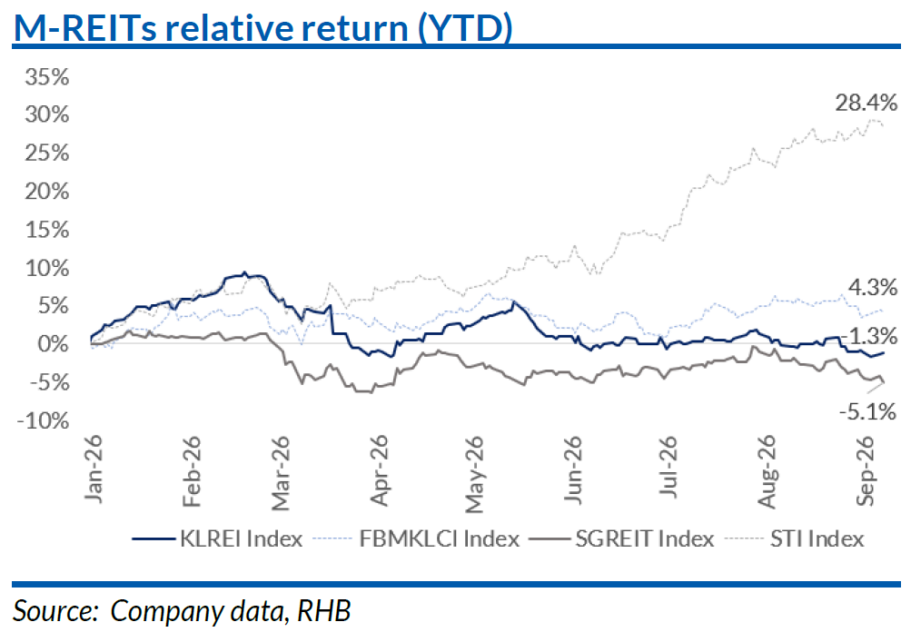
The Bursa Malaysia REIT Index (KLREI) has lagged behind the broader market so far this year, with the sector facing pressure from the expiry of the long-running withholding tax concession and higher bond yields.
Despite these headwinds, second-quarter 2026 (2Q26) results have largely supported our constructive view of the sector.
RHB remains positive on Malaysian REITs (M-REITs), particularly for their defensive characteristics and ability to provide relatively stable distributions in an uncertain macroeconomic environment.
All eight M-REITs under RHB’s coverage delivered results that were broadly in line with expectations.
On a market-capitalisation-weighted basis, sector revenue and earnings increased 14.5% and 15.6% year-on-year (YoY), respectively.
However, growth eased on a quarter-on-quarter (QoQ) basis, with revenue and earnings declining 3.2% and 6.5%, respectively.
The weaker sequential performance was largely attributed to seasonal softness in the retail segment.
Even so, underlying operating conditions remained encouraging. Occupancy rates were generally stable, rental reversions stayed positive and leasing demand continued to hold up, pointing to sustained resilience across the M-REIT sector.
Axis REIT, however, was slightly softer, with the first half of 2026 (1H26) core earnings down 4.9% YoY, dragged by vacancies at selected assets, rental suspension at Wisma Kemajuan and one-off maintenance expenses.
“Nevertheless, we view these as largely temporary, with committed leases expected to progressively lift occupancy to 95% by Jan 2027,” said RHB.
Its MYR456 mil acquisition and development pipeline should also support a stronger earnings recovery from 2027.
“We remain positive on the sector, with management guidance continuing to point to healthy leasing demand, stable-to-improving occupancy and positive rental reversions,” said RHB.
For retail REITs, however, they expect NPI margins to normalise from the strong 1H26 levels, as the shift in automatic fuel adjustment (AFA) from a rebate to a surcharge since May partly offsets the electricity cost savings from the Jul 2025 tariff revision.
Industrial REITs should remain relatively insulated given their lower utilities exposure.
On rates, RHB Economics expects the overnight policy rate to remain at 2.75% into 1H27, while their sensitivity analysis suggests a 25bps hike would lower 2027 earnings by up to 2%.
“Taken together, we expect these headwinds to remain manageable, while healthy leasing fundamentals should preserve earnings and distribution visibility,” said RHB.
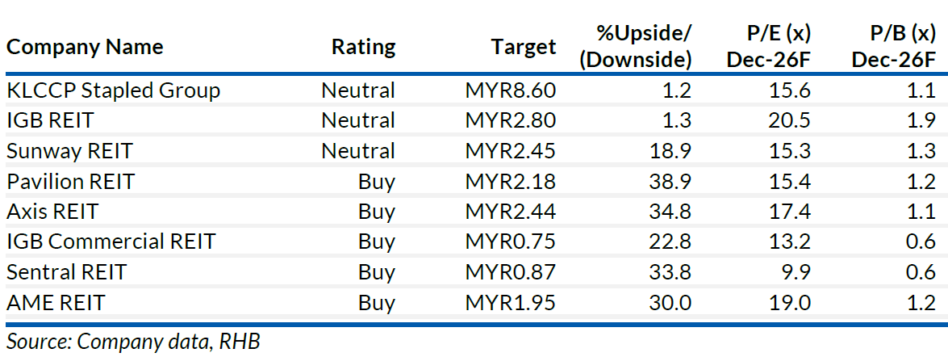
The research house likes Axis REIT for its industrial scale and visible inorganic pipeline, which should support stronger 2027 earnings.
They also like Pavilion REIT supported by the sustained demand for prime retail assets and further rental productivity upside from Pavilion KL’s ongoing reconfiguration.
Key risks are yield spread compression, persistent property oversupply and macroeconomic shocks.—Sept 15, 2026
Main image: ancgroup.biz