
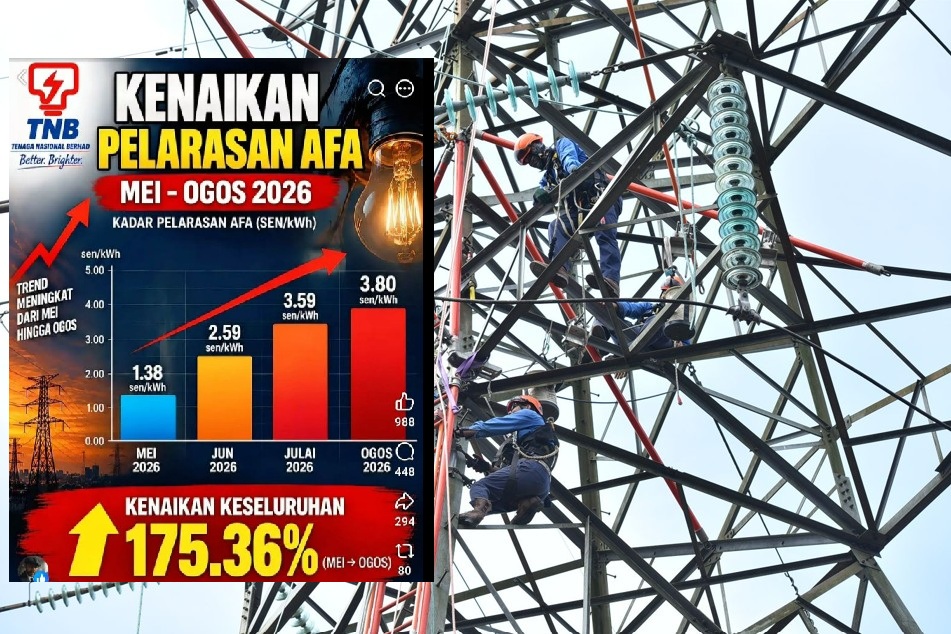
WHETHER this is an opposition orchestrated ploy or otherwise, Prime Minister Datuk Seri Anwar Ibrahim has come under fire for suggesting that adverse weather in recent times could have triggered higher energy consumption, hence an inevitable hike in electricity bill at household level.
In addressing grouses/grievances over a spike in power utility Tenaga Nasional Bhd’s (TNB) billing upon his return from a five-day working visit to India/Maldives (Sept 11-15), PMX pointed to the hazy spell as a likely culprit.
“The recent hazy conditions and hotter weather have driven up electricity consumption for some households, pushing their monthly usage beyond the 600kWh (kilowatt-hours) threshold and thereby subjecting them to the Automatic Fuel Cost Pass-Through (AFA) mechanism,” he penned in a media statement.
He nevertheless assured that target subsidies initiative remains intact to protect majority of the rakyat.
“Some 80% domestic consumers – those using 600kWh or less per month – remain protected and unaffected by the rate adjustments resulting from this year’s rise in fuel costs,” reiterated PMX.
On this note, the Madani government will hold a special meeting today (Sept 17) with the Energy Transition and Water Transformation Ministry (PETRA), the Energy Commission (EC), TNB and the Finance Ministry (MOF) to examine immediate mitigation measures to alleviate the impact of rising electricity bills on the affected households.
Can’t be the haze
However, PMX’s goodwill gesture to calm anger of energy consumers was met with unpleasant feedback as gauged from the 20.6K likes, 7.2K comments and 1.9K shares on his Facebook page.
For starters, he was mocked for attributing energy bill spike to hazy spell which only worsened in September when “the rakyat have been fussing over the matter for months”.
“Please discuss abolishing the network charge during tomorrow’s (today’s) meeting. It’s more of a burden than the AFA charge,” asserted one Kuala Lumpurian whose comment fetched 1.7K likes.
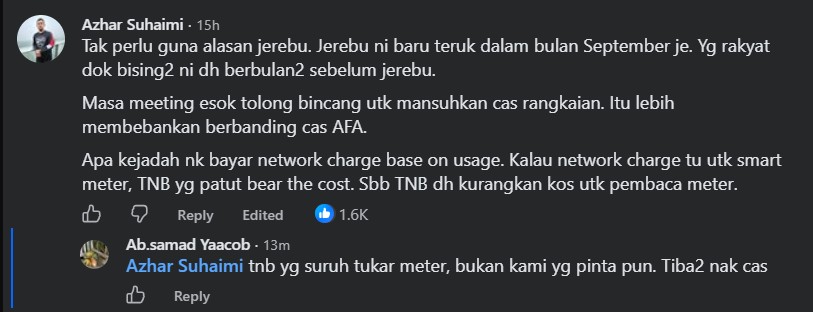
“Why on earth should we pay a network charge based on usage? If the network charge is for smart meters, TNB should bear the cost since it has already reduced expenses related to meter readers.”
Another contended that haze happens every year yet nobody fumed over TNB bills previously.
“It was the Madani keyboard warriors and backers who made noises back then and stirred up a public uproar. That’s how the whole “inviting TNB out for tea” idea came about,” recounted one seemingly opposition-slant unit trust consultant.
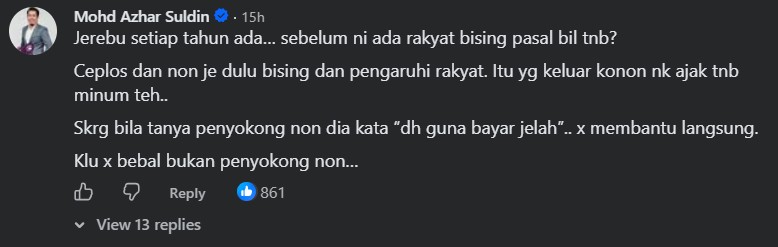

“Now, when you ask a Madani backer, they’ll just say, “If you used electricity, just pay the bill’ which is not helpful at all. If they weren’t thick headed, they wouldn’t be Madani supporters.”
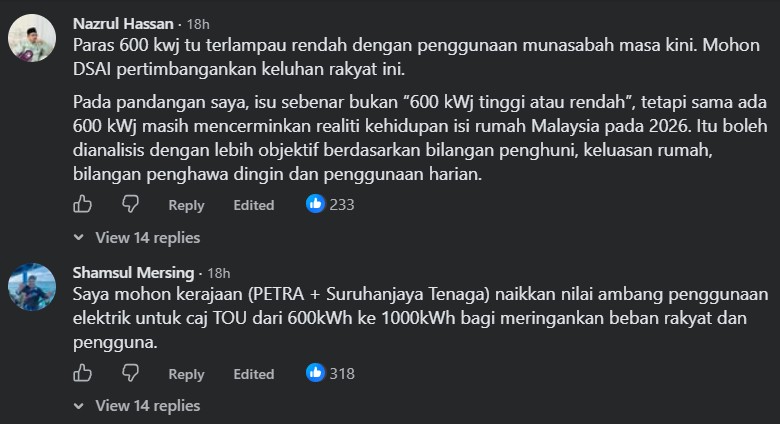
Others reckoned that the 600kWh usage threshold is far too low given “the reality of Malaysian household life in 2026”.
“This can be analysed more objectively based on the number of occupants, the size of the home, the number of air conditioning units and daily usage,” justified one netizen.
This is when one commenter urged the government (PETRA and the EC) to raise the electricity consumption threshold for time-of-use (TOU) charges from 600kWh to 1,000 kWh “to alleviate the burden on the public and consumers”.
TNB denies AFA is culprit
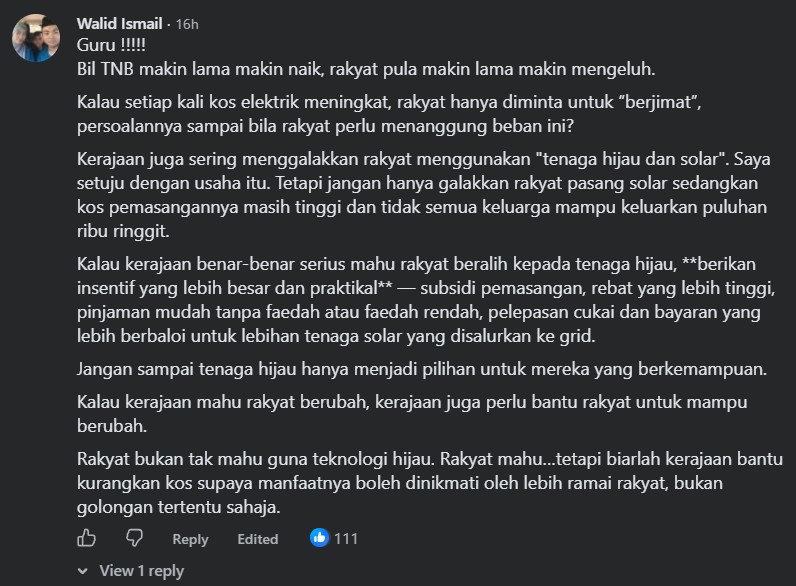
On the call to rely on green and solar energy for alternative power, one commenter lamented that “installation costs remain high and not all families can afford to spend tens of thousands of ringgit” for that purpose.
“If the government is truly serious about having the public switch to green energy, it should provide greater and more practical incentives such as installation subsidies, higher rebates, interest-free or low-interest easy loans, tax relief and better rates for surplus solar energy fed into the grid,” proposed the senior technician.
In a reaction, TNB has refuted claims that the AFA has been instrumental in the sudden spike in electricity bills.
“Factors such as festive seasons, school holidays and working from home (WFH) influence household electricity usage patterns, thus create a knock-on effect on monthly bills,” reasoned the power utility while mooting “Four Practical Steps to Reduce Your Bill”:
- Monitor usage: Use the myTNB app to track electricity consumption on a monthly and daily basis (for smart meter users).
- Practice energy efficiency: Set air conditioners between 24°C and 26°C and use timers. Use electrical appliances with a 4- or 5-star rating.
- Switch to time-of-use (TOU): Use energy during off-peak hours – specifically between 10pm and 2pm (Mondays to Fridays) and throughout the day on Saturdays, Sunday and public holidays – to enjoy lower tariff rates.
- Invest in rooftop solar: Under the Solar ATAP and SuRIA Home initiatives, consumers are eligible for rebates of up to RM3,000 for a 5kWac system with a payback period of approximately eight years. – Sept 17, 2026