TWO months ago, the Asia-Pacific International Roche Infectious Disease Symposium (APAC-IRIDS) drew attention to a growing public health concern — the link between climate change and antimicrobial resistance (AMR).
The research suggests that climate change does more than expand the habitats of disease-carrying vectors such as mosquitoes.
Rising temperatures and changing environmental conditions may also create conditions that allow bacteria to develop and spread resistance to antibiotics, making common infections increasingly difficult to treat.
For Malaysia, the risk could be particularly significant. The country’s hot and humid tropical climate, coupled with a heavily subsidised public healthcare system, leaves it exposed to the potential health consequences of climate-driven changes in bacterial resistance.
This is on top of the surging costs for treating a resistant infection in Malaysia (approximately 3x more than standard infection) due to longer ICU stays, specialized isolation units, and expensive reserve drugs.
“National data shows the cost of AMR treatment per hospital admission rose by over +130% in recent years,” said MBSB Research.
Relying on expensive Reserve Tier drugs also puts immense pressure on national drug procurement budgets.
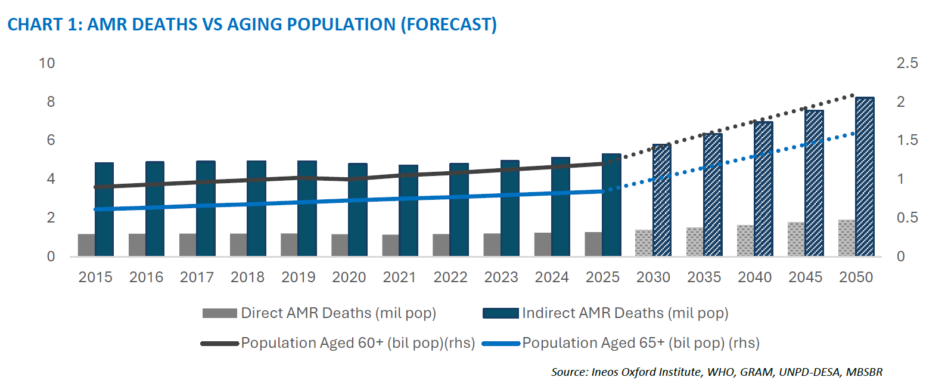
To note, over 4,000 direct deaths and 17,200 associated deaths occur annually in Malaysia from AMR.
Without stronger intervention, associated deaths could reach 21,800 by 2030.
Regional haze, driven by biomass burning, agricultural clearing, and transboundary particulate matter, acts as a physical carrier and genetic incubator for AMR.
Haze is not merely soot and smoke; fine particulate matter (PM2.5) creates an ideal atmospheric microenvironment for drug-resistant microbes and antibiotic resistance genes (ARGs).
Global epidemiological studies estimate that a 10% increase in regional air pollution correlates with a ~1.1% increase in overall antibiotic resistance.
In Malaysia, haze acts as an atmospheric bridge connecting agricultural land practices directly to clinical health risks.
“We noted that the impact of haze goes beyond simple respiratory illnesses, and we highlighted the following role of AMR caused by the anthropogenic disaster,” said MBSB.
Meanwhile, epidemiological studies across Southeast Asia confirm a direct, dose-dependent relationship between transboundary haze intensity—measured primarily by fine particulate matter (PM2.5 and PM10) or Pollutant Standards Index (PSI)— as well as sharp increases in outpatient visits, hospital admissions, and mortality.
Research by the MOH and local academia shows an immediate surge in healthcare utilisation whenever haze thresholds cross into unhealthy zones.—Sept 18, 2026
Main image: Bernama