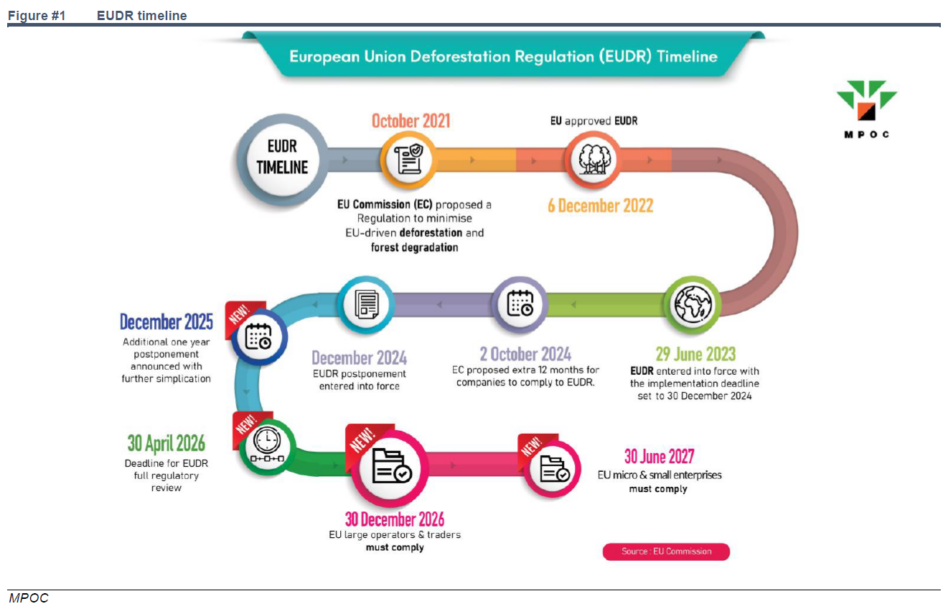
THE European Commission has completed the long-awaited regulatory framework for the EU Deforestation Regulation (EUDR), providing greater clarity over how the rules will be implemented.
Under the final Delegated Act, the regulation will cover more than just primary palm oil products such as crude palm oil (CPO), refined palm oil (RPO) and palm kernel oil (PKO).
Its scope will now extend to a broader range of downstream oleochemicals, including fatty acids, fatty alcohols and glycerine.
According to Hong Leong Investment Bank (HLIB), this effectively brings a larger segment of the palm oil value chain under the EUDR’s deforestation due diligence requirements.
Based on channel checks with integrated plantation companies under coverage, those affected by the expanded scope will have until Dec 30, 2027 to comply with the new requirements.
However, the additional compliance burden is expected to be limited.
Companies already covered by the EUDR are understood to have established traceability and due diligence systems for their existing products.
As a result, the expansion into downstream oleochemicals should require little, if any, additional compliance spending.
Some integrated plantation players also operate downstream manufacturing facilities in Europe, which could further facilitate their compliance with the expanded requirements.
Meanwhile, the Implementing Act is expected to have a more limited impact on oil palm plantation companies compared with the Delegated Act.
Rather than significantly expanding the regulatory burden on plantation companies, it mainly establishes the technical framework for the EUDR Information System.
This includes procedures for submitting due diligence statements (DDS), simplified declarations and contingency arrangements to be used if the information system experiences an outage.
“We do not anticipate the Implementation Act adding significantly to compliance costs, as most integrated plantation companies have already spent the past two years developing traceability systems, GIS mapping capabilities and due diligence processes,” said HLIB.
Instead, the Act should provide greater clarity on the regulatory requirements, giving companies more certainty as they complete their preparations ahead of the EUDR taking effect.
Overall, Malaysian palm oil producers, particularly those with established exposure to the European Union market, appear well placed to comply with the regulation.
Most have already put the necessary traceability and due diligence frameworks in place, which should help them meet the EUDR’s requirements without a significant additional compliance burden.
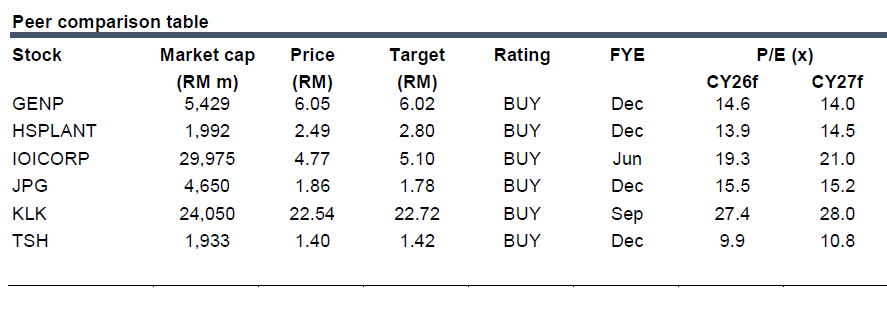
“We reiterate our Overweight stance on the sector, underpinned by our expectation that elevated CPO prices will be sustained through the second half of 2026, supported by tightening supply conditions and resilient demand,” said HLIB.
HLIB continues to favour planters with predominantly upstream operations and greater exposure Malaysia, given their higher earnings leverage to CPO price strength and lower exposure to foreign regulatory and policy risks.—Sept 22, 2026
Main image: apollo247.com