

MALAYSIA’S push to expand corporate renewable energy adoption could gain fresh momentum following a new CRESS Acceleration Package aimed at making projects more commercially viable.
The lower system access charge, coupled with rising electricity demand from data centres and new renewable energy requirements, could encourage more developers and corporate offtakers to lock in long-term CRESS agreements in the coming months.
“We expect the reduced 14 sen/kWh system access charge (SAC) to result in more CRESS agreements being signed in the coming months,” said RHB.
TNB, Solarvest and Samaiden are the main beneficiaries of the CRESS Acceleration Package.
The Energy Transition and Water Transformation Ministry (PETRA) said the lower SAC of 14 sen/kWh is intended to improve project bankability and approval process.
Note that the 14 sen/kWh SAC is 30% lower than the 20 sen firm rate for solar.
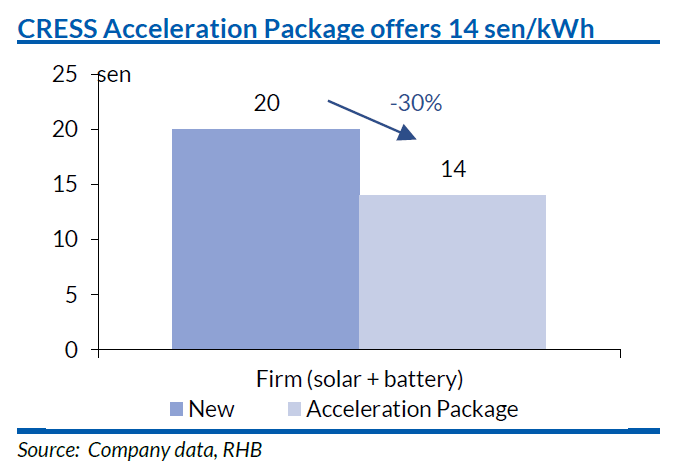
RHB believes the new Acceleration Package should help speed up the signing of CRESS agreements over the coming months.
Based on their channel checks, several developers are already close to finalising agreements with their respective offtakers.
Earlier this month, TNB entered into an agreement to explore supplying up to 1.5GW of electricity to DayOne Data Centre.
Meanwhile, Solarvest is working with Brookfield on the potential development of up to 1.5GW of CRESS projects.
The growing electricity needs of data centres have also prompted the Government to introduce three requirements for data centre investments in Malaysia.
These include:
i) Secured customers for DCs.
ii) 30% renewable energy (RE) mix.
iii) Minimum 10-year energy supply tenures.
“Given the new requirement for 30% RE mix and rising grid prices, we believe more DCs will sign CRESS agreements to lock in long term green tariffs,” said RHB.
The research house retained its base-case assumption of 300-500MW of CRESS project awards for Solarvest by end 2026, while rolling forward the valuation base year to 2028 to derive a new target price (TP) of MYR4.30.
Meanwhile, RHB raised the TP for Samaiden to MYR3 after imputing a 100MW orderbook replenishment assumption from CRESS with a 50% battery ratio.
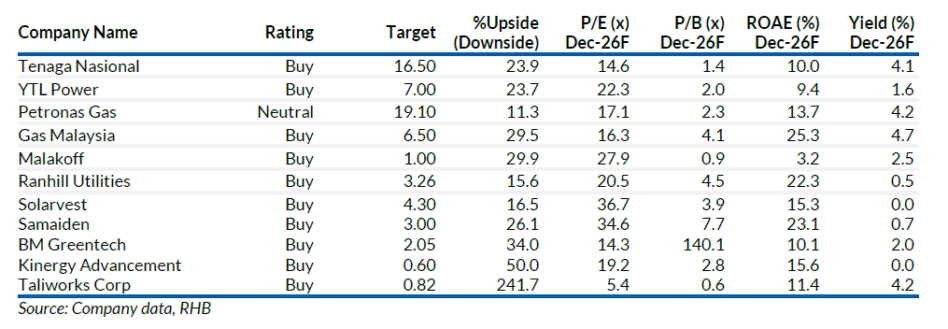
Supported by a MYR3.5 bil tenderbook, of which 70% comprises CRESS projects, further job wins could provide upside potential to their new MYR3 TP.
“Overall, we maintain our OVERWEIGHT sector call. A Top Pick YTLP is set to benefit from rising DC capacity, while TNB is the prime beneficiary of the National Energy Transition Roadmap, with the regulated framework providing a stable earnings base,” said RHB.
RHB also likes Samaiden and SOLAR as they can benefit from new solar tenders.—Sept 22, 2026
Main image: telefonicatech.com