

APEX Securities maintains an Overweight stance on Malaysia’s property sector, viewing Budget 2027 as more likely to focus on implementing existing housing policies than introducing major reforms.
The report expects continued support for homeownership through stamp-duty exemptions, financing schemes and potentially an expansion of the RM20 bil SJKP guarantee to younger Malaysians, self-employed buyers and those without conventional incomes.
Affordable housing is expected to remain a key priority, with the Government likely to begin putting greater resources behind the National Housing Policy 2026–2035.
The RMK13 target of one million affordable homes by 2035 is expected to be pursued through locality-based pricing, greater use of public land and stronger private-sector participation, allowing supply to better match local incomes and demand.
The report also highlights the Build-Then-Sell (BTS) model as a key issue.
Apex expects its implementation to remain gradual because an abrupt shift to the 10:90 payment structure could place significant financing pressure on smaller and mid-sized developers that rely on progressive billing.
A faster rollout without adequate financing support could reduce property launches in 2027 and 2028.
Infrastructure remains an important longer-term catalyst, particularly the Penang LRT Mutiara Line, RTS Link, ECRL, MRT3 and the JS-SEZ.
Penang developers with sizeable landbanks could benefit from improved connectivity and transit-oriented development, with E&O and Kerjaya Prospek Property viewed as the stronger beneficiaries.
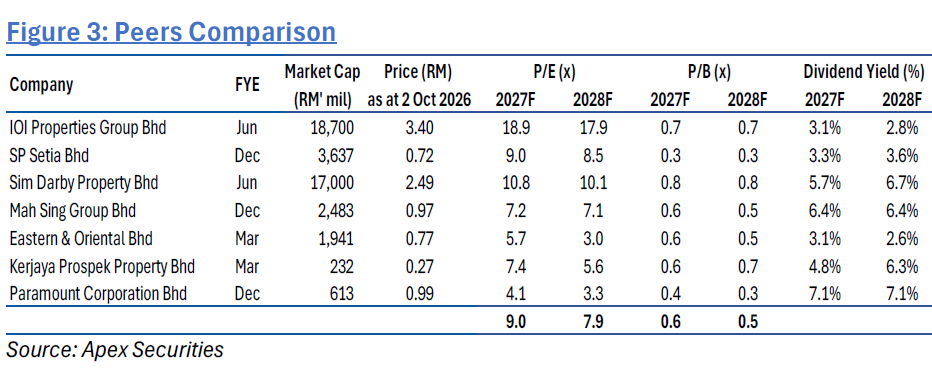
According to APEX, a possible minimum wage increase to RM1,800–RM2,000 could raise construction costs indirectly through higher contractor labour and EPF expenses, although the impact on the three highlighted developers is relatively modest.
Apex further favours E&O and Paramount, citing strong unbilled sales and earnings visibility.
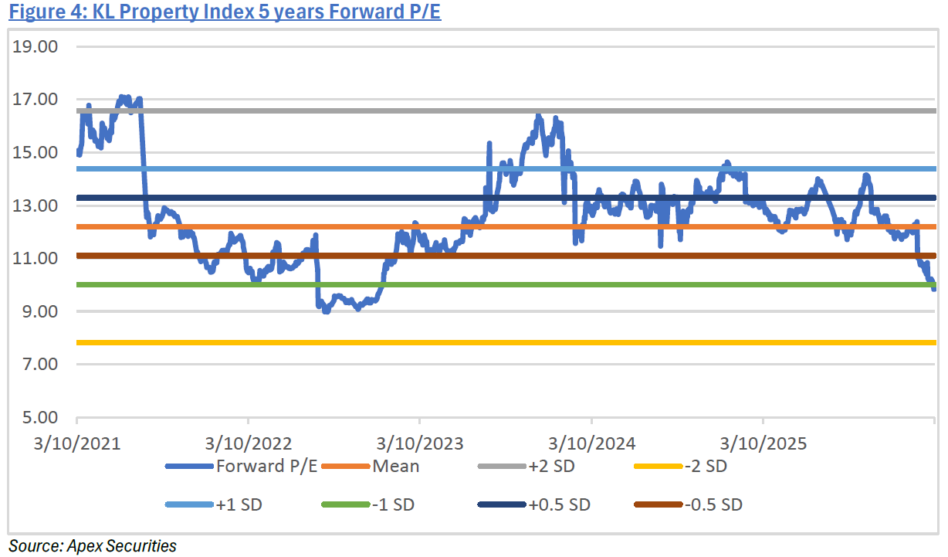
The sector’s forward P/E of around 10 times is also below its five-year average of 12.2 times, leaving room for a re-rating if housing policies and infrastructure spending provide further support.—Oct 5, 2026