


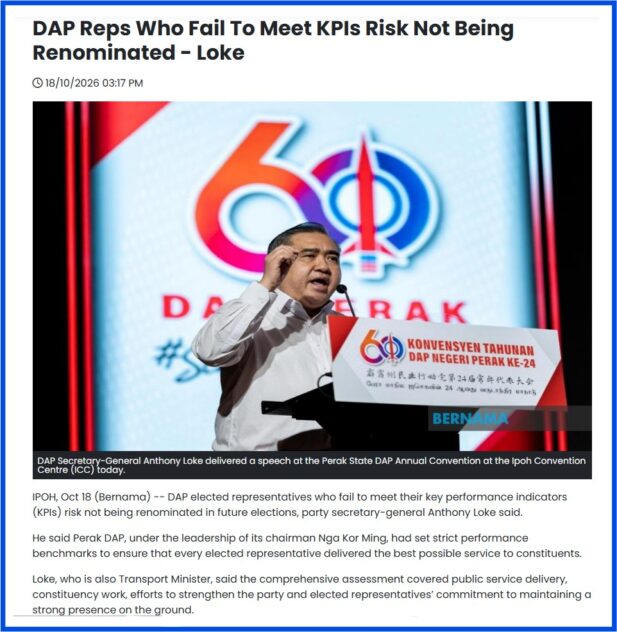
IT is rather surprising that DAP – having been in existence as both an opposition party and a participant in state and federal governments for decades – has come out with key performance indicators (KPIs) for the selection of future candidates.
This revelation was made by none other than the party’s secretary-general and Cabinet minister Anthony Loke Siew Fook.
Perhaps with its holier-than-thou attitude in judging other political leaders, it is indeed essential for DAP to accord priority to the selection of its own political candidates.
KPIs should have been introduced long ago but it is never too late to introduce them now.
For starters, KPIs are important in the selection of candidates for elections and later in the appointment of posts in state and federal governments.
Unfortunately, despite the move to introduce KPIs for judging performance, DAP is constrained by the fact that it is essentially a Chinese-based party with MCA and Gerakan being its main competitors.
Harsh truth
DAP boasts of itself as a multi-racial political party but in essence, it is a Chinese-based party.
The sprinkling of Indians and Malays hides its true political identity.
How can DAP introduce KPIs to judge candidates when the top party positions are reserved for the Chinese; not just any Chinese but those who are aligned with the dominant factions in the party?
The highest position in DAP is that of the secretary-general. Is it possible for a Malay or Indian to aspire to this position?
It would be impossible given the ethnic bias of the party. Is it possible for an Indian or Malay to aspire the position of the Penang DAP chairman for instance?
In the recent party state polls, a non-Chinese obtained the highest number of votes. He should rightfully have been appointed the Penang DAP chairman.
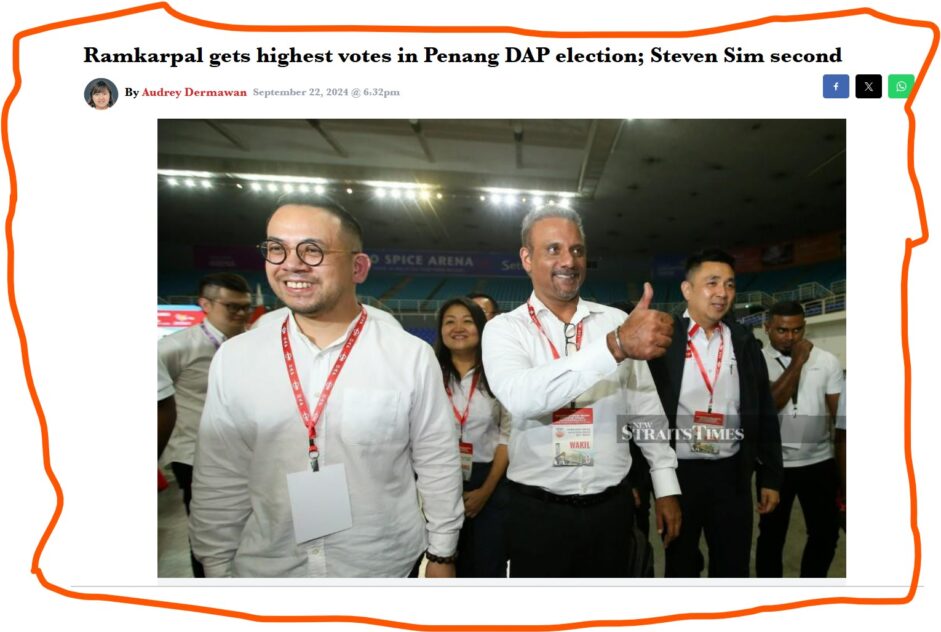
Unfortunately, the selection committee appointed a Chinese in place of the non-Chinese.
This was to make sure that a Chinese candidate, particularly one favoured by the dominant faction, gets the position of Penang chief minister by virtue of his party position.
‘Multi-racialism exists in name only’
Likewise, most of the DAP state committee chairmen nationwide are Chinese with the exception of Negeri Sembilan where the former chairman resigned after he lost in the state constituency in the recent state elections.
The reality is that more than 80% of DAP members are Chinese while the rest are Indians and Malays.
Multi-racialism exists in name only within the party. It is perfectly understandable why there is a need for DAP to get the backing of the aggrieved Chinese community.
But at least it should not pretend that it is a fully multi-racial party. This, however, does not belittle the efforts of DAP in fighting for the rights of Malaysians, particularly the non-Malays, in the past.

Yes, KPIs are important in ensuring that the right candidates are selected for party positions and later accorded governmental roles.
But DAP should not mislead the public by coming out with KPIs when the structure and functioning of the party are very much determined by ethnic considerations.
KPIs in this particular ethnic configuration do not make sense.
Again, it is not just any Chinese candidate but those who are seen to be aligned with certain dominant factions in the party.
Well, if there is inter-ethnic competition among the Chinese, what can we say about the prospects of non-Chinese candidates in the party apart from some window-dressing efforts? – Oct 19, 2026
Former DAP stalwart and Penang deputy chief minister II Prof Ramasamy Palanisamy is chairman of the United Rights of Malaysian Party (Urimai) interim council.
The views expressed are solely of the author and do not necessarily reflect those of Focus Malaysia.
Main image credit: Gobind Singh Deo/Facebook