
INDUSTRIAL park developers are increasingly competing on sustainability credentials as multinational and export-oriented manufacturers place greater emphasis on renewable energy access, climate resilience, green building standards and more.
According to Kenanga Research, the New Industrial Master Plan 2030 and National Energy Transition Roadmap are supporting the shift towards industrial decarbonisation and more sustainable industrial development.
The proposed carbon tax could further strengthen emissions management among affected sectors, depending on its final implementation.
In a report assessing five industrial property developers, namely Sime Darby Property, Eco World Development, AME Elite, Matrix Concepts and NCT Alliance, Kenanga identified encouraging initiatives across four areas: renewable energy accessibility, flood mitigation, green building certification and worker accommodation.
Eco World reported a 71% increase in installed photovoltaic capacity to 3,351 kWp, including 1,396 kWp added in 2025 across Eco Tropics, Eco Business Park III and Eco Business Park VII.
Meanwhile, 89% of its launched projects have obtained green building certifications, representing 39 certifications, although industrial park-specific coverage was not disclosed.
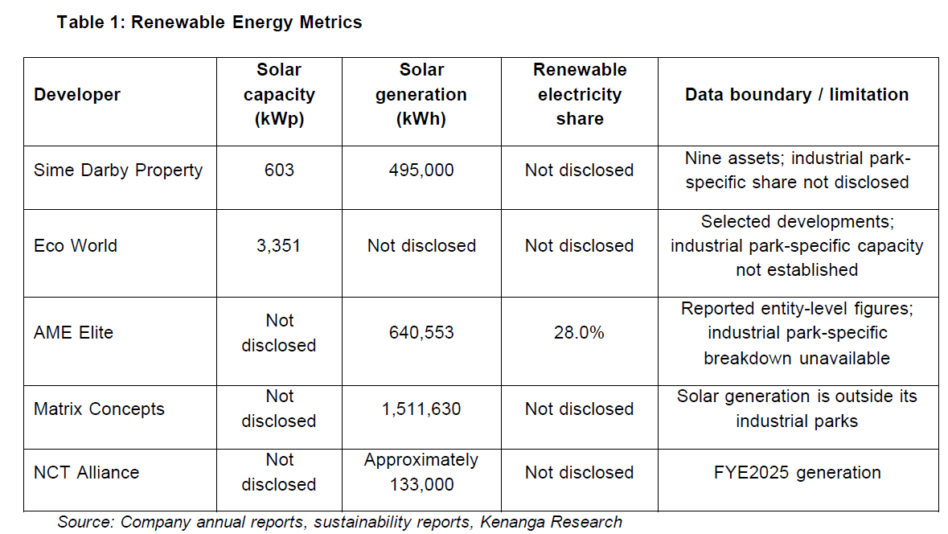
Sime Darby Property reported 603 kWp of rooftop solar installations across nine assets, generating 495 MWh and avoiding 383 tonnes of carbon dioxide equivalent emissions.
Its Bandar Bukit Raja Business Park also holds GreenRE Platinum certification, with flood mitigation measures including elevated roads and engineered platforms.
AME Elite recorded renewable energy generation of 640,553 kWh in 2026, with renewables accounting for 28% of its reported electricity consumption.
Its i-Stay worker accommodation facilities offer more than 9,000 beds, supporting industrial tenants’ workforce housing requirements.
On the other hand, Matrix Concepts claims solar generation of 1.51 mil kWh in 2026, equivalent to 13.5% of its energy mix.
However, the generation was outside its industrial parks, while MVV TechValley is positioned with renewable-energy-ready infrastructure.
NCT Alliance’s Smart Industrial Park features solar-ready factories and warehouses, alongside a proposed 150MW solar farm.
The company is also developing an 18-storey worker accommodation facility in Batu Kawan with capacity for up to 5,400 workers, targeted for completion by 2028.
Overall, Kenanga views sustainability readiness as an increasingly important component of industrial park competitiveness.
However, ESG credentials alone do not guarantee higher occupancy, rental premiums or stronger returns.
Actual financial benefits will depend on tenant adoption, infrastructure availability, implementation costs and measurable operating efficiencies.
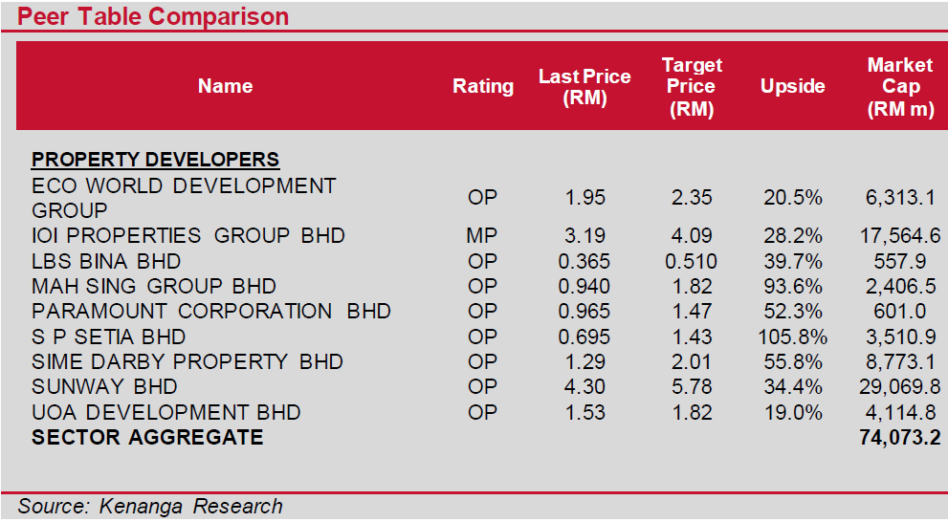
Kenanga maintains its Overweight rating on the property sector, with sustainability initiatives providing additional operational and strategic context for its investment outlook.—Oct 30, 2026
Main image: Buletin Mutiara