

HAVING kin or even offspring working in Anti-money Laundering Act 2001 (AMLA) regulatory divisions does not seem to prevent innocent elderly folks from falling victim to the wily charms of the well-oiled scammer.
With sweet promises of untold riches backed by fake charts and false projections, these scammers target senior citizens, the gullible and sorry to say, the greedy.
A post on Threads by 🐈⬛ (@_caughtin4u) declared that she was ashamed that as an AMLA staffer in a fraud department, she was unable to prevent her own mother from falling victim to a scammer’s tricks.
This lack of judgement in spotting a scam led to the poster’s mother being out of pocket to the tune of RM35K.
“I failed,” she sighed despondently.
View on Threads
The confession of failure has generated 12.8K likes, 570 comments, 629 re-posts and 539 shares at the time of writing, a reflection that this is a topic that has captured the attention of the public.
Unfortunately, there were many who had similar nasty experiences to share.
Tales were aplenty of elderly parents being conned out of their savings despite having offsping working in the AMLA and banking sectors.
It is indeed strange that they did not see fit to ask their own children for advice on matters that they have an expertise on. This lack of foresight led to painful and expensive losses by the affected parents.
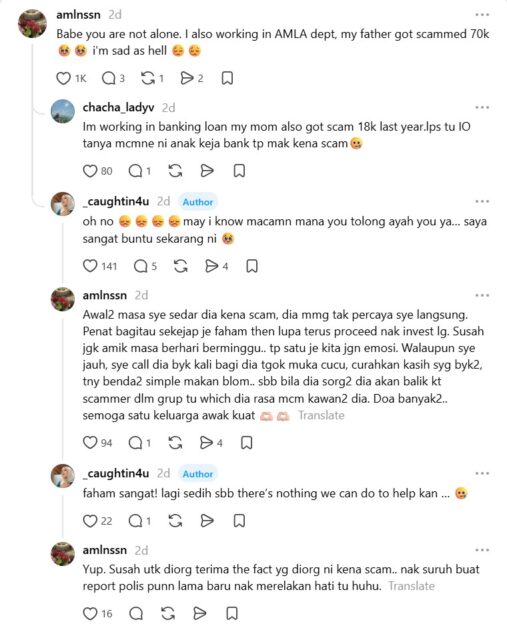
However, it did not matter whether the victims had close relatives who were able to advise them; it appeared that even when the victims themselves were working in the banking industry and even law enforcement did NOT save them from the clutches of scheming scammers.
Two commenters shared (sightly hilarious) anecdotes. One had to do with a bank staff who got scammed and was asked by the police “you are working in the bank yet still got cheated?”.
The other saw a reverse scenario whereby a copper had to report to the bank that he had been scammed and was met with the “you work as a police officer and you still got scammed?”.
This goes to shows that nobody is immune.

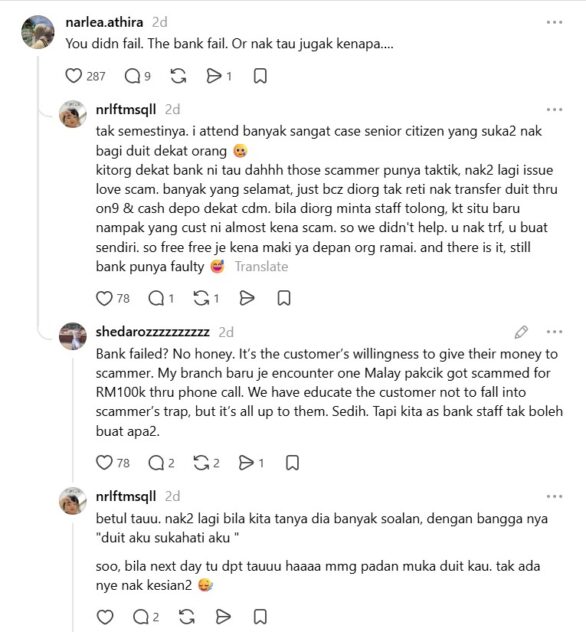
One commenter tried to make the poster feel better by claiming it was the banks that failed by allowing these scam transfers to go through.
This observation was met with swift put down from bank staffers who quite rightly pointed out that all these transactions were done on the customers’ own free will.
One bank employee shared that all too often naïve senior citizens agreed to transfer their money to others on flimsy basis while another shared a case whereby a customer was all too keen to tell all and sundry “it was his money and he was free to do what he wished with it”.
Bank staff were not there to advise such customers but merely to carry out their instructions.
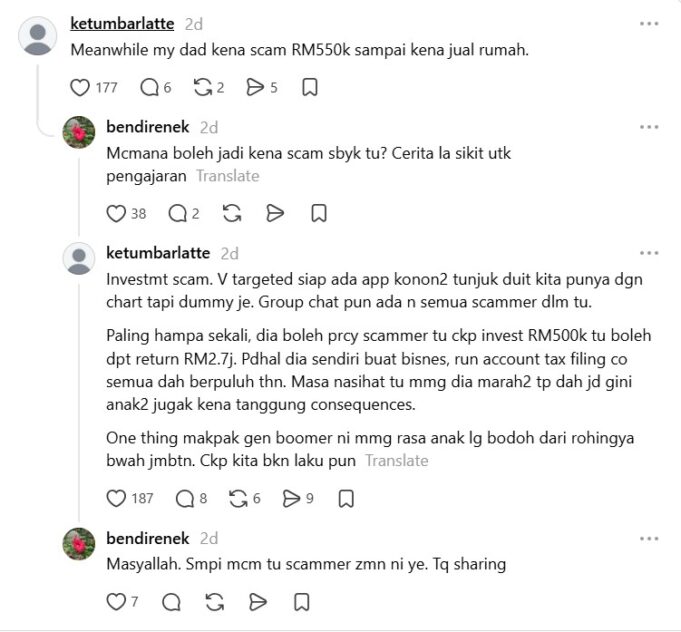
One painful incident left a scam victim facing losses of over half a million ringgit, forcing him to sell his house.
The victim’s daughter was angry as her advice fell on deaf ears and as a businessman of many years, her father should have known better. A claim that an investment of RM550K could lead to return of RM2.7 mil was just simply too good to be true.
Pertinent advice from younger generation was to cut off social media apps, especially Telegram, on their older folks’ phones. This was the avenue in for many a scammer.

How, where and when these scammers strike is one thing. The most crucial of red flags is quite simply when it is too good to be true, it is a clear sign to run.
One does not need a child working in the banking industry to tell them to avoid such schemes like the plague. – Nov 23, 2026
Main image credit: RinggitPlus