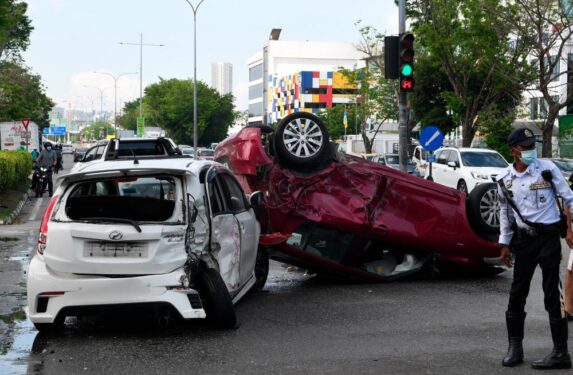


UNDER Section 52(2) of the Road Transport Act 1987, motorists involved in road accidents must report the incident to the nearest police station as soon as reasonably practicable, and no later than 24 hours.
The provision requires reporting within the stipulated period, but drivers must also stop at the scene and fulfil their other legal obligations.
Calls are now mounting to shorten the reporting window and strengthen alcohol and drug testing following accidents, particularly those involving injuries or fatalities.
Alliance for a Safe Community (IKATAN) chairman and founder Tan Sri Lee Lam Thye has proposed reducing the 24-hour reporting limit to six hours or requiring immediate notification, while Road Safety Research Centre head Associate Professor Dr Law Teik Hua has suggested adopting South Australia’s 90-minute post-crash reporting window.
Public health activist Datuk Dr Zainal Ariffin Omar has advocated compulsory alcohol and drug testing for surviving drivers involved in serious accidents, while Dr Law has recommended roadside breathalyser tests and hospital-based blood or urine tests when medically safe.
Road Safety Council executive member Datuk Suret Singh has also called for Malaysia to adopt Japan’s approach of requiring immediate reporting of accidents involving alcohol or substance abuse.
Universiti Kebangsaan Malaysia road safety expert Prof Dr Romzi Ismail, meanwhile, has proposed reducing the reporting period to 12 hours for accidents involving injuries or fatalities.
These proposals are intended to strengthen accountability and ensure drivers responsible for serious accidents do not escape punishment. However, there may also be unintended consequences for accident victims seeking compensation.
Having driven for the past 57 years, I have had my fair share of accidents, both driving my own car and metered taxis.
I was also in the car-hire business for about a decade, specialising in long-term rental and leasing for corporate customers, mainly multinational corporations.
Most of our rented or leased vehicles were driven by expatriates. In the past, we advised customers not to rush to the police station to make a report, particularly at night, if they were potentially in a condition that could raise suspicions of alcohol consumption.
Police stations were not always equipped with breathalyser testing facilities, and a driver’s appearance or demeanour could lead to assumptions.
Moreover, making a report without the vehicle registration card and insurance certificate could mean another trip to the police station, unlike today, when much of the information can be retrieved electronically.
At the customer’s office or mine, we would prepare the report and sketch a map showing how and where the collision occurred before proceeding to the station.
However, motorists should not interpret this as advice to delay reporting or leave an accident scene. Drivers must comply with the law, and suspected drink-driving or drug-related incidents should be handled through proper investigation and testing.
It is also important not to admit legal liability at the scene. While motorists should cooperate, provide accurate information and avoid speculation about fault, any admission of liability could potentially affect an insurance claim, depending on the policy’s terms and circumstances.
Motorists should notify their insurers and follow the prescribed procedures.
Long ago, I typed a report in the same format as the form used at police stations, prepared a sketch map and made photocopies before proceeding to the Jalan Bandar traffic police station.
The policeman at the counter was so impressed that he stamped both copies and returned one to me as my official copy of the report.
Now, back to the calls by road safety experts. Their proposals are aimed at ensuring drivers who cause suffering to accident victims and their families are held accountable.
But there is also a concern about whether victims could be left without compensation if insurance coverage is disputed.
Motor insurance policies generally contain exclusions relating to driving under the influence of alcohol or drugs, although the consequences for third-party claims, insurers’ obligations and recovery against insured drivers depend on the applicable law and policy terms.
An insurance dispute does not necessarily mean an accident victim is automatically left without recourse.
Nevertheless, if a driver responsible for a serious accident is uninsured in practical terms, or unable to meet compensation obligations, the injured victim could face considerable difficulty recovering damages.
Road safety measures must protect victims, not merely punish offenders. Any tightening of accident reporting rules and testing requirements should therefore be accompanied by safeguards that ensure victims are not left bearing the financial consequences of another person’s wrongdoing. ‒ Nov 26, 2026
YS Chan is a tourism, transport and training consultant.
The views expressed are solely of the author and do not necessarily reflect those of Focus Malaysia.
Main image: Bernama