


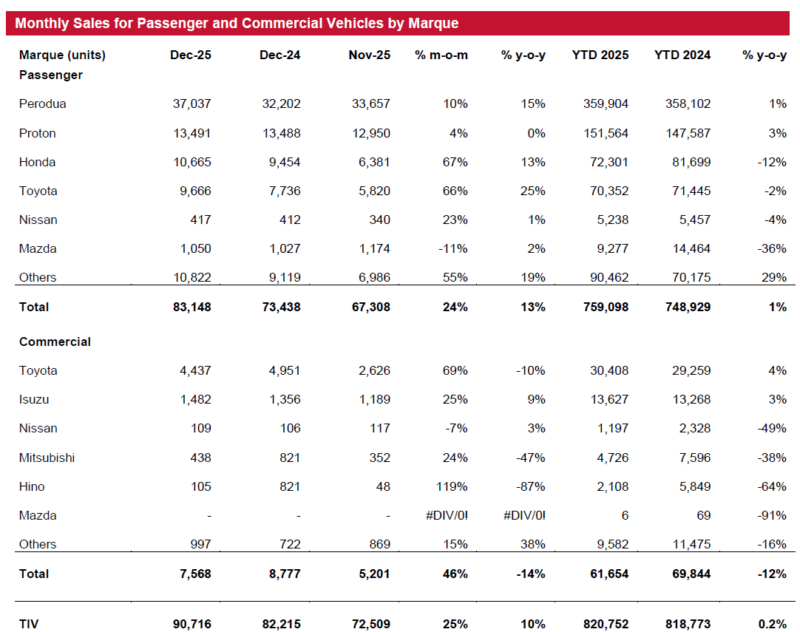
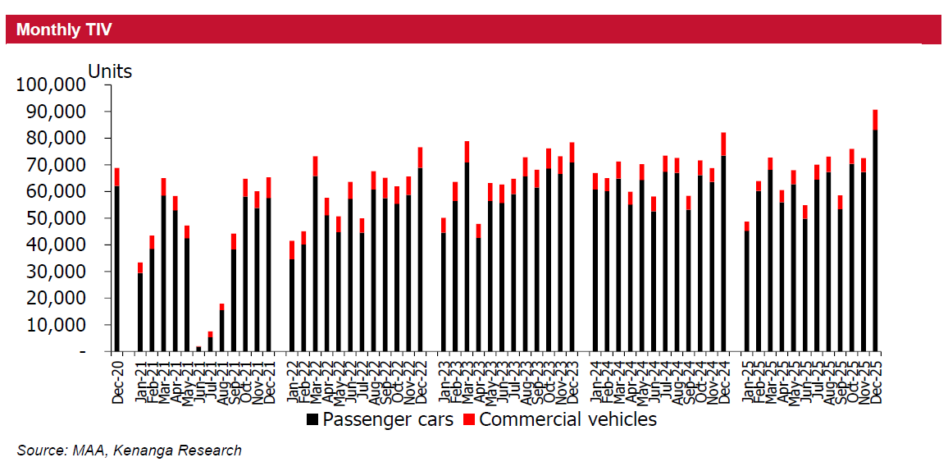
DECEMBER total industry volume (TIV) soared 25% month-on-month (MoM) and 10% year-on-year (YoY) (record high monthly sales) driven by the ending of electric vehicle (EV) complete built up (CBU) incentives and continuation of attractive year-end promotional campaigns.
TIV at the end the year stood at a record high of 820,752 units (+0.2%) which is in-line with Kenanga’s contrarian estimate of above 800k units for 2025, also in-line with the recent revised estimate by MAA of calendar year 2025 (CY25) TIV to exceed 800k units.
MAA attributes the performance to robust economic growth (GDP of +4.7% in first three quarters of 2025), strong domestic demand, recovering exports, favourable financing (2.75% OPR since July), socio-political stability, 2.9% unemployment rate (an 11-year low), strong order backlogs especially in the A-segment, rise of EV (+109%), and aggressive promos.
“Following a record performance, we expect TIV for 1QCY26 (January-March 2026) to weaken as automakers and consumers take a breather preparing for the coming triple festive period (Thaipusam, Chinese New Year and Hari Raya Aidilfitri),” said Kenanga.
For CY26 as a whole, MAA forecasted TIV to decline to 790k units (-4%) due to several factors, including rising cost of living that is outpacing the Ringgit’s strength, and reducing disposable income, leading to weaker purchasing power.
“On the other hand, we project a TIV of 725K units in 2026 (-12% YoY) as a reflection of the trend in CY15 when TIV reach a peak, then fell 13% post-GST tax holiday,” said Kenanga.
Kenanga expects gradual transition to BEVs which currently enjoys tax exemption up until 2027 for locally-assembled complete knockdowns (CKD)s.
Looking further, Kenanga also has a nuanced view of EV adoption eventually picking up and gasoline vehicles demand will eventually peak, but they do not think that will happen in the next five years due to infrastructure challenges.
“This new petrol subsidy mechanism, in our view, could make the transition even slower than earlier expected as the middle- and lower- income group now have less incentive to switch from ICE to EV for the time being,” said Kenanga.
Recall that, the new registration for BEVs leapt from 274 units in CY21 to over 3,400 units in CY22, 13,301 units in CY23, and 21,789 units in CY24, or 3% of TIV.
In the latest announcement, the BEV registration for Jan-Nov 2025 is at 36,690 units, far surpassing CY24 numbers, which were mostly driven by CBU models.
Malaysia aims for electric vehicles to represent 20% of new vehicle sales by 2030, with longer-term vision extending to 80% by 2050, including hybrid vehicles.
The government is currently focused on building out the EV ecosystem, including establishing 10,000 public charging points with the current number of proposed charging stations currently at 4,477 (5,149 built-to-date) and providing tax incentives to stimulate adoption and local production. —Jan 21, 2025
Main image: Spanar Boy