

MALAYSIA’s advertising expenses (adex) landscape continues to shift decisively toward digital channels, underpinned by rising social media engagement and advertisers’ increasing preference for programmatic, data driven ad buying across internet search platforms.
According to MAGNA, digital media accounted for 77% of total Malaysian adex in 2024, led by social media (41%), search (24%), and other digital channels (12%).
Looking ahead, MAGNA forecasts Malaysia’s total ad revenue to rise 6.4% year-on-year (YoY) in 2025 to RM9.54 bil (2024: 8.4%), driven by continued strength in social media (+11%) and search advertising (+8%).
These gains are expected to offset ongoing declines in traditional media (TV: –3%, print: –7%, radio: –6%). Over the longer term, by 2029, MAGNA expects digital media to expand its market share to 85% of total adex (2024: 76%), while television’s share narrows to 5% (2024: 8%).
“We believe this reflects digital media’s superior reach, engagement, and targeting precision,” said Kenanga.
Social media enables brands to deliver personalised, interactive, and emotionally resonant content. Meanwhile, search advertising captures high-intent demand at the point of purchase decision, resulting in superior conversion efficiency.
Moreover, AI-driven programmatic tools and real-time analytics further enhance campaign optimisation and ROI, reinforcing digital media’s structural advantage over traditional media’s broad but largely passive reach.
Traditional media operators in Malaysia continue to have a relatively small footprint in digital advertising.
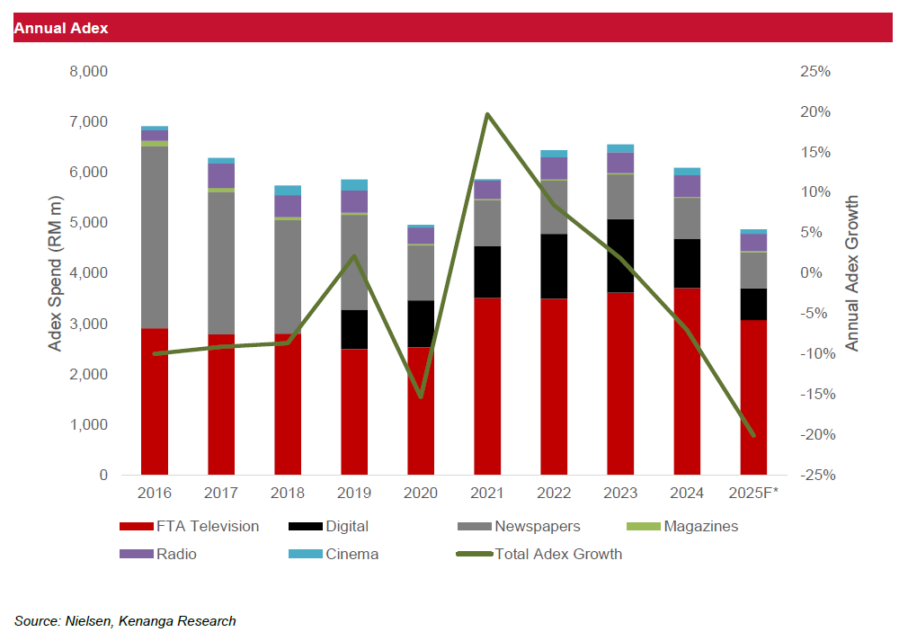
Their digital monetisation offerings are largely confined to basic display formats, such as banner advertisements and video placements on their respective websites.
This highlights a lag amongst traditional operators in offering more sophisticated digital advertising solutions vis-à-vis digital native players such as FOODIE.
“We commend MEDIA’s progress in broadening its digital presence, via REV Media group, relative to other traditional media players,” said Kenanga.
The group commands a sizeable digital audience, comprising 140 mil social media followers and has amassed 3.5 bil video views.
Nonetheless, digital adex remains modest, accounting for just 11% of quarter one of financial year 2026 (1QFY26) revenue. This reflects substantial untapped potential and a significant gap versus digital-native competitors.
Meanwhile, ASTRO has recently invested in a newly launched digital marketing venture, KULT. While still in its early stages, KULT is intended to re-engage previously lapsed advertisers seeking digital-first solutions, thereby extending ASTRO’s relevance beyond traditional broadcasting.
At present, however, digital adex remains immaterial, contributing only 2% of the group’s total adex in the nine months of financial year 2026.
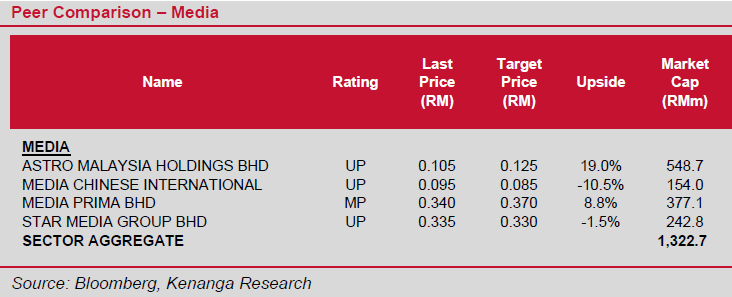
“We reiterate our UNDERWEIGHT rating on the media sector, as profitability continues to be eroded by rising competition from digital-native players and cost drag from legacy infrastructure,” said Kenanga.
Although recent initiatives such as workforce optimisation, AI-led efficiency improvements, and selective asset impairments have helped cushion losses, these measures have not
resulted in sustainable turnaround of losses or earnings recovery.
“In our view, the sector requires more transformative or radical shifts, including regional expansion, mergers and acquisitions, divestiture of non-core businesses, or a holistic pivot
toward scalable IP ownership. We do not have any stock picks for the sector,” said Kenanga. —Jan 6, 2025
Main image: twofour54