
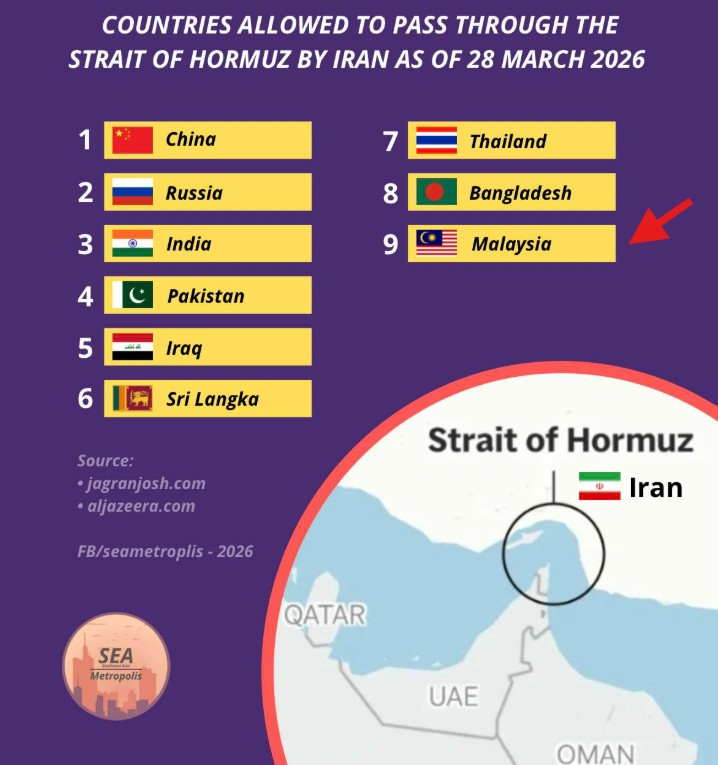
IRAN has reportedly granted limited permission to vessels from “friendly” nations to pass through the Strait of Hormuz amid tensions sparked by the US-Israel attack on Tehran.
This latest policy follows a previous closure of the waterway that disrupted global energy supplies. Priority access was given to countries not directly involved in disputes with Iran.
However, strict restrictions remain in place for countries considered hostile. This indicates that Iran is now using its control over the Strait of Hormuz as a geopolitical bargaining chip beyond simply as a crucial trade route.
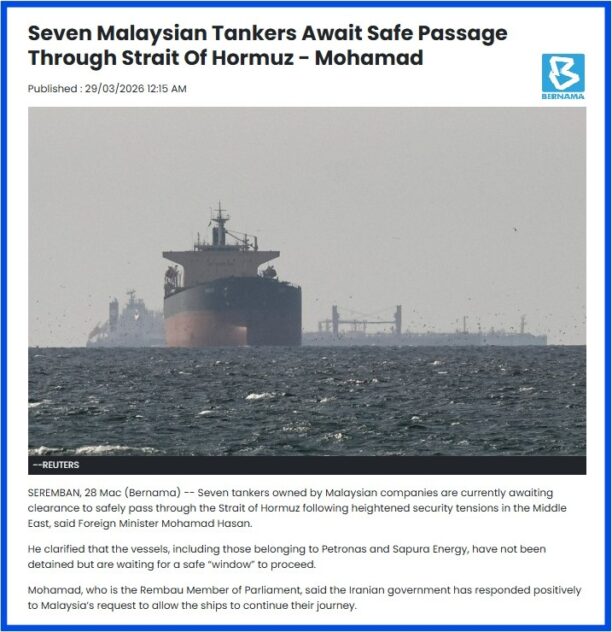
Foreign Minister Datuk Seri Mohamad Hasan has recently clarified that seven Malaysian-owned tankers were awaiting clearance – as opposed to having been detained – to safely pass through the Strait of Hormuz following heightened security disruption in the Middle East,
According to the Rembau MP, the vessels, including those belonging to PETRONAS and Sapura Energy (now Vantris Energy Bhd), were waiting for a safe “window” to proceed.
He clarified that the vessels, including those belonging to Petronas and Sapura Energy, have not been detained but are waiting for a safe “window” to proceed.
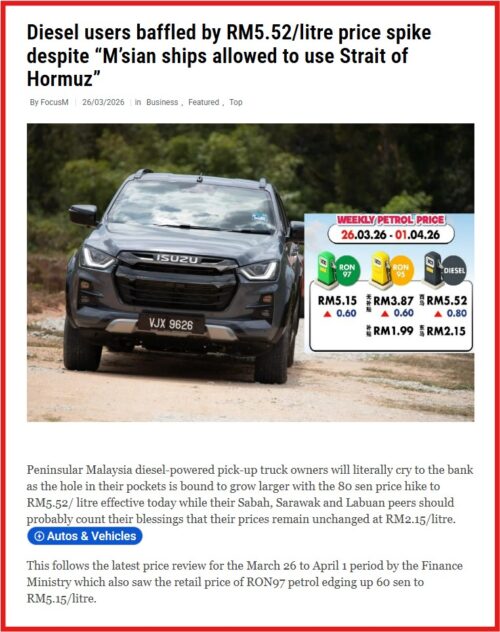
While the fruitful diplomacy of Prime Minister Datuk Seri Anwar Ibrahim is welcome, Malaysians should at best refrain from over-rejoicing that the steep record high non-subsidised diesel and RON97 price – currently at RM5.52/litre and RM5.15/litre respectively – would head south to a more affordable level in due course.
There are at least four ‘realities of life’ that they should pay heed to:
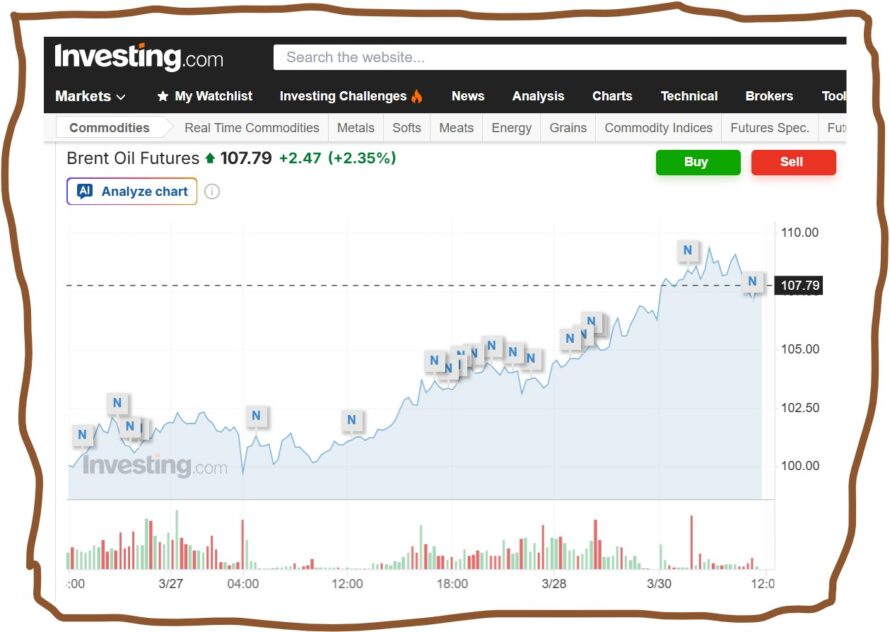
#1 – Highly volatile Brent crude oil price: At the time of writing, global oil prices have soared as Yemen’s Houthis fired missiles at Israel and US President Donald Trump reportedly wants to seize Iran’s oil, thus deepening concerns over escalating risks to Middle East energy flows.
Citing data from LSEG, CNBC has reported that May futures for the Brent crude rose over 3.2% to US$116.12/barrel during early Asia hours with the international benchmark heading for a record monthly jump.
#2 – The “war zone” insurance premium: Even if Iran promises not to pull the trigger, the global insurance market does not trade on promises. The Strait of Hormuz is currently classified as a High-Risk Area (HRA).
When a tanker enters these waters, “war risk insurance” kicks in. In the last week of March 2026, these premiums have surged by over 400%.
Whether the ship belongs to MISC Bhd or a global giant, the cost to protect that cargo has spiked. That cost is baked into every drop of fuel you pump in Subang or Shah Alam.
(Source: Carz AUTOMEDIA)
#3 – Malaysia is an oil producing nation yet a “net oil importer”:
This may sound confusing to many layman Malaysians who still assume that their motherland is an oil producing nation as they had once picked up during their school geography lessons.
The truth is that Malaysia has since 2022 become a net oil importer despite being an oil producer because its domestic refineries are designed for heavy, cheaper crude oil whereas most of its own production is light, premium oil sold abroad for higher profit (for use as aviation/shipping fuel or in petrochemical products).
While producing around 570,000 barrels/day, domestic demand exceeds this, thus forcing higher imports of oil – of which 50% pass through the Strait of Hormuz – to meet consumption, inevitably making the nation vulnerable to global prices.
#4 – Meteoric spike in subsidy bill for RON95/diesel for Sabah & Sarawak: As many diesel-powered pick-up trucks lay idle as their owners switch to their RON95-run sedans, those long-distance travellers should be wary of exhausting their monthly BUDI95 quota which will be reduced to 200 litres (from 300 litres) effective Wednesday (April 1).
Even though, PMX who is also the Finance Minister has vouched that 90% of BUDI95 car owners pump less than 300 litres monthly, the bigger picture seems to be on the government’s subsidy bill which has spiralled to a staggering RM3.2 bil in just seven days of this month from RM700 mil previously.
“The Math: If you drive a 1.5L SUV and commute 50km daily, you will likely burn through that 200-litre by the third week of the month. After that, you aren’t paying the “special deal” price; you’re paying the RM3.87/litre war-market price (for non-subsidised RON95),” cautioned Carz AUTOMEDIA. – March 30, 2026
Main image credit: SEA Metropolis/Facebook