


FOR years, Malaysian companies have been free to define profit however flatters them best. That freedom ends in 2027.
A new accounting rulebook forces every listed company to present earnings the same way – and to show its workings on any adjusted figure in an audited note.
The clock has started already – not in 2027. Anyone who sits on a board, signs off on accounts or invests based on them should read on before the next set of results is drafted.
An accounting standard is simply a rulebook. It tells every company how to lay out its results, so a reader can trust that profit means roughly the same thing whether it is written by one company or another.
Replacing the rules used for over two decades, MFRS 18 is Malaysia’s version of a new global rulebook for how a company’s profit and loss statement must be organised.
To be precise, this does not change how much money a company made. Net profit or the bottom line stays the same.
What changes is the presentation: which items sit together, what they are called and how much a company must explain about the adjusted figures it chooses to show investors.
Every company must now pack its results into the same standard envelope with the same labels, hence what is inside can finally be compared side by side.
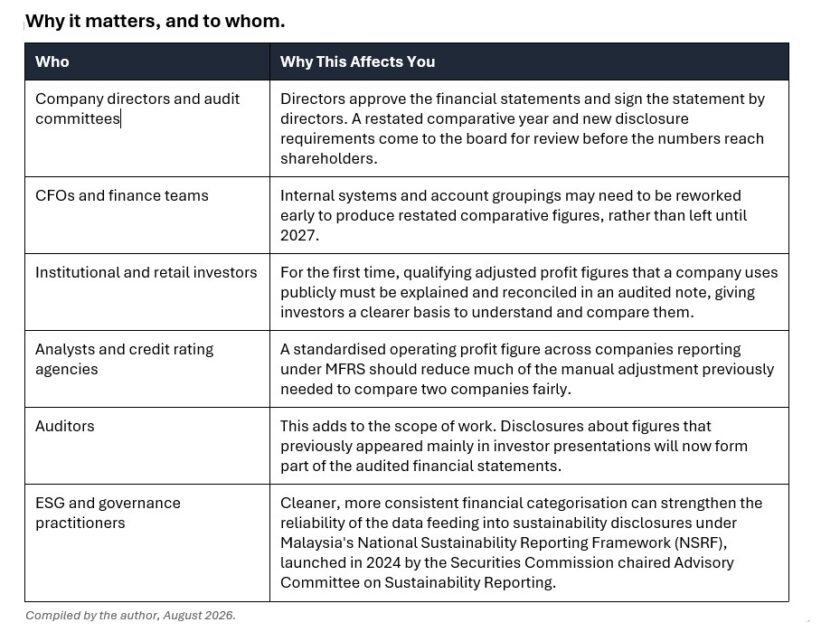
The real target: Management’s own numbers
The part of this rule that matters most to everyday investors is what it does to figures such as adjusted EBITDA (earnings before interest, taxes, depreciation and amortisation) or core operating profit which is sometimes called management defined performance measures (MPMs).
An MPM is simply a company’s own version of profit, a subtotal it creates and promotes itself rather than one defined by the accounting standard. Until now, these figures have lived largely outside audited scrutiny.
A simple example makes this concrete. Suppose a company reports a statutory net profit of RM50 mil, the audited figure is calculated the same way every year.
In its investor presentation, the same company also shows an adjusted EBITDA of RM58 mil which is arrived at by adding back RM8 mil in restructuring costs it considers one off.
Both figures are real. But only one of them, which is the RM50 mil has been checked by an auditor. Under MFRS 18, that RM8 mil adjustment must now be set out – line by line, reconciled and audited – in a dedicated note.
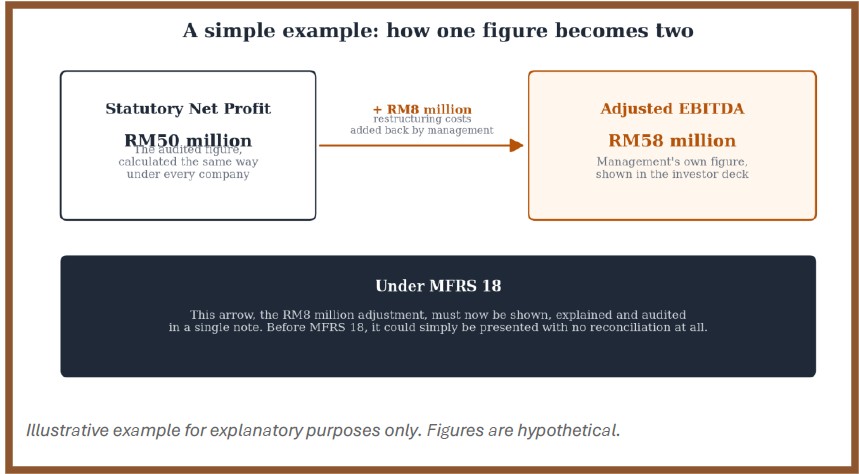
The real impact is not whether a company can show the higher figure. It is whether that figure can survive being reconciled and audited every year.
A genuine, one-off adjustment gains credibility once reconciled. The same adjustment repeated year after year becomes far harder to defend.
There is one more layer to this. Under MFRS 18, showing the gross RM8 mil alone is not enough either.
A restructuring cost reduces taxable income, hence at Malaysia’s standard corporate tax rate of 24%, that RM8 mil actually carries a tax saving of about RM1.92 mil, thus leaving a net after tax impact of roughly RM6.08 mil.
Companies must now show this tax effect for each adjustment, not just the headline figure.
This is not a new idea globally as company reporting in the US have disclosed tax effected adjustments for years under securities regulation. As such, MFRS 18 simply brings Malaysia into line with that practice.
What this means
The rules behind this change are detailed. They define exactly which category every item of income and expense must sit in, introduce new compulsory subtotals and set out precisely how last year’s figures must be re-stated before the new format even takes effect.
Boards, auditors and finance teams need that level of detail. For everyday readers, the takeaway is simpler.
Before this rule, companies were free to group their results however suited them best and to promote their own version of profit with no obligation to show their workings.
From 2027, that freedom ends. And because the change must be applied backward, the 2026 financial year currently being reported is already the comparative period that must be re-stated.
None of these changes how much money a company actually made. What it changes is how much a company can present – unquestioned – the number that matters.
An earlier generation of standard setters gave companies that flexibility, trusting it would be used to inform rather than to flatter. Over three decades, that trust wore thin.
This new rule does not accuse anyone of wrongdoing. It simply closes the room where the argument could happen and it makes 2026 – not 2027 – the year that matters most. – Sept 22, 2026
Aida Lim Abdullah has more than 30 years of experience in a variety of organisations and institutions ranging from audit firms, conglomerates, digital & fintech financial institutions, GLCs to regulators such as Bursa Malaysia Bhd and the Securities Commission Malaysia (SC).
The views expressed are solely of the author and do not necessarily reflect those of Focus Malaysia.