

HISTORY does not seem to side of Malaysia’s real estate sector when it comes to the raising of the overnight policy rate (OPR): do expect transaction volume to fall in tandem with interest rate hikes.
Based on historical data since 1991, RHB Research observed that transaction volume typically falls when the average lending rate is revised up and vice versa.
“Essentially, this means that transaction volume or housing demand will likely fall when Bank Negara Malaysia (BNM) raises the OPR progressively over the next two years,” opined analyst Loong Kok Wen in a real estate sector update.
“The extent of the decline (in demand) would also depend on whether the economic growth trajectory remains intact. Any slip in GDP (gross domestic product) growth could worsen the drop in housing demand.”
Raising interest rates will likely be the main monetary policy tool for many central banks over the next six to12 months as global inflation worsens. Locally, RHB Research expects one more OPR hike in the remainder of 2022 after yesterday’s (July 6) 25 basis points (bps) hike and possibly two more increases in 2023.
“This should bring the OPR to around 2.75-3% by the end of next year while mortgage rates may reach 4.1-4.15% by end-2023 from 3.1-3.15% currently,” projected the research house.
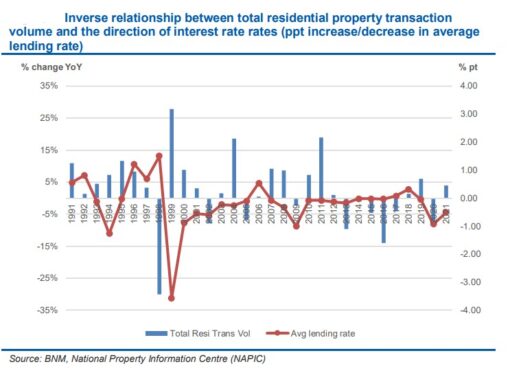
Nevertheless, assuming that the Malaysian economy continues to recover (RHB’s current GDP growth forecasts for 2022-2023 being 5.3% and 4.5%), the research house reckoned that the decline in demand for property may still be relatively moderate as mortgage rates by end-2023 would still be comparatively lower than the 4.5%-4.6% levels recorded five years ago.
“Also, home buyers should be able to adapt to the higher interest rate environment over time,” suggested RHB Research.
“However, as the risk of a recession emerging in the western countries is growing – although the potential downside risk to economic growth may delay the speed of interest rate hikes – demand for property will still be negatively affected as unemployment rates may rise.”
According to the research house, its cautious outlook on the property sector is due to the fact that year-to-date (YTD) impairment on residential mortgages is up 14% year-on-year (yoy).
“Home buyers tend to be more sensitive to rate hikes amid an inflationary environment as every 25bps hike in the OPR will lead to a 3.2%-3.5% rise in monthly mortgage repayments,” RHB Research pointed out.
“Expect house prices growth to be flat. Growth prospects for this remain tepid as the demand for property and market sentiment are typically sensitive to various economic factors.”
Notwithstanding this, the persistent supply glut has already capped the house price increase over the past four years with the overhang issue will likely stay put longer as unstable economic growth will affect the speed in unwinding unsold units. – July 7, 2022