

THE global semiconductor industry continues to enjoy a strong upcycle, supported by resilient demand from high-growth segments, particularly artificial intelligence (AI) and the ongoing expansion of data centre infrastructure.
Data from the Semiconductor Industry Association showed that worldwide semiconductor sales climbed to US$120.6 bil in May 2026, marking a 9.2% increase from the previous month and a 104.1% jump compared with the same period a year earlier.
This marked the 31st consecutive month of year-on-year sales growth. Meanwhile, the global semiconductor sales for 5M2026 increased 77.4% YoY to USD502.1 bil.
The continued expansion of data centre infrastructure, particularly to support generative AI workloads, has driven robust demand for high-performance logic chips and high-bandwidth memory, which together account for more than half of global semiconductor sales.
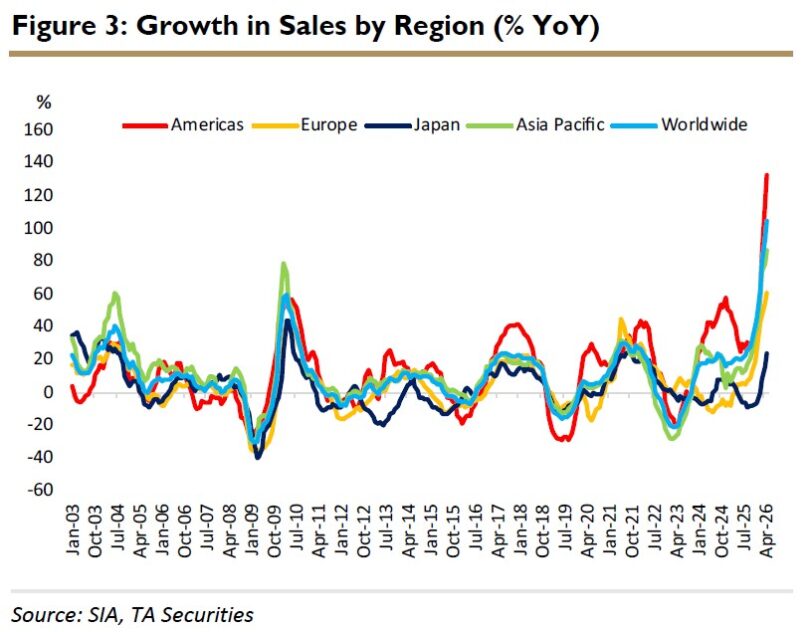
The strong YoY growth was broad-based across all regions, led by the Americas (+132.2%), followed by Asia Pacific/All Other (+118.9%), China (+88.8%), Europe (+60.7%), and Japan (+23.8%).
Looking ahead, TA Securities (TA) believes the semiconductor industry’s positive momentum will continue, driven primarily by sustained demand for artificial intelligence (AI) applications.
While global semiconductor sales are expected to maintain solid growth on the back of AI-related spending, the research house remains cautiously optimistic about Malaysia’s semiconductor sector.
It expects the recovery to vary across different segments, with companies serving AI and data centre infrastructure markets likely to outperform.
On the other hand, chipmakers that rely heavily on traditional end markets, including personal computers and smartphones, could continue to face a more difficult business environment.
TA Securities added that although manufacturers may be able to pass higher memory costs on to customers, the resulting increase in product prices could soften consumer demand and ultimately limit shipment growth.
On top of that, geopolitical tensions and the potential strengthening of the ringgit remain key risks that could weigh on the sector’s growth prospects.
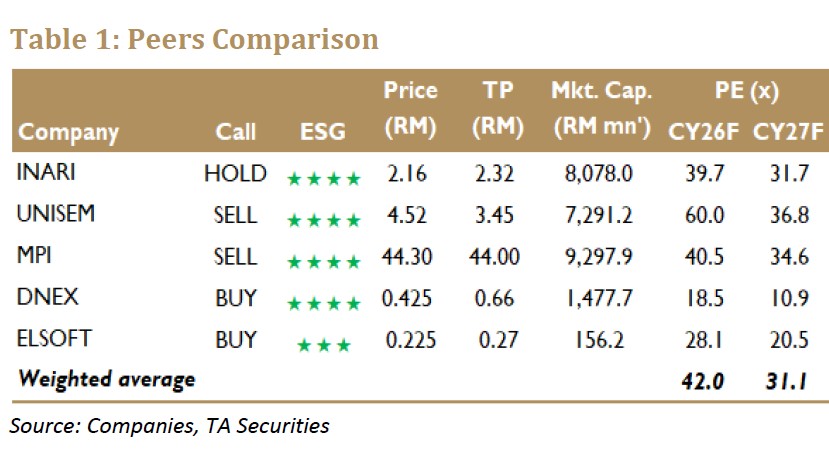
“All in all, we maintain our NEUTRAL stance on the semiconductor sector,” said TA.—July 14, 2026
Main image: simon-kucher.com