
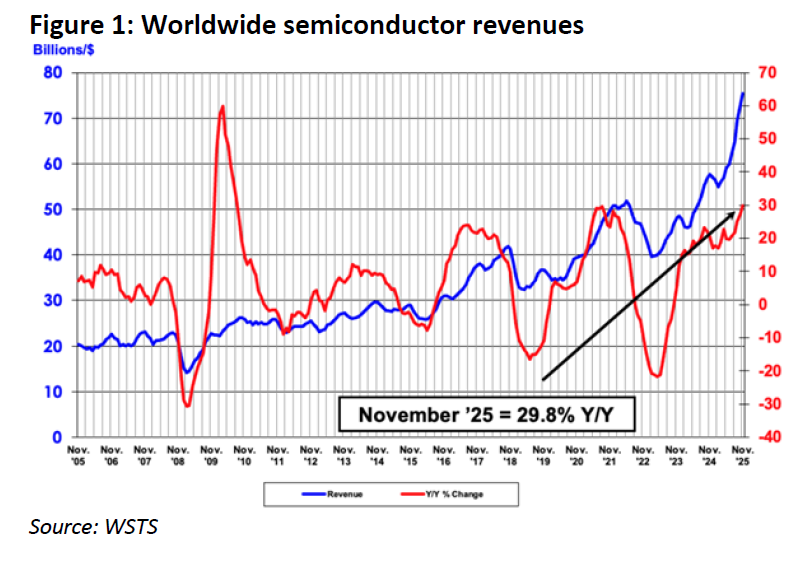
THE Semiconductor Industry Association (SIA) announced that the global semiconductor sales (GSS) came in at USD75.3 bil for the month of November 2025.
This represents an improvement of +29.8% year-on-year (yoy) and +3.5% quarter-on-quarter (qoq).
Inclusive of this, the monthly GSS has been on an upward trend for 25 consecutive months, leading to November 2025 being the highest monthly sales recorded.
“According to SIA, higher demand was seen across all major product categories on a month-to-month basis. This was supported by AI-related applications and continued demand in computing and data centre infrastructure,” said MBSB Research.
Moving forward, SIA commented that “the global chip market is projected to grow substantially in 2026, reaching nearly USD1 tri in annual sales”.
To recall, in December 2025, the World Semiconductor Trade Statistics (WSTS) projected the global semiconductor market to grow by +26.3% yoy to USD975.5 bil, led by memory and logic.
At the recently concluded Consumer Electronic Show (CES) 2026, which is one of the world’s largest technology trade shows, Nvidia led the stage with the launch of its next-generation Vera Rubin superchip.
This set to replace the Blackwell architecture in the second half of this year. Apart from speed and storage upgrade, it is interesting to note that the Vera Rubin platform features a 100% liquid-cooled system that uses warm-water cooling system.
This removes the need for energy-intensive traditional chillers in data centre which is a major boost to energy efficiency.
Apart from Nvidia; Intel, Qualcomm and AMD also launched their respective new chips which is targeting the laptop market. Intel launched its news latest laptop, Panther Lake using its new 18A manufacturing technology, which uses a smaller, more advanced design to deliver faster performance with less battery power.
Qualcomm also announced the Snapdragon X2 plus which is designed to bring high-end AI performance to more affordable laptop. Meanwhile, AMD introduced Ryzen AI Max+ which enables the laptop to run extremely large AI models entirely on the device. This could potentially provide some support to the ailing PC sales.
There is also an emphasis on physical AI, especially humanoid robots doing human-centric tasks. Some notable robots showcase include Atlas by Boston Dynamics which is meant for industrial application and CLOiD by LG to help out which common house chores.
“We view that while there could be near-term limitation whereby the use cases are constrained to certain scope and/or environment, it also shows that the technology is closer to mass commercial deployments,” said MBSB.
Thus, having presence in the supply chain of physical AI and robotics space would prove to be an accretive move, especially for our local semiconductor companies.
Notably, ARM holdings (ARM) has also set up a Physical AI business unit. This unit will look to develop technologies that combine AI and real-world physical movement, from vehicles to robots to autonomous machines.
“We do not discount the possibility that this could have positive spillover effect on the local front. To recall, in March 2025, Malaysia formed a RM1.1 bil partnership with ARM to shift Malaysia’s semiconductor industry from assembly/testing to higher-value front-end design,” said MBSB. —Jan 16, 2025
Main image: T_HQ