

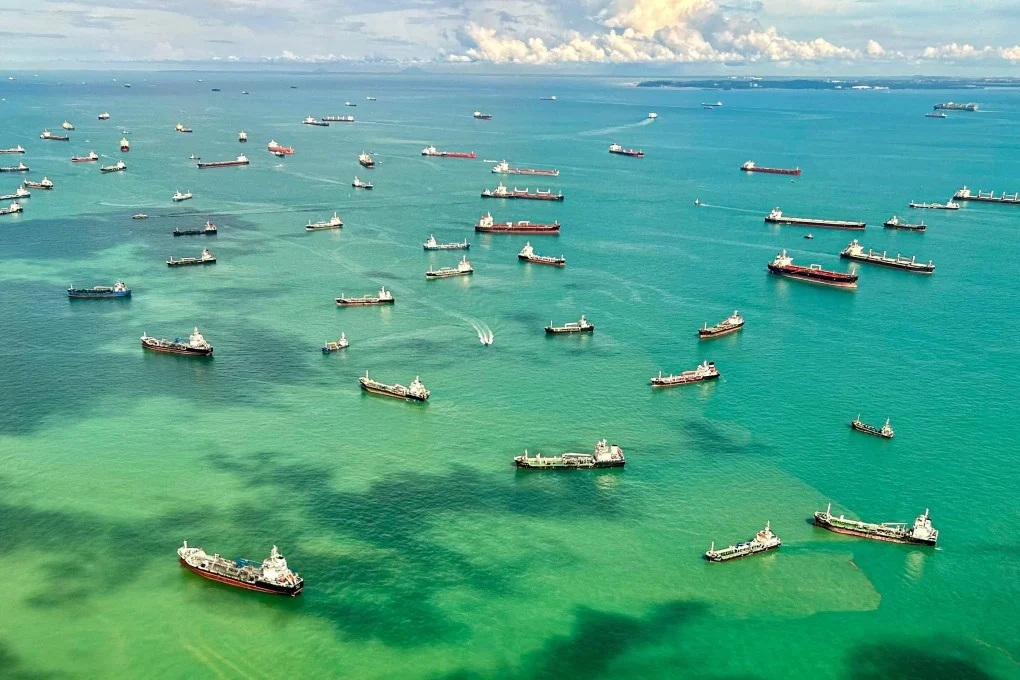
ESCALATING TENSIONS in the Strait of Hormuz have placed greater focus on the vulnerability of major global shipping routes.
As concerns over maritime security grow, market attention is increasingly turning to the Strait of Malacca, a vital passage much closer to home.
The Strait of Malacca plays a central role in international trade, serving as the most direct and cost-effective shipping corridor linking the Indian Ocean with the South China Sea.
Spanning roughly 900km to 930km between Peninsular Malaysia and Indonesia’s Sumatra island, the strait connects major economic zones across Europe, the Middle East, South Asia and East Asia. It also functions as a key maritime route for trade flows between large economies such as India and China.
Data from the Malaysia Maritime Department showed that vessel traffic through the strait continued to climb, with over 102,000 ships recorded in 2025 compared with 94,300 in 2024, highlighting the steady growth in global commerce and deeper regional supply chain integration.
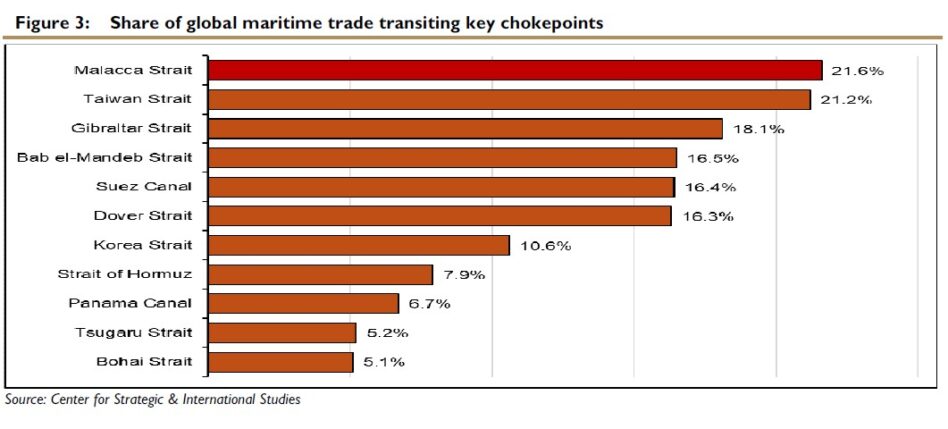
Situated within the waters of Malaysia, Indonesia, Singapore, and Thailand, the Strait of Malacca handles nearly 22% of global maritime trade. Its significance is even more pronounced in energy markets.
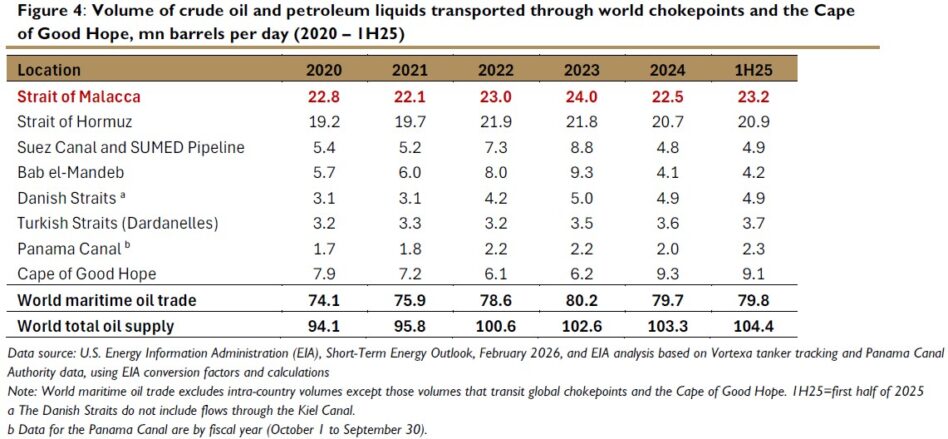
According to the US Energy Information Administration (EIA), it is the world’s largest oil transit chokepoint, carrying approximately 23.2mn barrels per day in the first half of 2025 — equivalent to roughly 29% of global seaborne oil flows, surpassing even the Strait of Hormuz.
Crude oil accounts for slightly more than 70% of total oil volumes transiting the Strait of Malacca, with the remainder made up of refined petroleum products.
The US is also part of these flows, exporting around 800,000 barrels per day of crude and condensates to East Asia via the strait.
Beyond oil, the strait is also a key conduit for liquefied natural gas (LNG), with approximately 9.2bn cubic feet per day transiting in 1H25.
A central question surrounding the Strait of Malacca is who actually controls it. Although it lies within the territorial waters of Malaysia, Indonesia, and Singapore — each exercising sovereignty over its respective portion— this does not grant any single country ownership over the entire waterway.
Looking ahead, emerging infrastructure developments may gradually reshape regional trade dynamics without immediately displacing the strait’s dominance.
Thailand’s proposed land bridge project — linking the Gulf of Thailand and the Andaman Sea via a 90-kilometre multimodal corridor between Ranong and Chumphon —aims to provide an alternative route between the Indian and Pacific Oceans.
By potentially reducing transit time by around four days and lowering logistics costs by 10–15%, the project could evolve into a credible strategic complement over the medium to long term, with construction expected to span 2026 to 2039.
While near-term impact is likely to be limited, the project could generate positive spillovers for Northern Malaysia — particularly Perlis, Kedah, and Penang.
At the same time, it may introduce competitive pressures on key Malaysian gateways such as Port Klang and the Port of Tanjung Pelepas.
Nevertheless, given the scale, efficiency, and entrenched role of existing shipping routes, the Strait of Malacca is expected to remain a resilient and indispensable artery of global trade. —May 6, 2026
Main image: South China Morning Post