

THE property market has experienced softer demand since tensions in the Middle East escalated at the end of February, with the wider equity market, including property-related stocks, also coming under pressure.
That said, rising costs are nothing new for developers. The industry has weathered repeated spikes in construction material prices and periods of acute labour shortages over the years, forcing companies to adapt and become more resilient.
As a result, many developers are now better equipped to manage these challenges. They have responded by refining their product offerings, optimising layouts and specifications, and making measured pricing adjustments.
These strategies have helped cushion the impact of higher costs while keeping buyer demand largely intact.
As such, RHB do not foresee a significant downside risk in developers’ quarter two 2026 (2Q26) net profits.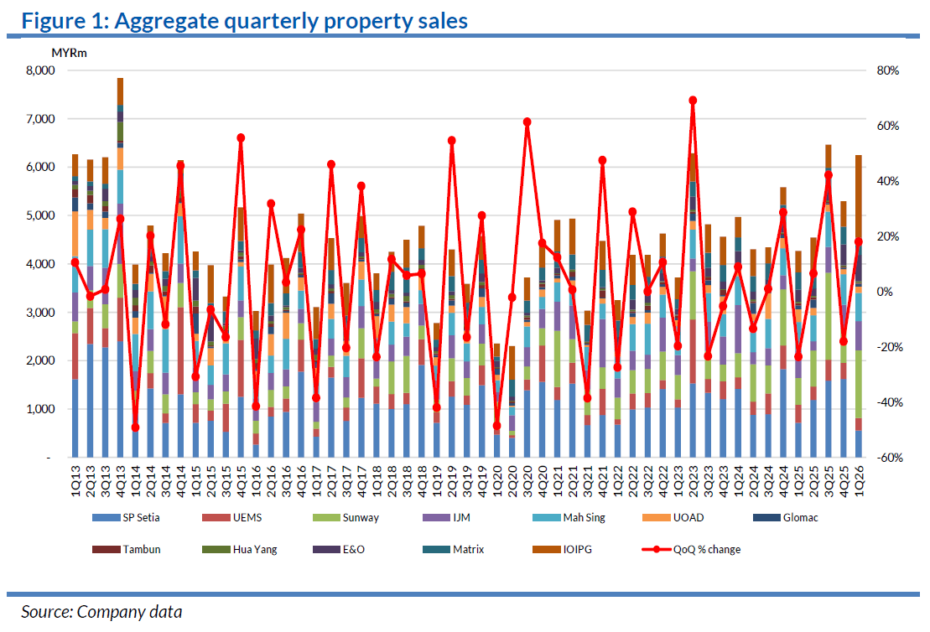
The slight weakness in margins could also be offset by the ramp-up in new launches as most launches by the major developers in 1Q26 took place in late March.
Demand still seems healthy during the quarter, especially for the industrial segment. RHB expects 2Q26 sales to be sequentially stronger, given the timing of launches in the first half (1H) this year.
Although demand has turned slightly softer, especially in the low to mid-range residential segment, we believe the softening in demand should be temporary:
1/ Developers are still reporting strong sales in the industrial segment, which suggest that local and foreign multinational corporations are still actively expanding, and therefore, job opportunities and income growth should be supported.
2/ The low- to mid-range residential segment is relatively more susceptible to changes in market conditions, and this segment is likely to see higher loan rejection.
3/ Demand in the higher-end segment remains strong, driven mainly by upgraders, investors, and foreign buyers.
“Therefore, we think that, as soon as the Middle East conflict and local political landscape stabilise, the overall demand for property will recover, especially in the mid-range segment,” said RHB.
In their view, the market may potentially interpret results for the recent two state elections as indicators for the unity government’s solidity and voter support.
This election noise may weigh on the broader equity market as well as the property sector.
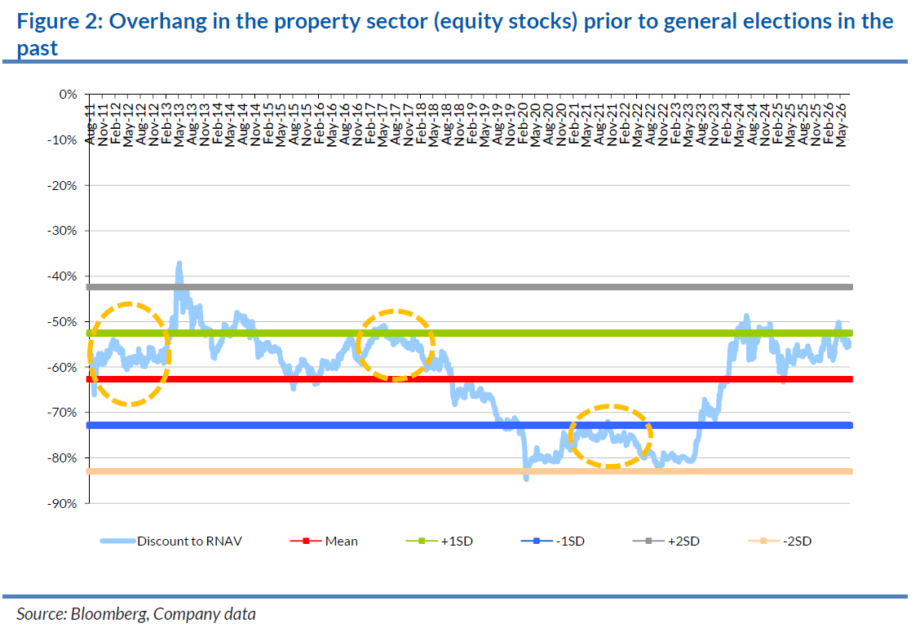
Historically, taking a cue from past experiences, General Election (GE) 13 in 2013, GE14 in 2018, and GE15 in 2022, the sector tends to range-bound 6-9 months ahead of general elections.
This is possibly due to investor concerns over some uncertainties, especially over the country’s economic policies.
“We reasonably think that it should show the same trend ahead of GE16,” said RHB.
Over the near term, RHB is more confident with the prospects of the Iskandar Malaysia property market.
Dato’ Onn Hafiz emphasised that the state government’s priority now is to continue driving the Maju Johor 2030 agenda with greater focus and effectiveness to build a more developed, prosperous, and inclusive Johor for all Johoreans.
RHB believes the Federal Government will unveil the Special Economic Zone Investment blueprint and masterplan by end of the year.
December should also see the completion of a major cross-border infrastructure network, that is the Johor Bahru-Singapore RTS Link, which should boost market sentiment and investors’ confidence on the growth prospects of the state.
Local and foreign investment interest in manufacturing and DCs is expected to remain intact, and this should continue to support demand for property, including landed homes, commercial shops, industrial land and properties and selected high-rise projects in Johor.
Major land transactions driven by DC players continue to provide RNAV re-rating for developers with sizeable landbank exposure in Iskandar Malaysia.—Aug 4, 2026
Main image: lelongtips.com.my