

MALAYSIA’S labour market remained relatively stable in June 2026, although the latest figures suggest that the pace of improvement is beginning to moderate.
The labour force was largely unchanged at 17.34 mil during the month, compared with the same figure recorded in May. The labour force participation rate also held steady at 70.9%.
On a year-on-year (YoY) basis, however, the picture was less positive. The labour force contracted by 0.5%, continuing the softer trend recorded in recent months.
This was partly due to a higher base from the stronger growth registered during the corresponding period last year.
Employment also remained broadly flat on a month-on-month basis, rising marginally to 16.83 mil in June from 16.82 mil in May.
The annual comparison was weaker, with total employment declining 0.5% YoY, compared with a 0.2% contraction recorded in May.
Taken together, the latest data suggest that Malaysia’s labour market is still holding up reasonably well, but the momentum seen earlier this year is gradually losing steam.
Meanwhile, the number of unemployed persons rose 0.9% month-on-month to 517,800 in June, up from 513,400 in May.
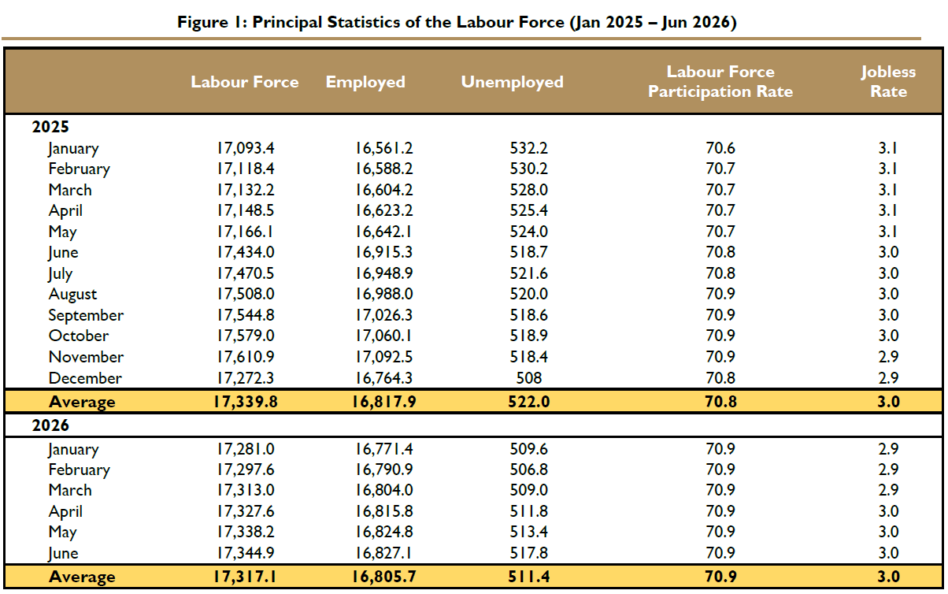
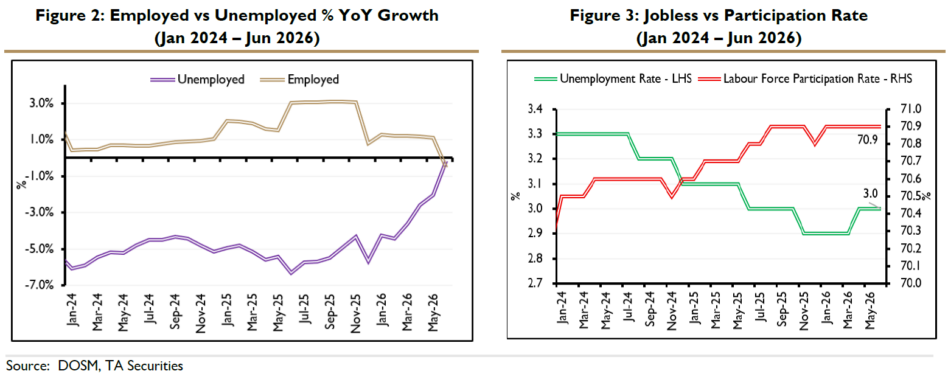
On an annual basis, the decline in unemployment narrowed substantially to just 0.2% YoY, compared with contractions of 2.0% in May and 2.6% in April.
Consequently, the unemployment rate remained unchanged at 3.0%, suggesting that the overall labour market has yet to experience a significant deterioration despite softer employment momentum.
The latest figures point to a gradual normalisation in Malaysia’s labour market following the relatively strong expansion recorded last year.
Of particular note, employment growth has steadily moderated from 1.3% YoY in January to -0.5% YoY in June, while the annual decline in unemployment has also narrowed considerably.
Although the weakness is partly due to an unfavourable base effect, the trend deserves attention as businesses may be becoming more selective in hiring amid persistent cost pressures and ongoing external uncertainties.
At the same time, demand for workers is expected to increasingly favour higher-skilled, technical and digital roles, driven by continued investments, digital transformation and the wider use of automation.
Therefore, the moderation in overall employment growth should not necessarily be interpreted as a widespread deterioration in labour market conditions.
Instead, it could also point to a changing employment landscape, with businesses placing greater emphasis on specific skills and capabilities.
Against this backdrop, reskilling and upskilling will become increasingly crucial to ensure Malaysia’s workforce can keep pace with changing industry needs and remain relevant as the economy becomes more technology-driven.—Aug 12, 2026
Main image: klsescreener.com