
GLOBAL clean energy outfit Gentari Sdn Bhd expects Malaysia to contribute between 10% and 20% of its renewable energy (RE) capacity over the next five to 10 years, underpinned by stronger domestic growth prospects and supportive government policies.
This is given that the country is expected to record much stronger growth as new RE initiatives and projects are rolled out, according to the company’s head of renewables (Malaysia and Southeast Asia) Syed Malek Faisal Syed Mohamad.
As it is, Malaysia’s improving policy and regulatory framework, including initiatives such as the Corporate Renewable Energy Supply Scheme (CRESS), Community Renewable Energy Aggregation Mechanism (CREAM), Solar for Rakyat Incentive Scheme (SolaRIS) and utility-scale Battery Energy Storage System (BESS) programme, are expected to accelerate RE growth while encouraging more investments.
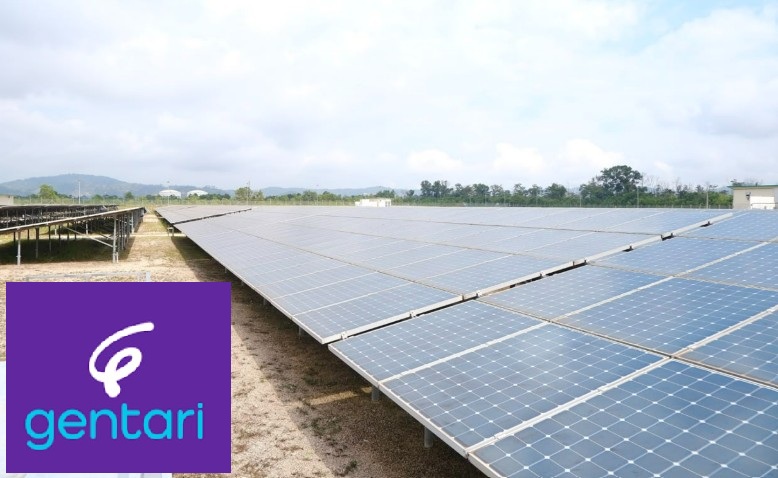
“Currently, India is our largest market. However, with the programmes like that, we can undertake more projects in Malaysia,” Syed Malek told reporters after a media visit to Voltage Renewables Sdn Bhd (VRSB) 10-megawatt (MW) solar power plant in the Gebeng Industrial Area, Kuantan.
“We are projecting much stronger growth here.”
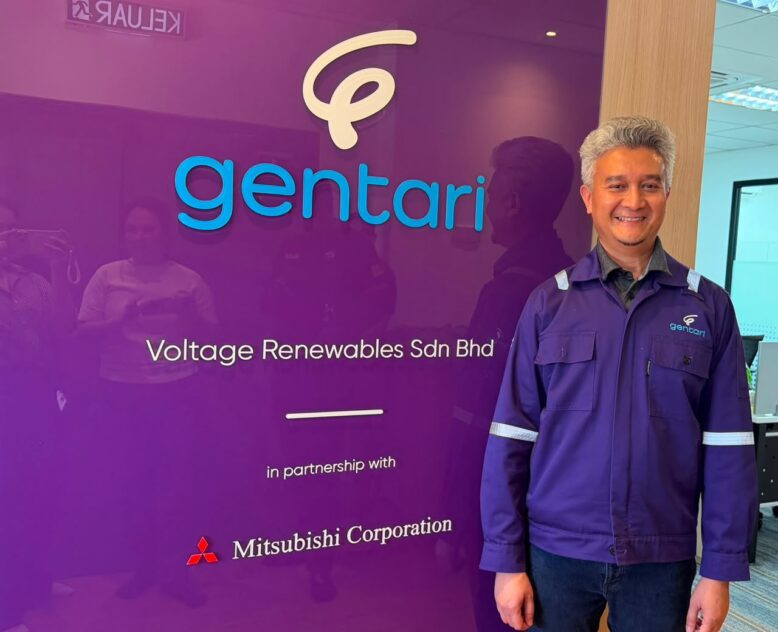
Bright prospect
According to Gentari, VGSB’s Gebeng solar power plant was commissioned under Malaysia’s Feed-in Tariff (FiT) mechanism in January 2014, hence making it one of the earliest solar power plants in Pahang.
The facility, now under Gentari’s purview, comprises 29,960 solar modules across a photovoltaic area of 50,569 sq metres.
Globally, Gentari has achieved a cumulative installed and under-construction renewable energy capacity of 9.1 gigawatts (GW).
“From Gentari’s 9.1 gigawatts of capacity that is either operational or under construction, at least 80% is currently solar,” revealed Syed Malek.
On market demand, he expects the rapid expansion of hyperscalers and data centres in Malaysia to drive significant demand for green electricity.
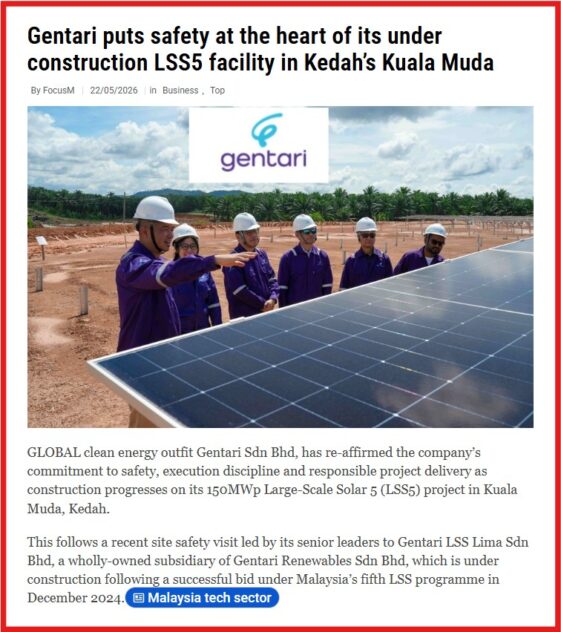
“We’re seeing significant demand coming from hyperscalers and data centres following which we’re developing several projects to support this growth,” he envisages.
Malaysia is targeting renewable energy to account for 70% of the country’s installed power generation capacity by 2050 under the National Energy Transition Roadmap (NETR).
Syed Malek further noted that solar technology is already mature with technologies such as artificial intelligence (AI) being used to improve weather forecasting and optimise solar farm management.
Malaysia is also now in a much stronger position than before in the RE sector following the introduction of various new policies and mechanisms to support the country’s energy transition agenda, he added. – June 23, 2026