

THE local construction sector continues to benefit from strong project flows, particularly from the rapid expansion of data centres and related infrastructure, even as contractors contend with elevated material costs and labour constraints.
Strong 2Q26 margins among major construction players, record investment commitments and a growing pipeline of infrastructure projects point to sustained activity ahead.
However, rising input costs and shortages of skilled workers could weigh on margins as contractors take on larger order books.
Material prices remain above pre-US-Iran war levels, forcing builders to find ways to contain costs.
Some are locking in prices for selected materials ahead of time, while sharing procurement expenses with main contractors for certain supplies.
Net margins in quarter two 2026 (2Q26) for key sector heavyweights (SCGB and KPG) remained commendable, due to the fast turnaround of data centre (DC) projects, along with the finalisation of project accounts which led to provisions being restored.
On the other hand, piling contractors such as Econpile saw margin compression on a year-on-year (YoY) basis, in light of diesel costs –bringing its net margin to 3.2% in 2Q26 from 10.5% a year ago.
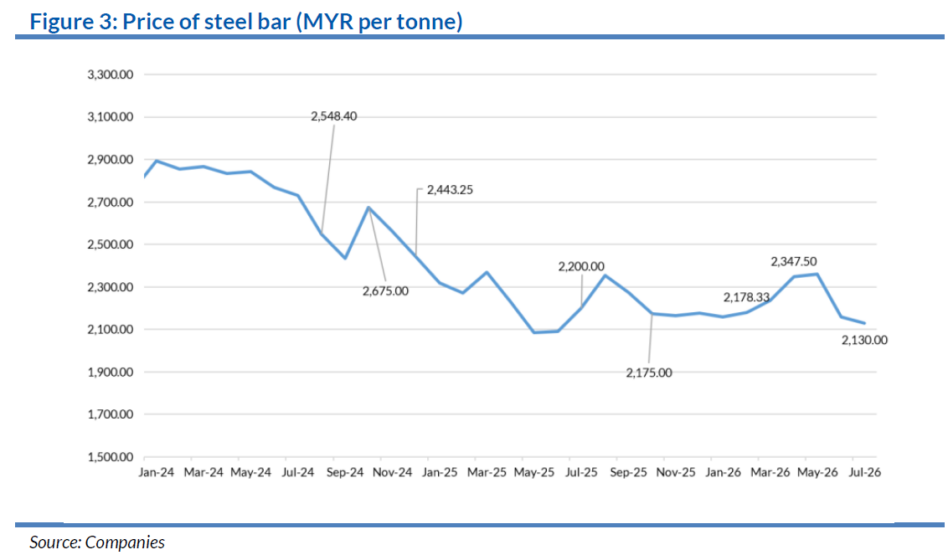
Steel bar prices dropped by 9.5% YoY in July to reach MYR2,130 per tonne, the lowest since Jun 2025.
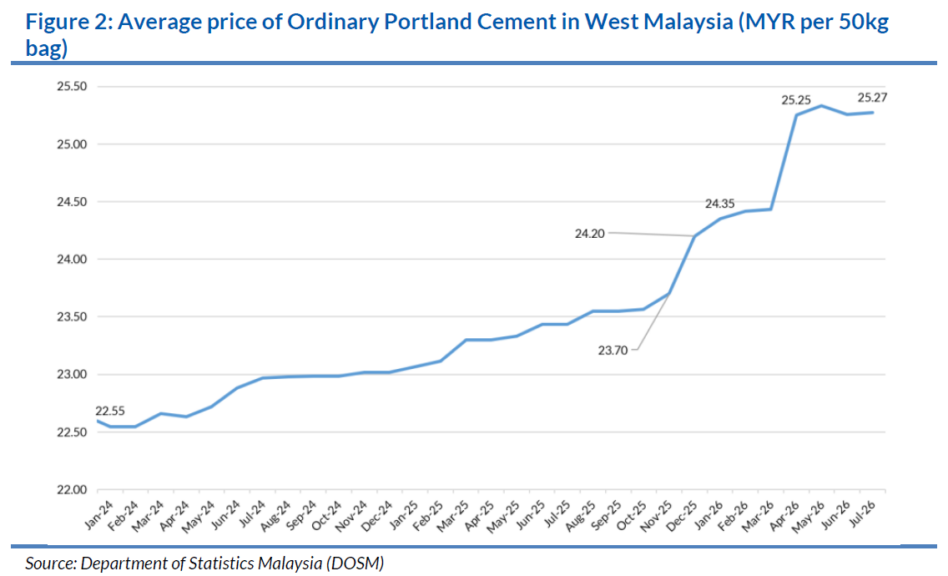
Average bag cement prices in West Malaysia rose 8% YoY in July to MYR25.27 per 50kg bag while we observed there are some contractors which are still able to procure at prices between MYR22-24 per 50kg bag.
Total approved investments in Malaysia of MYR218.5 bil (+11.7% YoY) in the first half of 2026, with 44% coming from DC and artificial intelligence related projects.
According to Cushman & Wakefield, Johor has a DC pipeline of 2,486MW that may translate to a potential construction value of MYR49.7 bil.
Separately, the proposed US restrictions on China-made data centre components could further encourage companies to adopt a China+1 strategy.
Manufacturers of sub-components based in China may look to relocate some production, with Malaysia potentially benefiting as they seek to establish manufacturing operations outside China.
At the same time, rising investments in data centres and cloud infrastructure could create wider spillover benefits across the semiconductor supply chain.
This may translate into stronger demand for industrial properties and, in turn, create more employment opportunities.
For instance, the value of industrial property transactions in states such as Penang and Johor have grown 68% and 33% YoY in 1Q26 based on data from the National Property Information Centre.
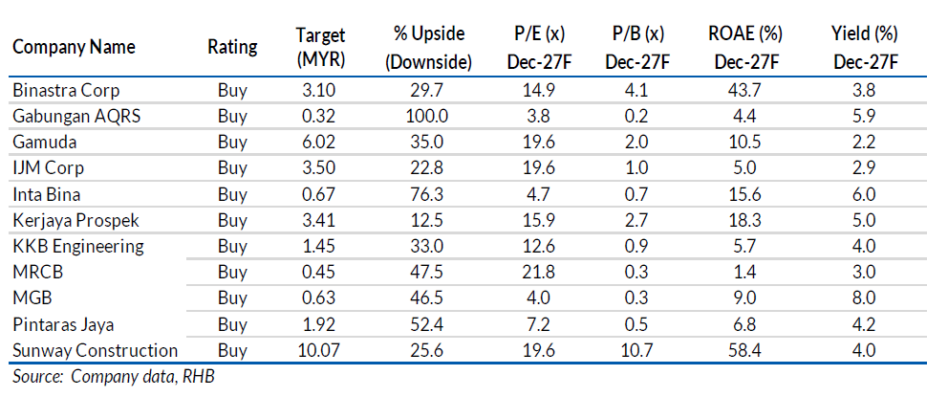
“As such, we view the growth to keep contractors busy as infrastructure project awards reach MYR33 bil for 8M26 vs 2025’s full-year figure of MYR58.7 bil,” said RHB.
Several infrastructure projects are expected to move into focus in the near term, including Segment 2 of the Penang LRT, which will link Macallum with Penang Sentral and is estimated to be worth RM4 billion to RM5 billion.
Another project on the radar is the proposed East Coast Rail Link-Port Klang extension, with an estimated value of RM600 million to RM900 million.
However, contractors could face continued pressure from elevated material costs and labour shortages, particularly as their order books continue to expand.—Sept 3, 2026
Main image: information-age.com