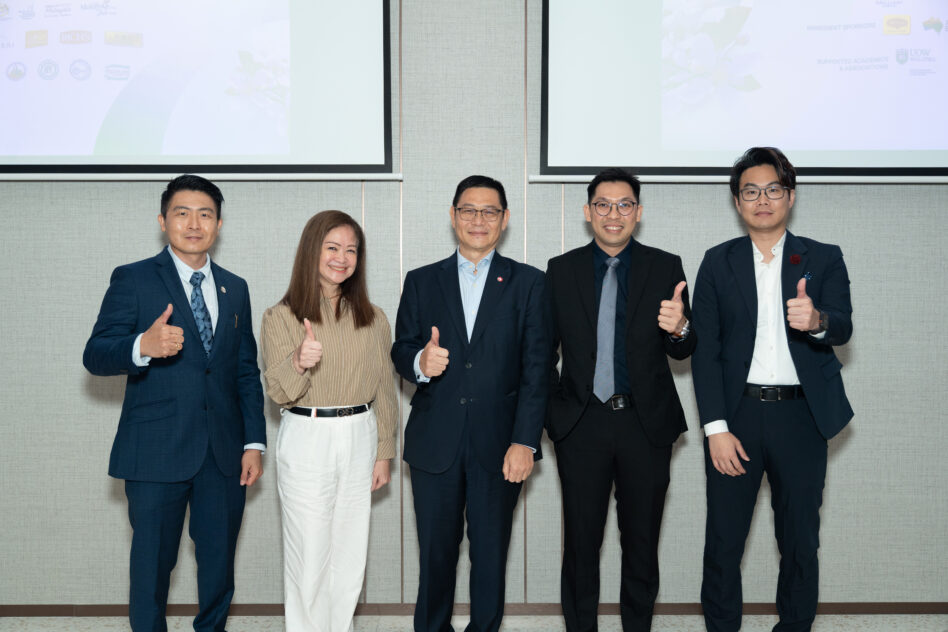


SUSTAINABILITY WEEK Asia, which is an annual event organised by The Economist Impact highlighted the transition of biodiversity from a peripheral CSR consideration into a core component of investment and operational decision-making.
Although policy support for sustainability is gaining traction across the region, biodiversity considerations are still lagging behind climate in terms of integration into business and investment strategies.
A turning point is likely to come when nature-related risks are systematically reflected in investment decisions.
However, progress remains constrained by the lack of consistent measurement standards, making comparisons and large-scale adoption difficult.
Discussions on water highlighted that stress in ASEAN is less about limited resources and more about inefficiencies within distribution networks.
“While companies have made strides in reducing water intensity, further improvements are becoming harder to achieve without new technologies, indicating a plateau in efficiency gains,” said Kenanga.
A major structural concern is the high level of non-revenue water (NRW)—treated water that is lost before reaching consumers due to leaks, theft, or metering issues.
This significantly reduces the amount of water available for use, even in countries with ample supply.
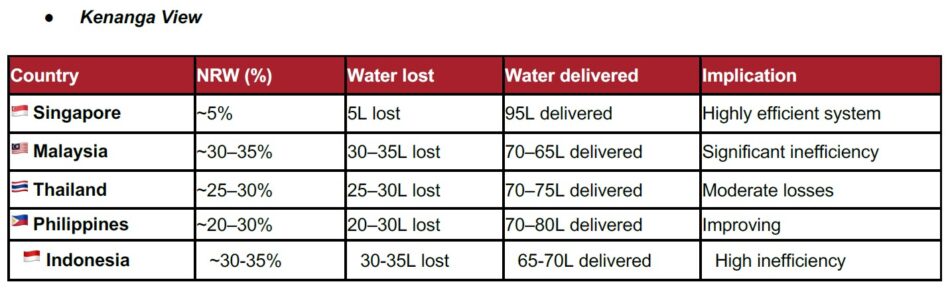
The regional disparity in system efficiency is evident in NRW levels. Singapore operates at approximately ~5% NRW, reflecting a highly efficient and well-maintained system.
In contrast, Malaysia records significantly higher losses of ~35–40%, indicating substantial inefficiencies in infrastructure and water management.
“Malaysia’s high NRW of ~30-35% is closely linked to its tariff structure, where prices remain below the full cost of supply,” said Kenanga.
This limits utilities’ ability to reinvest in pipe replacement and system upgrades, resulting in persistent leakage and slow progress.
The government has set a target to reduce NRW to ~28%, but achieving this will likely require not just infrastructure investment, but also gradual tariff rationalisation to improve cost recovery.
As water demand rises, particularly from industrial users such as data centres, this highlights that NRW is not just an operational issue, but a structural constraint tied to pricing and funding.
Kenanga believes reducing NRW is the most immediate lever for freeing up CAPEX for infrastructure upgrades, without requiring new resource development. —Apr 28, 2026
Main image: suhakam.org.my