
THE LOCAL media industry faced a softer start to 2026 as weaker digital and newspaper advertising offset gains in TV and radio, highlighting persistent structural challenges despite festive-driven spending during Hari Raya.
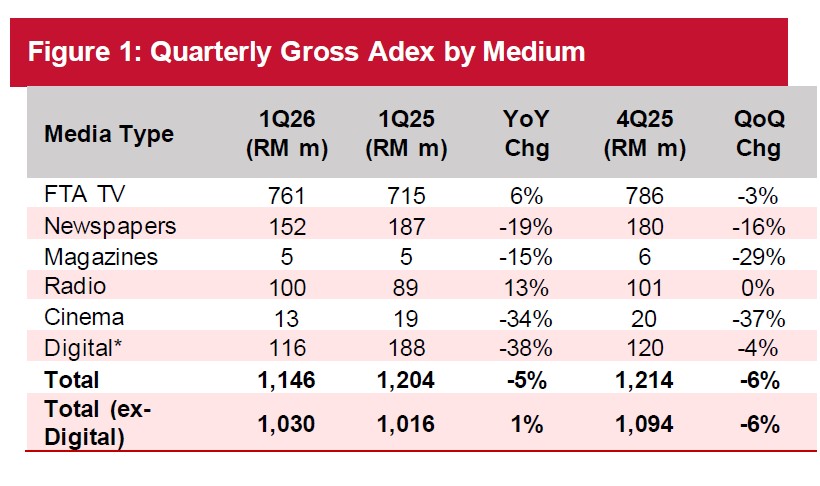
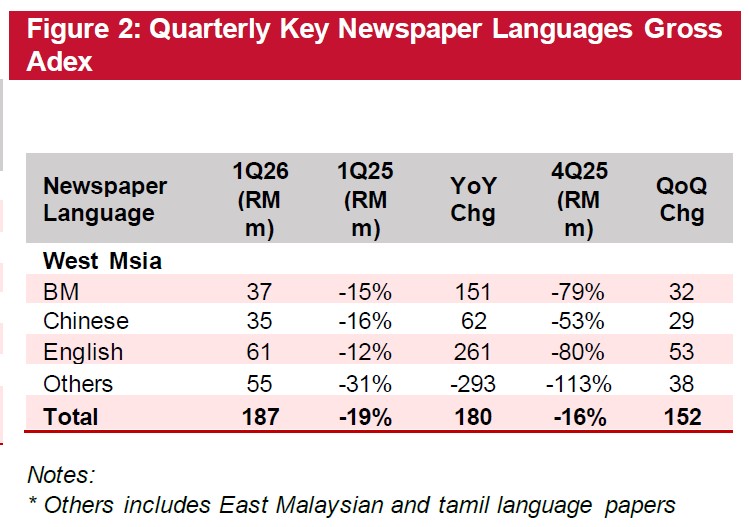
Weaker advertising expenses (adex) in quarter one calendar year 2026 (1QCY26) was largely driven by declines in digidex (-38% year-on-year (YoY) and newspapers (-19% YoY) that more than offset gains from FTA TV (+6% YoY) and radio (+13% YoY).
“We believe the gains were supported by stronger adex contribution from Hari Raya, which fell earlier on 21 March in 1QCY26, resulting in a greater concentration of festive-related adex within the quarter,” said Kenanga.
Excluding digidex, traditional adex expanded by 1% YoY in 1QCY26, likely reflecting earlier Raya festivities as mentioned above.
Kenanga noted that Hari Raya-related advertising remained active for up to two weeks after the celebration, supported by ongoing school holidays, festive gatherings and open house events.
At the same time, digital advertising continued to face pressure as marketers increasingly shifted spending toward alternative online platforms such as social media, search engines and live commerce channels.
The decline in 1QCY26 digidex was primarily driven by YouTube (-41% YoY), extending its downturn to a tenth consecutive quarter.
“Furthermore, we believe a growing share of YouTube’s inventory is skewed toward its mobile and smart TV apps, reflecting shifts in how its audiences consume content,” said Kenanga.
However, this transition is not fully captured in Nielsen Malaysia’s digidex metrics, which track only display and video ads on desktop and mobile web browsers, excluding in-app advertising formats.
Therefore, Nielson’s reported figures may understate YouTube’s actual monetisation performance.
“We believe it is imperative that traditional media companies in Malaysia boost their earnings resilience by enhancing their focus on intellectual property (IP) development,” said Kenanga.
Developing a strong and scalable intellectual property pipeline is seen as an important strategy to help media companies navigate the long-term decline in traditional advertising revenue.
A well-established IP portfolio can also strengthen brand identity while creating additional income opportunities through merchandising, licensing deals and content adaptations across multiple platforms.
As the media landscape becomes more fragmented and competitive, companies with the ability to create, own and expand appealing original content are expected to maintain stronger market relevance and more stable earnings.
Signs of progress are already emerging, with ASTRO increasing its focus on locally produced content through its in-house production and distribution arm, Astro Shaw.
This strategy has begun to bear fruit, as evidenced by the recent success of Papa Zola, which is the highest-grossing Malaysian animated film on record, achieving over RM69 mil in gross box office (GBO) collections. From this project, ASTRO captured roughly 15% of GBO, consistent with its role as the principal marketing and distribution partner.
By comparison, for franchises where the group holds stronger ownership positions, it is able to command a substantially larger share of returns, reaching up to 90% of GBO.
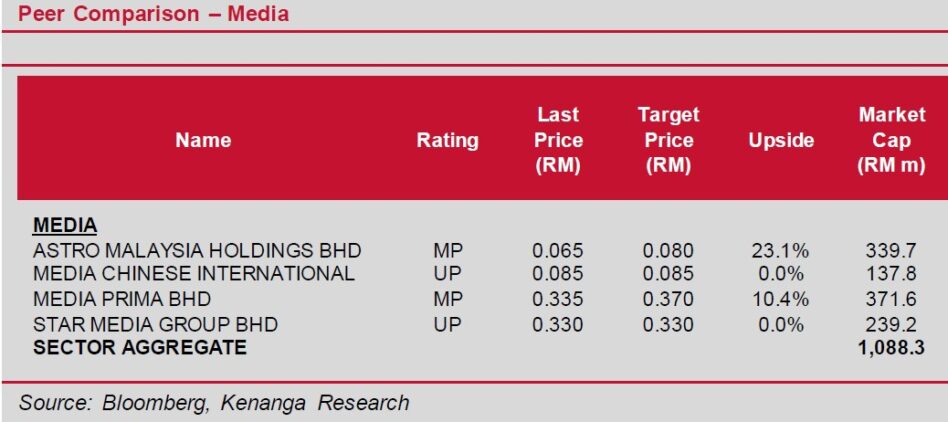
Kenanga continue to be Underweight on the sector, as earnings are persistently dragged by two key structural challenges: (i) ongoing migration of adex toward digital-native platforms, and (ii) rising cost burdens associated with maintaining legacy infrastructure.
Among them are the broadcast towers, satellite transponder leases, printing machinery, and logistics fleet for distribution.
Meanwhile, efforts to monetise IP monetisation remain at an early stage, with meaningful contributions likely to take time as companies gradually develop, scale, and commercialise their content portfolios.
“We do not have any stock picks for the sector,” said Kenanga. —May 11, 2026