
MISC Berhad has secured a contract from Petronas Gas Berhad to supply and manage a newly built floating storage and regasification unit (FSRU), marking the group’s first formal expansion into the FSRU segment.
The move broadens MISC’s LNG-related business portfolio by building on its established experience in operating LNG carriers and floating storage assets.
The long-term contract is expected to strengthen earnings visibility for the company, with revenue support extending through 2049.
As part of the project, MISC has appointed Samsung Heavy Industries to construct the new unit, which is expected to incorporate improved efficiency features aligned with MISC’s fleet sustainability ambitions.
However, the project is not without risks. Given its dependence on SHI, any supply chain bottlenecks or technical setbacks could affect the delivery timeline, potentially delaying both the FSRU rollout and the RGT-3 project.
Operationally, maintenance also remains a key consideration. Compared with land-based facilities, FSRUs are generally more vulnerable to corrosion and require more frequent upkeep, including during the construction phase.
While no value was disclosed, a newbuild FSRU typically costs between USD300m-350m (approximately RM1.4b-1.6b).
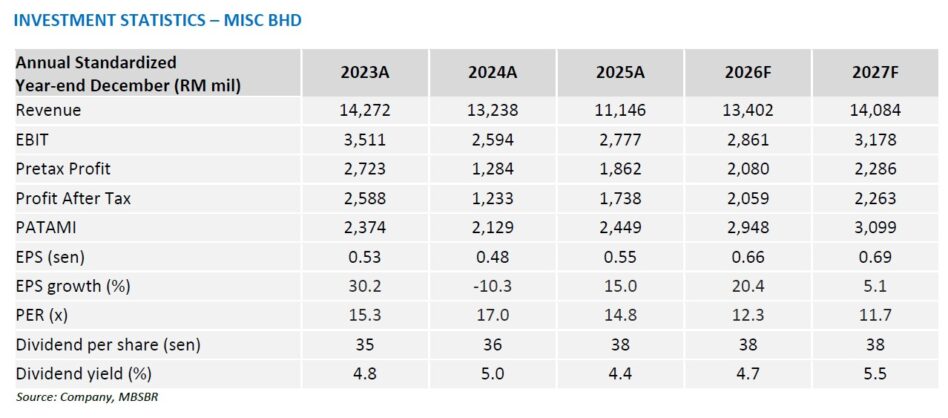
“However, we noted that land-based terminals are higher in upfront cost than FSRUs, ultimately shielding both companies from additional upfront costs,” said MBSB Research.
Construction for FSRUs also typically takes 2-3 years, making the target 2029 commencement doable. The flexibility of FSRUs to move cargo also promised a potential additional revenue in transportation cost.
Earnings impact would be significant in 2029 onwards. For MISC, we opine that the group will be investing roughly RM1.6b into the newbuild FSRU, giving them an estimated annual revenue of RM200m-250m (based on a USD120kpd charter rate for FSRU).
Considering the financing costs, MISC could see +3% to +5% earnings increase. For PGB, we opine that the cost of the RGT-3 project is around RM3b, including the FSRU newbuild.
Under the Incentive-based Regulation (IBR) framework, PGB earns a return on capital estimated at 7% of the asset base (as compared to RGT-1 and -2).
Subsequently, this would translate to a boost in PGB’s bottom line of +5% to 9% increase.
Pending the groups’ 1QFY26 earnings announcements and more clarification on this project, we maintain our NEUTRAL call for PGB with a target price of RM19.25. —May 5, 2026
Main image: Reuters