

TO consume or not to consume.
That is not a query to be taken lightly especially when it comes to halal integrity of F&B (food & beverage) items.
Hence, it is perfectly understandable that Muslims are cautious about what they consume, particularly if it may contravene their religious obligations.
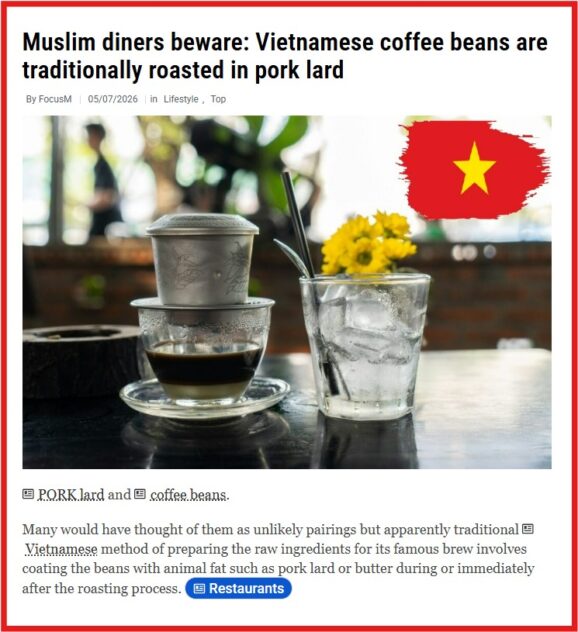
It has been shared on social media that Muslims were ridiculed for asking if certain everyday consumable items such as an ordinary cuppa kopi O was halal.
As shown by this report, their queries were entirely valid/justified as SOME traditional coffee producers in Vietnam still used pork lard when roasting the beans.
But does this extend to accepting fruits and vegetables from a Chinese neighbour who had planted them?
This query was met with plenty of ridicule online, not least by policial commenter Prof James Chin.
The inaugural director of Asian Studies at the University of Tasmania, Australia lamented “this is why Malaysia is turning into a completely brainless society where the idiots control the political discourse and public debate”.
Making no bones about where he stands on the issue, he concluded: “Good luck, Malaya (Peninsular Malaysia). Oh, and according to official figures, the country already has a massive shortage of psychologists and psychiatrists. There is no cure for racial/religious bigotry stupidity.”
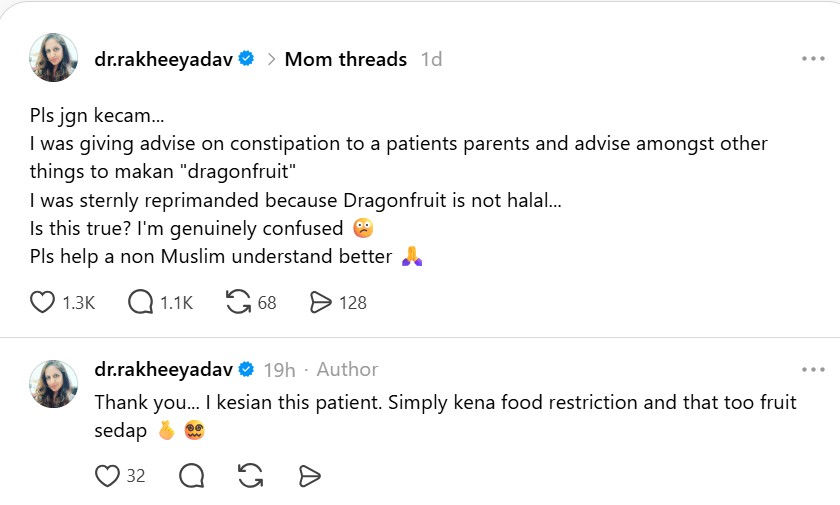
This theory was apparently put to the test in a patient-doctor scenario posted by Dr Rakhee Yadav (@dr.rakheeyadav) on Threads.
The Damansara Specialist Centre 1 KPJ’s Pediatric Unit head reached out for clarification on the matter after she was “sternly reprimanded” for recommending dragon fruit to cure a child’s constipation.
Editor’s Note: According to Harvard Health, dragon fruit (pitaya) is a low-calorie tropical superfood packed with fiber, antioxidants, and vitamin C. I
t supports good digestion, boosts one’s immune system, promotes heart health and helps nourish one’s skin with every refreshing bite.
Pleading confusion, the childcare expert sought clarification for better understanding on the subject. The post has generated 1.3K likes, 1.1K comments, 68 reposts and 128 shares at time of writing, denoting that many others were similarly bemused.
The query caught many Muslim netizens by surprise as well.

Many commenters sympathised with the good doctor for having to deal with these such “stupid” patients. Another counselled that such “people should stop breeding” as “constipation has affected their brains”.

However, amid all the ridicule, there appeared some substance to the patient parent’s fears.
This had to do with the rumour that certain dragon fruit farmers (in the Sepang area) used water from pig farms to spray their trees. “Just advise them to buy from Muslim farmers or grow themselves” was the advice proffered by one pragmatic commenter.
After all, a fatwa has been issued that “it’s fine to consume dragon fruit although it’s deemed makruh (not forbidden but best avoid as in the case of smoking) in Islam”.
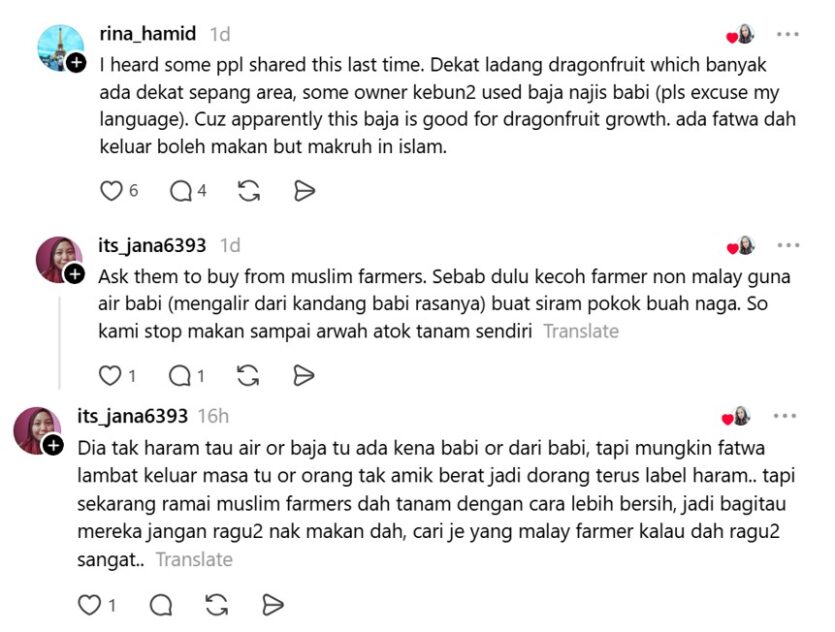
It was also clarified that fruit and vegetables are NOT haram unless they were obtained in a wrongful manner such as theft.

A Muslim commenter proffered naming conventions as another possible explanation for the fruit ban. It was also suggested that some Muslims tend to avoid food items that resemble prohibited animals.

Adding to the confusion was a suggestion that some Muslims refrain from consuming fruits with thorns.

Officially, dragon fruit is 100% halal. As a natural, plant-based fruit, it falls under the fundamental Islamic principle that all safe, wholesome vegetation and fruits from the earth are inherently permissible to eat unless mixed with harmful or forbidden ingredients.
It is, perhaps, this last part that has given rise to the confusion given the rumour that certain dragon fruit farmers were using water from swine farms to refresh the trees.
Hence, some Muslims’ apprehension is perfectly understandable. They may be a tad conservative or overly-cautious but that is no reason to pour scorn and opprobrium on their beliefs. – Aug 6, 2026