
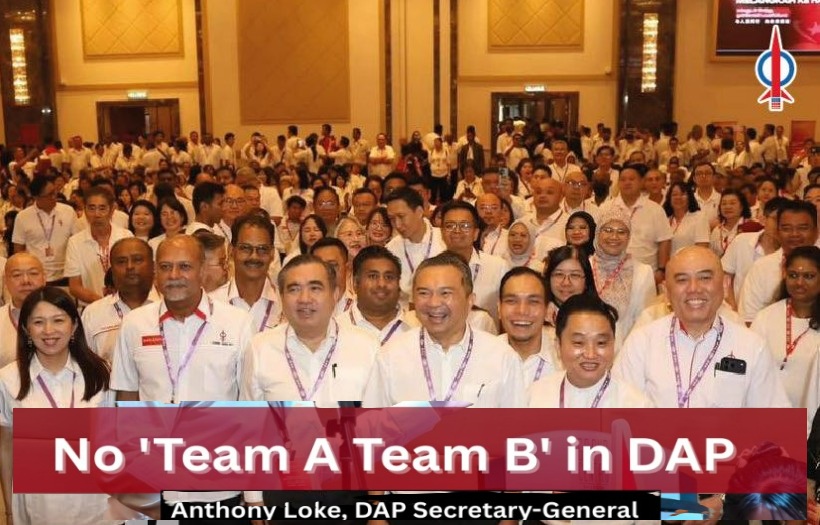
I THINK it is a bit too late for UMNO president Datuk Seri Ahmad Zahid Hamidi to withdraw his statement about the existence of two camps known as “Team A” and “Team B” in DAP.
The Deputy Prime Minister (DPM) divulged this information about DAP being split into two camps after his conversation with the latter’s secretary-general Anthony Loke Siew Fook.
Loke might not have described the dissension in the DAP as being split into two camps.
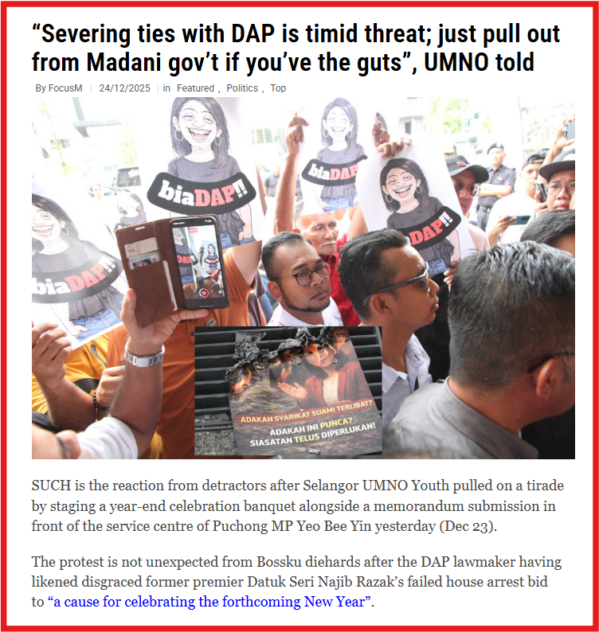
But it is certainly true that he might have alluded to the fact that there are some in DAP who do not agree with him on a variety of matters such as expressing joy over the failure of former premier Datuk Seri Najib Razak in obtaining house arrest.
Whether there are two camps in the DAP – one allied with Loke and the other with the party’s former chairman Lim Guan Eng – remains to be seen.
The recent Central Executive Committee (CEC) elections and the Penang DAP state elections are indicators that the party is not as united as before.
The slow but sure marginalisation of those associated in the dissident faction is evident.
Dissension is commonplace
Without the existence of two groups or factions, it would be difficult to explain why the dissident failed to make it in the party national and state elections.
It is not that the opposing group is strong but they are certainly in a position to embarrass Loke and his team on a variety of matters.
The rejoicing of some DAP leaders after Najib lost his bid to obtain house arrest was not only to ridicule UMNO but also those in DAP who are seen as having given up the party’s fight for a better Malaysia.
Statements and remarks in a political party by politicians are not directed at one party alone but at multiple targets.
That some DAP leaders were rejoicing over the recent court verdict on Najib was intended to embarrass the dominant faction in DAP.
There is a feeling in DAP – especially among those opposed to Loke – that the party has given up its right to fight for the non-Malays, particularly the Chinese.
Following the Sabah state election, the opposition within DAP has sought to raise the matter of stalled reforms in the country.
This was not directed solely against the government but also served as a reminder to DAP that it has failed to implement the mandate for reforms.
It was in this context of calls for reform by the dissident faction in DAP that Loke came out with a six-month deadline for reforms with the caveat that such a timeline would not affect the party’s support for Prime Minister Datuk Seri Anwar Ibrahim.
Zahid could be spot on
Loke called for reforms to forestall the initiative of the dissident faction. Once a ferocious opposition party, DAP is now merely an appendage of the Pakatan Harapan (PH)-led coalition government.
With power, positions and perks, it has been reduced to a submissive and pathetic role.
The dissident faction might not be strong at the moment but it certainly exists and may thrive on the non-performance of the party under the dominant faction.
DAP is like a pendulum as described by Austro-Hungarian economic historian, economic sociologist and politician Karl Polanyi: too much accommodation with the government will have the effect of a counter-swing that might ignite opposition within the party.
Even if there are no two camps in DAP, the existence of opposition among some leaders cannot be dismissed.
To dismiss the role of internal opposition is to deny history and its forward movement. The late Singaporean elder statesman Lee Kuan Yew had once dismissed the suggestion that Singapore does not need an opposition.
Lee who reigned as a premier for 31 years (June 5, 1959 until Nov 27, 1990) responded that it was virtually impossible to eliminate opposition because it was part and parcel of the functioning of a democratic society.
Even if Loke denies the existence of two factions, is he prepared to admit that opposition to him is non-existent within the party?
Zahid might have withdrawn his statement about the existence of two camps in DAP but is he willing to deny that there is no dissension within the DAP? – Jan 19, 2026
Former DAP stalwart and Penang deputy chief minister II Prof Ramasamy Palanisamy is the United Rights of Malaysian Party (Urimai) interim council chairman.
The views expressed are solely of the author and do not necessarily reflect those of Focus Malaysia.