
SAMAIDEN posted a strong 2026 performance, with core profit rising 67.4% on the back of stronger EPCC contributions, electricity sales and progress in its solar projects.
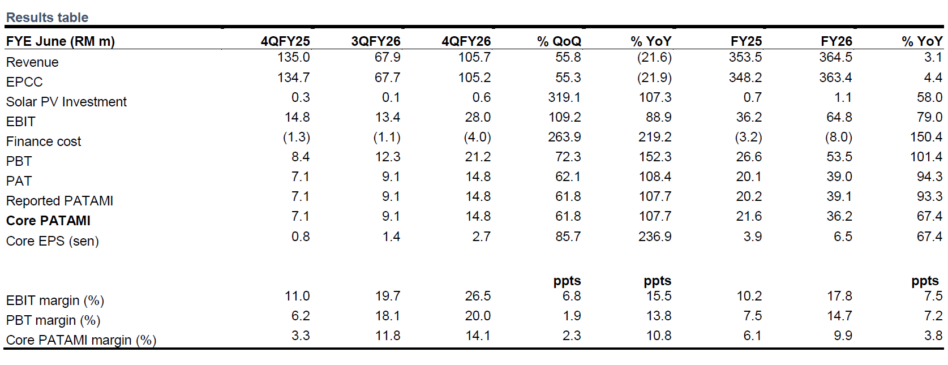
It’s quarter four 2026 (4Q26) core profit after tax and minority interest (PATAMI) came in at RM14.9 mil, bringing 2026 core PATAMI to RM36.2 mil or +67.4% year-on-year (YoY).
Revenue grew 55.8% YoY, driven by stronger contributions from both EPCC (+55.3%) and electricity sales (+319.1%).
EPCC growth was underpinned by accelerated construction progress on LSS5 projects, which progressed from early site preparation in 3Q26 to main construction works during the quarter.
“We understand that the 29.7% gross profit margin achieved in 4Q26 was largely driven by procurement gains, with modules secured ahead of the China VAT rebate removal-induced price run-up, supplemented by supply-chain management and post-award value engineering,” said Hong Leong Investment Bank (HLIB).
Management guided that this improved margin could sustain for another 2–3 quarters.
Margins are expected to ease back towards normal levels as LSS5 projects move deeper into construction.
The boost from lower-cost panels secured earlier is likely to diminish as revenue recognition catches up with project progress, eventually resulting in more stable execution margins.
HLIB remains positive on the Group’s growth pipeline, supported by an active tender book of approximately RM3.5 bil, with 80% comprising utility scale projects.
Within the utility-scale portion, CRESS tenders account for 70% of total bids, while LSS5+ EPCC opportunities make up another 10%.
As of 4Q26, unbilled order book stood at RM435.8 mil, with the vast majority scheduled for revenue recognition in 2027.
Management maintained its RM1 bil order book target for 2027, with new contracts expected to come mainly from the LSS5+ and CRESS programmes.
HLIB said the group’s existing order book, together with its robust pipeline of tenders, should provide greater earnings visibility and support growth in the medium term.
“We understand that LSS6’s nodal points are concentrated in the southern region, which could favour established players given the programme’s tighter land and grid-interconnection requirements,” said HLIB.
Samaiden has secured some land in the southern region, providing management with confidence of achieving 20% market share.
However, HLIB retains their assumption of 15% market share for now and they expect EPCC margins to remain broadly unchanged in the high-single-digit range despite the larger BESS content.—Aug 28, 2026
Main image: Samaiden