
THE global semiconductor sector continues to ride a powerful upcycle, supported by strong demand across key growth segments.
AI-related investments and the rapid expansion of data centre infrastructure remain the main forces driving this sustained momentum.
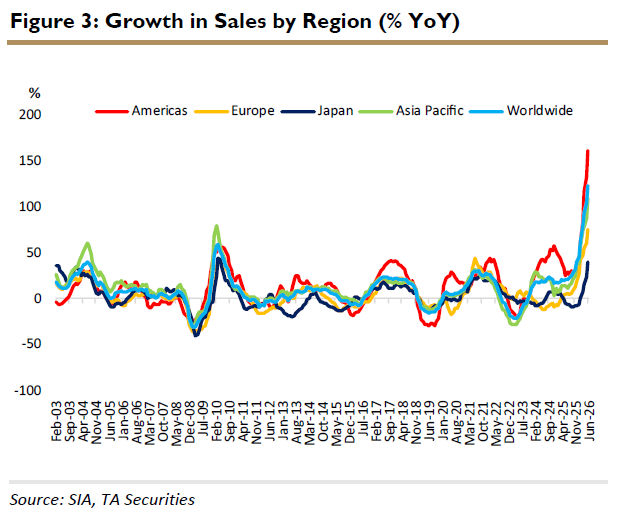
According to the Semiconductor Industry Association (SIA), global semiconductor sales reached USD134.5 bil in June 2026, representing growth of 9.7% month-on-month (MoM) and 123.6% year-on-year (YoY).
This marked the 32nd consecutive month of YoY sales growth.
Meanwhile, global semiconductor sales jumped 35.1% quarter-on-quarter (QoQ) to USD403.3 bil in quarter two 2026 (2Q2026), while the first half of 2026 (1H2026) sales surged 85.5% YoY to USD636.6 bil.
The rapid growth of artificial intelligence and the ongoing build-out of data centre infrastructure have driven strong demand for high-performance logic processors and high-bandwidth memory, which collectively make up more than half of worldwide semiconductor sales.
According to SIA President and CEO John Neuffer, global semiconductor sales are expected to exceed USD1.5 tri in 2026.
The strong YoY growth was broad-based across all regions, led by the Americas (+160.9%), followed by Asia Pacific/All Other (+124.4%), China (+112.8%), Europe (+75.2%), and Japan (+39.0%).
Looking ahead, the global semiconductor industry is likely to maintain its growth trajectory, with artificial intelligence (AI) continuing to be a major source of demand.
This should be underpinned by sustained spending on data centres and the growing adoption of accelerated computing technologies.
The outlook, however, faces a new potential challenge following US President Donald Trump’s proposal to impose a 15% tariff on imported products made using polysilicon, an important raw material for both semiconductor and solar panel manufacturing.
The proposed tariff could have a modestly negative effect on the global semiconductor industry by increasing the cost of upstream materials and creating additional uncertainty across the supply chain.
That said, its overall impact is expected to be contained, as polysilicon represents only a relatively small component of the total cost of producing semiconductors.
Malaysia is likely to face limited direct exposure to the measure, given the country’s relatively small role in upstream polysilicon production. The tariff is primarily intended to encourage greater localisation of semiconductor-related supply chains within the US.
At the same time, a further tightening of global trade restrictions could encourage semiconductor manufacturers to diversify their production bases beyond China. This could work in Malaysia’s favour as companies pursue a “China Plus One” strategy.
With its established semiconductor ecosystem, skilled workforce and existing presence across various stages of the semiconductor value chain, Malaysia is well positioned to capture some of the investment and supply-chain diversification arising from these developments.
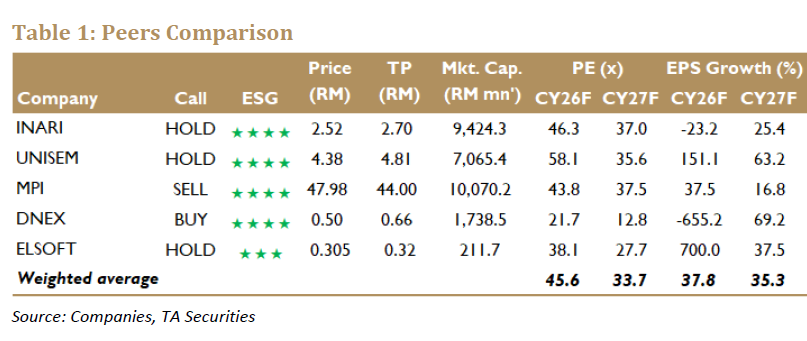
All in all, TA Securities maintains their Neutral stance on the semiconductor sector.
“Our top pick is DNEX, which we view as a compelling local AI proxy.
Its semiconductor subsidiary, SilTerra, is benefiting from the ongoing AI supercycle, supported by strong order flows for silicon photonics products amid robust demand from AI and data centre applications,” said TA.—Aug 11, 2026
Main image: mirrikh.com