

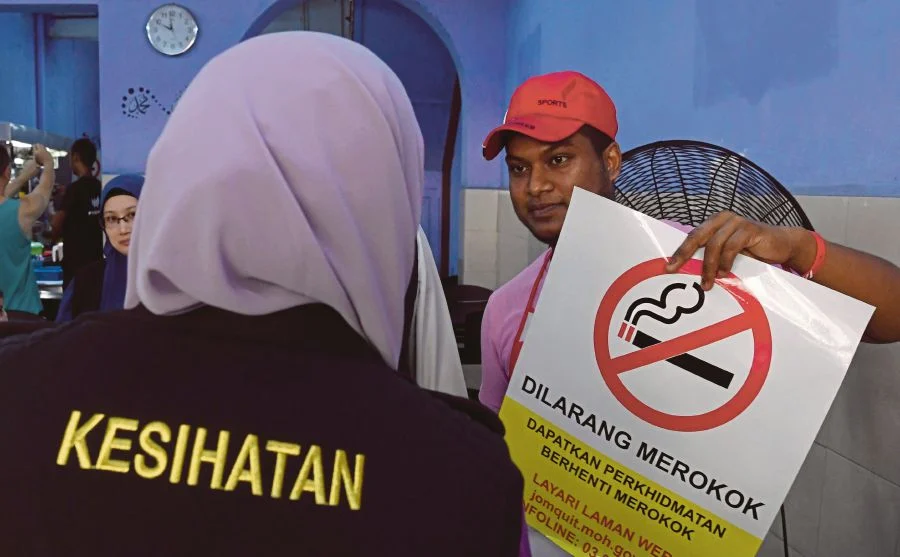
THE Malaysian Council for Tobacco Control (MCTC) has expressed serious concern over recent allegations of bribery linked to efforts to weaken or undermine tobacco control policies in Malaysia.
It said that while such allegations must be investigated through proper legal channels, they must not be exploited to derail or discredit the implementation of effective public health laws.
“We must not allow allegations, pressure or intimidation—whether real or manufactured—to distract the country from the real issue, which is protecting public health through strong and enforceable tobacco control laws,” stressed its president Dr Murallitharan Munisamy.
On the Control of Smoking Products for Public Health Act 2024 (Act 852), Dr Murallitharan said the landmark law reflects decades of evidence-based policy development and Malaysia’s commitments under the WHO Framework Convention on Tobacco Control (FCTC).
“Act 852 did not emerge overnight. It is the result of long-standing public health evidence, global best practices, and Malaysia’s obligation to safeguard its people—especially children—from nicotine addiction,” he remarked.
“MCTC reiterates that all stakeholders must remain committed to ensuring the success of Act 852, despite continued pressure from industry players and certain interest groups seeking to dilute its impact.”
According to Dr Murallitharan, effective tobacco control depends on consistent and equitable enforcement nationwide, and weak or selective implementation risks rendering the law ineffective and undermining public confidence.
“Implementation must be uniform. Tobacco and nicotine products do not harm people selectively, and enforcement cannot be selective either,” he continued.
“MCTC also notes positively Health Minister Datuk Seri Dr Dzulkefly Ahmad’s openness to introducing a retail display ban, a proven measure internationally to reduce product visibility, impulse purchases, and youth initiation.”
Dr Murallitharan further expressed support for the conducting of a comprehensive impact assessment of the Control of Smoking Products for Public Health Act 2024 in collaboration with the Health Ministry to evaluate enforcement, compliance, and public health outcomes.
However, he cautioned that tobacco control in Malaysia still has “unfinished business”, adding that previous regulations allowed exemptions and grey areas particularly in designated non-smoking zones.
“These gaps must now be addressed decisively to achieve the core objectives of tobacco control which is to protect the public from the harms of exposure to tobacco smoke, to reduce smoking prevalence in line with the tobacco endgame, and to safeguard children from the normalisation and influence of adult smoking in public spaces,” he said.
“Special attention is required for public walkways, city centres, and high-density urban areas, including Kuala Lumpur and public areas, where non-smoking compliance remains weak and public exposure to second-hand smoke persists.”
On the government’s efforts to minimise youth access to nicotine products, Dr Murallitharan expressed support for a standardised minimum sales price across all nicotine product categories, measures designed to deter access by individuals below 18 years of age as well as robust enforcement to prevent product switching strategies targeting young users.
“Beyond regulation, youth-focused tobacco control must include widespread public education and prevention initiatives, including the Tobacco VIP programme, with structured deployment in schools, higher education institutions, and community settings,” he continued.
“If we fail to protect the young today, we will pay the price in preventable disease, healthcare costs, and lost lives tomorrow.” ‒ Jan 6, 2026
Main image: Bernama