
Letter to Editor
AN eye for an eye. A life-for-a-life.
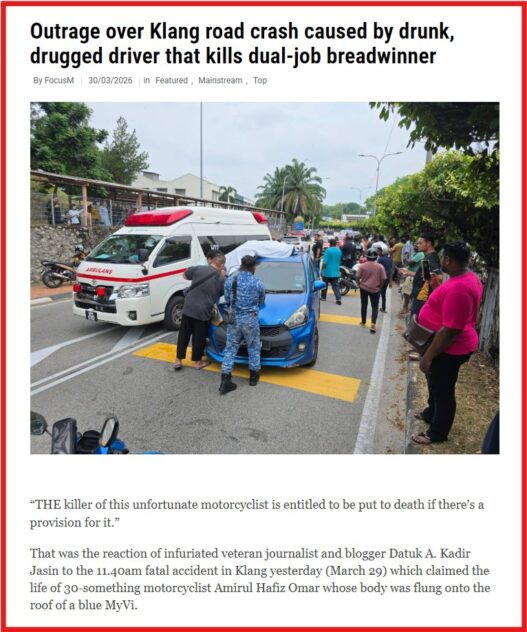
That seems to be the prevailing sentiment among an outraged public in connection to a horrific accident in Klang on March 29 involving an intoxicated driver which tragically claimed the life of a motorcyclist.
This was the call from Machang MP Wan Ahmad Fayhsal Wan Ahmad Kamal who argued that drunk drivers that cause fatal accidents be made to face the gallows.
“Therefore, I urge the government to study amending the law to allow for the death penalty to be imposed on drunk drivers who cause death,” declared the former Bersatu-turned-independent lawmaker in a Facebook post
“When someone under the influence still chooses to drive, the law should consider that the person has intent to kill because their actions clearly have a high risk of killing others.”
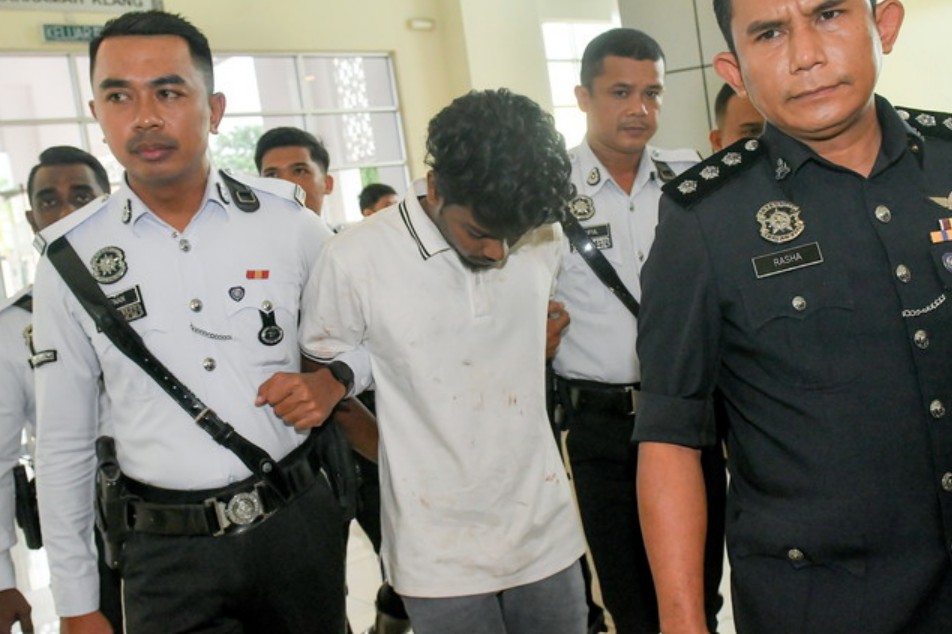
Understandably, the aggrieved widow of the victim had also demanded that a life be re-paid with a life when she appeared at the court hearing of the reckless driver who has admitted to being under the influence of narcotics.
They seem to have gotten their wish as the accused has been charged under Section 302 of the Penal Code which carries the death penalty.

Editor’s Note: Section 302 of the Penal Code of Malaysia defines the punishment for murder.
It is the primary legal provision used to charge individuals who have caused the death of another person with intention, knowledge or under specific reckless circumstances. The death sentence is at the discretion of the judge.
Similar circumstances, different law
With this case being a hot topic, it is also worth noting that a very similar case took place near Pagoh, Johor on March 4.
A pick-up truck driver who tested positive for drugs and was found in possession of narcotics following a crash that killed two relatives on a motorcycle.
However, the case is being investigated under Section 44(1)(A) of the Road Transport Act 1987 and Section 12(2) and Section 15(1)(A) of the Dangerous Drugs Act 1952.
Now, given the public furore over the accident in Klang which has deprived three young children of a father, the authorities have seen fit to react accordingly with a murder charge.
The pertinent question is whether the charge for the Pagoh case be amended as well? Circumstances are very similar. Both cases involve an intoxicated driver who hit a motorcycle coming in opposite direction leading to fatalities.
Is the murder charge reserved for drunk drivers only instead of those under the influence of narcotics? Doesn’t make sense, does it?
If the authorities are serious about throwing the book at such wrongdoers by treating them as dangerous felons instead of just errant motorists, then some uniformity in the application of the law must be in place.
Otherwise, this will look like an exercise in selective prosecution. There will then be claims of mala fides and the prosecution acting on the whims of public sentiment.
This letter is no way questioning the need for stiffer laws to deal with the menace of intoxicated drivers. Rather the laws, whether existing or new provisions, must be uniformly applied.
Emotions may be running high at the moment but that should not be the reason for miscarriages of justice. – April 2, 2026
A Sober Driver
Seremban
The views expressed are solely of the author and do not necessarily reflect those of Focus Malaysia.
Main image credit: Bernama