

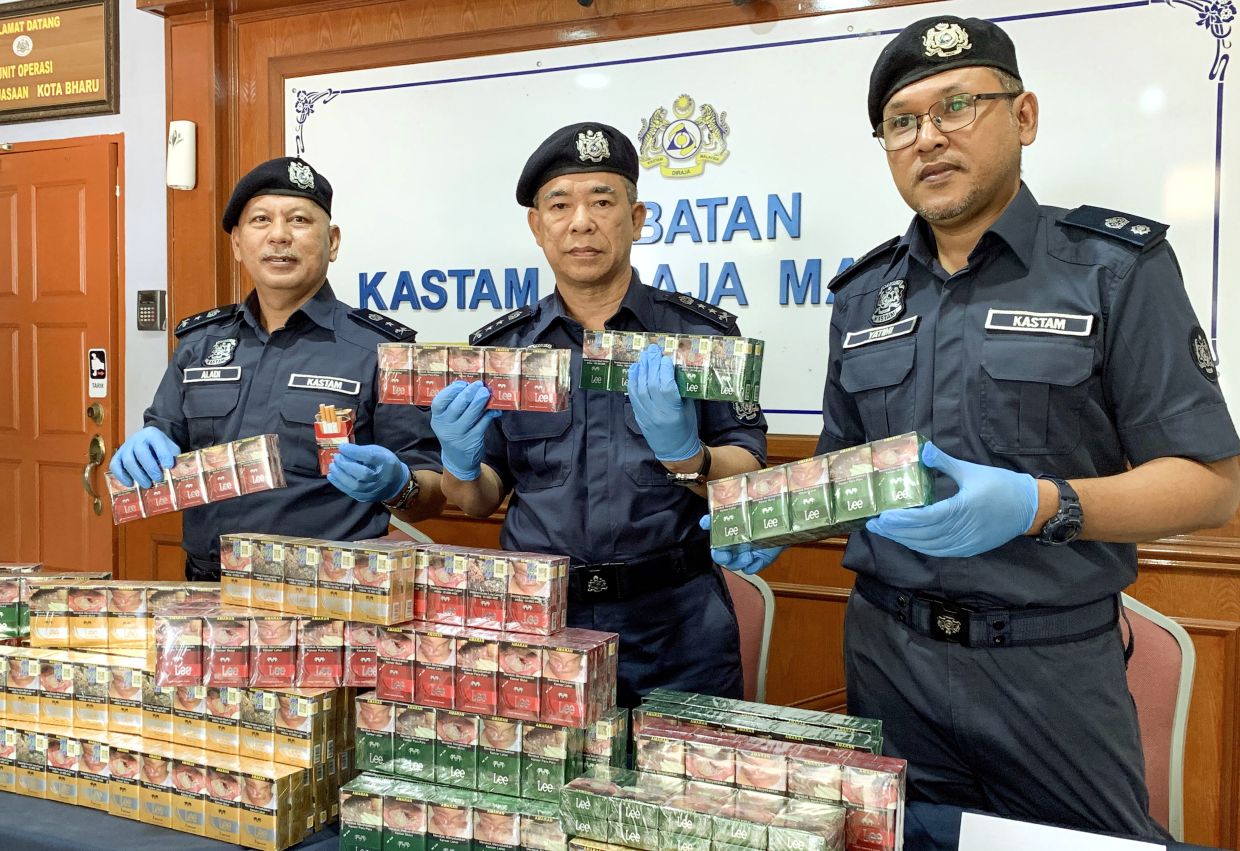
MALAYSIA’S enforcement agencies have demonstrated strong commitment and professionalism in tackling the illicit cigarette trade but enforcement alone has not been sufficient to significantly reduce the scale of the illegal market.
Such was the contention of Datuk Dr Yusoff Nook, a former Sarawak state police chief, qualified lawyer and expert in economic crime control.
His comments follow recent reports highlighting continued high-value seizures of illicit cigarettes and contraband across multiple states against the backdrop of enforcement budgets, border controls and inter-agency coordination having been strengthened in recent months.
While he acknowledged the clamp down by the Royal Malaysian Customs Department which reflects determination and capability as measured by increases in seizures, intelligence-led operations and entry point actions, Yusoff is concerned that the illicit cigarette market remains stubbornly resilient
That enforcement intensity has increased while the illicit cigarette market continues to thrive suggests that the challenge extends beyond policing and border control alone.

“When enforcement intensifies, we expect the illegal market to contract. Instead, what we’re seeing is persistence and adaptation,” observed the president of E-Cure Sdn Bhd, a consultancy specialising in economic crime control. “That tells us the issue is not simply about enforcement capacity.”
Don’t burden enforcement with outcomes
Drawing on his experience in commercial crime investigations, economic intelligence and legal practice, Yusoff noted that organised illicit trade adapts quickly to enforcement pressure by adjusting logistics, routes and distribution networks.
However, he stressed that supply-side action alone cannot address demand that continues to exist at the consumer level.
“As long as illegal products remain widely accessible and are perceived by consumers as more affordable alternatives, enforcement agencies will always be placed in a reactive position,” he justified.
“This is not a failure of enforcement but a reflection of behavioural and market realities that must also be addressed.”

Yusoff went on to caution against placing the burden of outcomes solely on enforcement agencies, noting that officers often operate under difficult conditions while confronting highly adaptive criminal syndicates.
“The needle has barely moved. That should prompt a more honest assessment of whether we’re addressing the full ecosystem, including consumption habits, that allows illicit trade to thrive,” he warned.
Yusoff therefore urged for a more integrated national response that complements enforcement with policies aimed at influencing consumer behaviour and narrowing the economic space in which illicit trade operates.
“If success continues to be measured only by seizure figures, we risk mistaking activity for impact. The real measure of success is whether the illegal market is shrinking. On that front, there is still much work to be done,” added the former Sarawak state security advisor. – Jan 26, 2026