


THE Consumer Choice Centre (CCC) Malaysia has cautioned against proposals to introduce a mandatory “buyer choice” courier selection system following comments by Pos Malaysia Bhd on competition concerns in Malaysia’s e-commerce logistics ecosystem.
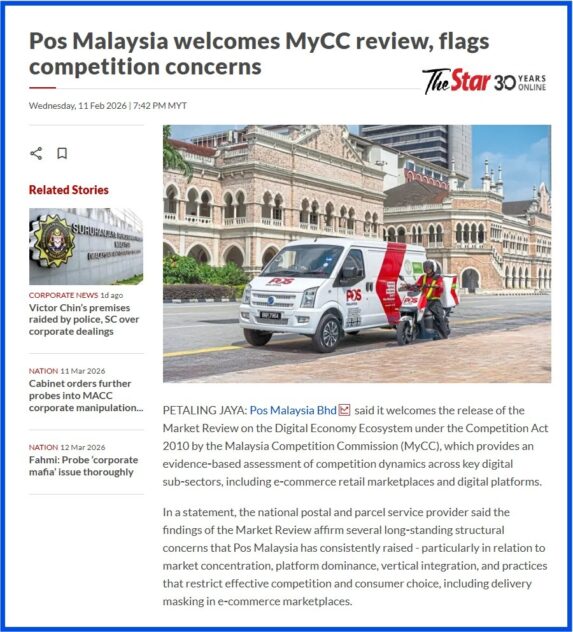
Malaysia’s national postal service provider and sole licensee for universal postal services has reportedly raised concerns about how courier services are allocated on major e-commerce platforms and called for greater transparency and consumer choice in courier selection.
In CCC’s view, policymakers should ensure that any regulatory response preserves competition and efficiency in Malaysia’s fast-growing logistics sector.
“Despite its name, the so-called ‘buyer choice’ proposal could actually reduce consumer choice,” countered CCC Malaysia’s country associate Tarmizi Anuwar in a media statement.
“If courier selection is dictated by regulation instead of performance, it stops being a choice and becomes protectionism.”
As it is, most e-commerce platforms currently rely on automated logistics systems to match parcels with courier providers. Among others, these systems evaluate factors such as route efficiency, delivery capacity, service performance and price to determine which courier can deliver most effectively.
According to CCC Malaysia, algorithm-based allocation has been a key factor behind the rapid growth of Malaysia’s e-commerce ecosystem by enabling millions of parcels to be delivered quickly and efficiently.
Regulatory risks imminent
“Automated courier allocation allows platforms to assign deliveries to the provider that can serve a route most efficiently,” asserted Tarmizi. “This improves delivery reliability, reduces delays and keeps logistics costs competitive for consumers and small businesses.”

Therefore, replacing automated allocation with mandatory manual courier selection risks introducing unnecessary bureaucracy into a logistics network that depends on speed and real-time optimisation.
On a similar note, CCC Malaysia also warned that the selection of systems requiring courier services from approved lists could create governance risks.
“When market participation depends on administrative approval rather than performance, the risk of regulatory capture increases,” cautioned Tarmizi.
The consumer advocate further raised concern that mandatory courier selection could disproportionately affect rural and semi-rural areas.

Automated logistics systems allow deliveries to be bundled along efficient routes, helping courier networks maintain service coverage even in lower-density regions.
“If courier allocation becomes fragmented through manual selection, delivery networks become less efficient,” justified Tarmizi. “That could increase delivery costs or reduce service frequency in rural areas where logistics margins are already thin.”
As such, CCC urged policymakers to ensure that regulatory responses preserve open competition and innovation in Malaysia’s logistics sector.
“Consumers benefit most when logistics providers compete on performance. Policy should strengthen that competition, not replace it with administrative allocation,” added Tarmizi. – March 17, 2026