
MALAYSIA’S CONSUMER Price Index (CPI) increased by 1.7% year-on-year in March 2026, rising from 1.4% in February and broadly matching market forecasts.
The uptick was partly attributed to a surge in oil prices during the month, influenced by geopolitical tensions involving Iran, the United States and Israel.
On a month-on-month basis, CPI edged up 0.3%, suggesting some inflationary pressure, which appears largely driven by supply-side factors.
Despite this, overall inflation remained relatively contained, with little sign of widespread cost pass-through or persistent supply-driven price pressures.
Over a longer horizon, Malaysia’s inflation has averaged around 2.1% from January 2008 to March 2026, indicating that current levels are still below historical norms and point to a generally manageable inflation environment.
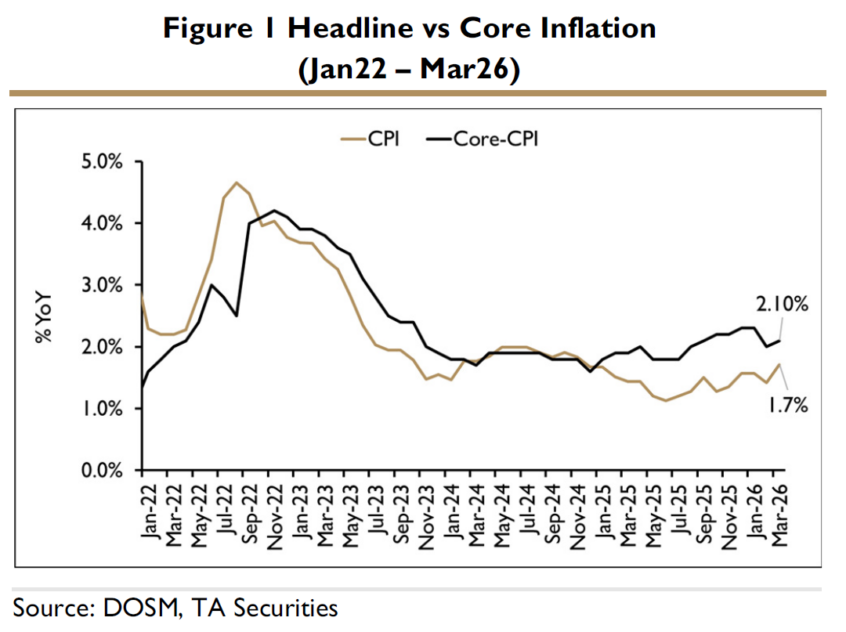
On a 3-month moving average basis, headline inflation rose by 1.6% year-on-year (YoY), up by 0.1 percentage point from the previous reading.
Core CPI rose by 2.1% YoY in March 2026 (Feb26: 2.0% YoY), indicating that underlying price pressures remain relatively contained despite the uptick in headline inflation.
Eight states recorded increases above the national inflation level YoY, namely Pahang (2.5%), WP Labuan (2.4%), Negeri Sembilan (2.2%), WP Kuala Lumpur (2.2%), Sabah (2.1%), Johor (2.0%), Kedah (1.9%) and Pulau Pinang (1.8% YoY).
However, the remainder eight states increased below and equal to the national inflation rate with Kelantan recorded the lowest inflation (0.7%) in March 2026.
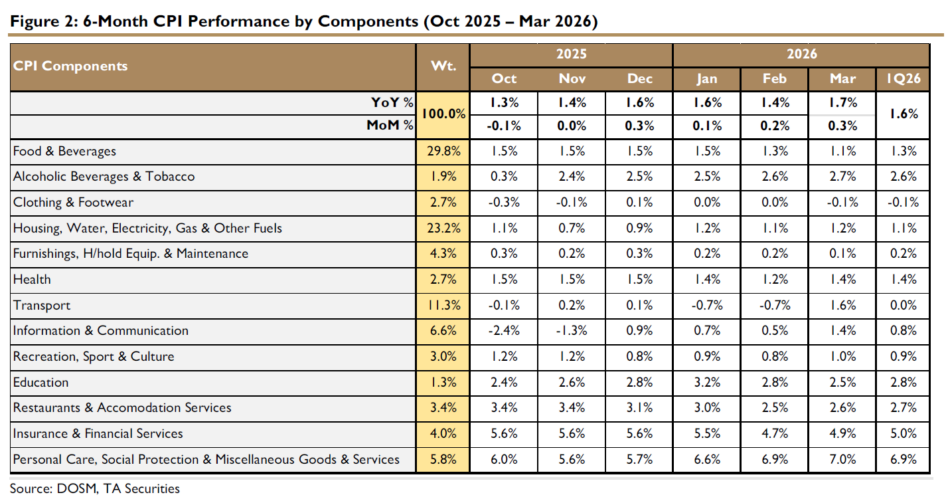
In comparison to inflation in other selected countries, inflation in Malaysia in March 2026 was lower than inflation in Vietnam (4.7%), Philippines (4.1%), Indonesia (3.5%), and Republic of Korea (2.2%).
However, the rate was higher than China (1.0%) and Thailand (-0.1%).
Most CPI components recorded an acceleration during the month, except for Food & non-alcoholic beverages, Clothing & footwear, Furnishings, household equipment & routine maintenance, and Education.
However, these four categories collectively account for only 38.1% of the CPI basket, suggesting limited breadth in price pressures and thus constraining upside risks to the overall price level.
Nonetheless, the transport segment rose significantly, moving out of negative territory, largely reflecting higher fuel costs, with the exception of RON95. —Apr 20, 2026
Main image: emirresearch.com